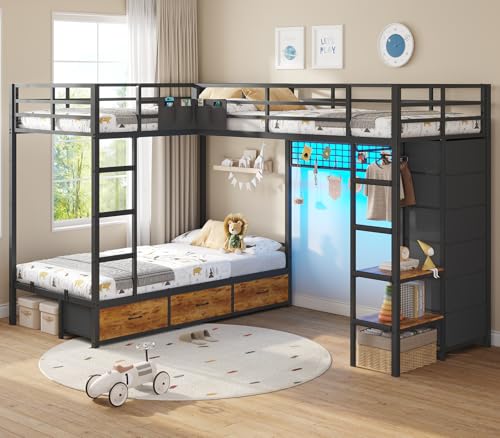
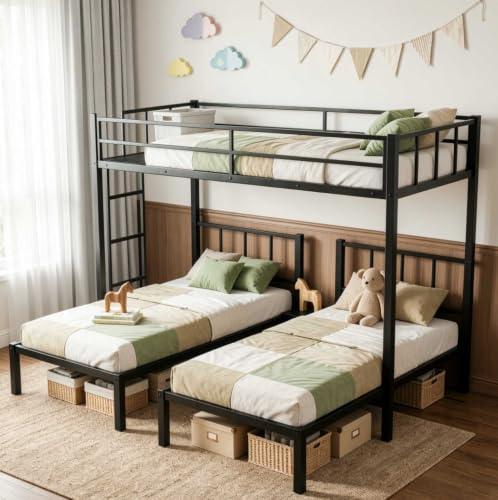
Triple Bunk Beds That Separate: The Complete Buyer's Guide
Learn how modular triple bunk beds work, how they convert into three individual beds, and what to check before choosing a separating system for your home.
Explore OptionsWhy this guide matters: If you are researching triple bunk beds that separate, you have likely outgrown the limits of a fixed three-tier bunk. Separating triple bunks solve a specific problem: they deliver the space-saving footprint of a bunk stack today, then convert into three independent beds as your household changes. This guide explains the mechanics, safety requirements, configurations, and buying criteria so you can choose with confidence.
What Are Triple Bunk Beds That Separate?
Triple bunk beds that separate are modular sleeping systems assembled from individual bed units. Each unit is a complete, freestanding bed with its own frame and mattress support. When stacked, the units lock together into a three-tier bunk using interlocking posts, alignment brackets, or locking pins. When unlocked, each unit stands alone as a standard single bed.
This design differs from a conventional triple bunk, which is welded or bolted into a single fixed frame and cannot be divided. Separating systems are engineered around detachable components — removable ladders, shared guardrails that reattach to individual units, and frame connectors that release without tools or with simple hardware.
Fixed Triple Bunk vs. Separating Triple Bunk
| Feature | Fixed Triple Bunk | Separating Triple Bunk |
|---|---|---|
| Structure | One welded or bolted frame | Three independent bed units with locking connectors |
| Reconfiguration | Not possible without disassembly and modification | Separates into single beds or re-stacks as needs change |
| Best for | Permanent shared bedrooms | Growing families, guest rooms, and flexible floor plans |
| Assembly complexity | Moderate to high | Moderate, with modular hardware and clear instructions |
| Long-term flexibility | Limited | High — adapts to changing household needs |
How Separating Triple Bunks Work
Understanding the conversion mechanism is the single most important step before buying. Most separating systems rely on three components that work together:
- Interlocking posts and brackets: Vertical posts align with connectors that lock stacked units in place. Look for locking pins or heavy-duty bolts rather than friction fit alone.
- Detachable ladders: Ladders hook onto the frame and lift off when a unit is separated. Confirm the ladder has a secure hook system and a weight rating that matches the bunk.
- Reattachable guardrails: Shared guardrails on upper tiers must be movable to the individual bed once separated. Check that mounting points exist on every unit, not just the top one.
The conversion process itself is usually straightforward: remove the ladder, release the locking hardware at each connection point, and lift the upper unit off the lower one with a helper. Manufacturers typically recommend two adults for the lift and provide step-by-step instructions. Entry-level separating systems may use simpler pin connections, while mid-range and premium tiers often add reinforced steel brackets and tool-free locking mechanisms.
Planning tip: Measure your ceiling height before ordering a three-tier stack. Each upper tier needs enough headroom for the sleeper to sit up comfortably, and the top unit requires additional clearance for safe access. If headroom is tight, a staggered configuration or a two-tier bunk paired with a standalone bed may suit your room better.
Key Benefits of Separable Triple Bunks
Separating triple bunks are a long-term investment rather than a one-time purchase. Their value comes from adaptability:
- Space efficiency now: A stacked triple bunk frees floor area in shared bedrooms, guest rooms, and compact homes. This matters especially in tight layouts, where space-saving bunk designs are often the only practical solution.
- Flexibility later: When children grow, rooms are repurposed, or guests arrive, the same system becomes three standalone beds without new furniture.
- Moving and storage: Modular units are easier to disassemble, carry through doorways, and store than a single oversized frame.
- Multi-room use: One unit can stay in a shared bedroom while another serves a guest room, and the third moves to a study or studio apartment.
- Household transitions: Separating systems are well suited to families moving from a shared children's room to separate bedrooms, or to teenagers who need a more independent sleeping space.
For households that regularly host overnight guests, a separating bunk also pairs well with temporary beds for sleepovers — the modular units can be repositioned as extra sleeping space without buying additional furniture.
Safety Requirements to Check
Safety is the deciding factor in this category. A triple bunk that separates places three sleepers at different heights, and the conversion hardware must hold securely in both stacked and separated states. Check the following before purchasing:
- Guardrails on every upper tier: Both the middle and top tiers need full-length guardrails with no gaps wide enough for a sleeper to slip through.
- Locking pin integrity: Connectors should use metal locking pins or bolts, not plastic clips alone. Confirm the system cannot separate accidentally under normal use.
- Weight ratings: Every unit should carry a stated weight capacity. Teenagers and adults should only use units rated for their weight, and lower tiers typically carry higher ratings than upper tiers.
- Ladder security: The ladder must hook firmly onto the frame and be removable only when intended.
- Stable separated footprint: When a unit stands alone, it should have a wide enough base and stable legs. Look for frames with anti-slip feet and no wobble.
- Certifications: Verify that the system meets recognized furniture and bunk bed safety standards in your region, and check the mattress thickness limits for upper tiers.
Popular Configurations
Separating triple bunks come in several arrangements. The right choice depends on room shape, ceiling height, and how the beds will be used after conversion:
| Configuration | Layout | Best For |
|---|---|---|
| Straight triple stack | Three tiers directly above one another | Narrow rooms with high ceilings |
| Staggered triple bunk | Tiers offset in a stepped arrangement | Rooms where headroom is uneven |
| L-shaped modular set | Two-tier bunk plus one separate unit | Corners and irregular floor plans |
| Storage-integrated stack | Triple stack with drawers or shelving in the base unit | Bedrooms that also need clothing or toy storage |
| Twin-over-twin-plus-single | Two units stacked, third used as a standalone daybed | Flexible rooms that double as guest space |
Storage-integrated systems are especially practical for shared rooms, where drawer space in the base unit reduces the need for extra furniture. If you are comparing storage-focused layouts, it helps to review space-saving beds with storage alongside this guide.
Materials and Build Quality
Because separating triple bunks are under more mechanical stress than fixed bunks — the connection points are repeatedly locked and unlocked — material quality matters more than usual. Use these descriptors to compare build tiers:
- Essential tier: Solid pine or composite frames with basic pin connectors. Adequate for light use by younger children, with a simpler finish.
- Balanced tier: Hardwood or high-grade steel frames with reinforced brackets and better hardware. A solid choice for families with teenagers.
- Top-tier: Heavy-duty steel or premium hardwood with commercial-grade locking mechanisms, thicker guardrails, and a rust-proof finish. Suited to frequent conversion and adult use.
Across all tiers, look for solid build characteristics: thick corner posts, reinforced mattress support slats, and hardware rated for repeated use. Metal frames generally offer higher weight ratings and a slimmer profile, while wood frames blend more easily into traditional bedroom styles. For households with adult sleepers, confirm that the units are rated accordingly — solid wood bunk beds for adults are a useful comparison point for weight capacity and frame strength.
How to Choose: A Practical Checklist
Use this checklist to narrow your options before ordering:
- Measure the room: Confirm the stacked footprint, the separated footprint of each unit, and ceiling clearance for three tiers.
- Confirm the conversion method: Read the assembly instructions or product manual to see exactly how units detach and reattach.
- Check guardrails and ladder: Every upper tier needs a guardrail, and the ladder should be removable and weight-rated.
- Verify weight ratings per unit: Match each tier to its intended sleeper, especially if teenagers or adults will use it.
- Review the mattress requirements: Bunk systems usually specify maximum mattress thickness for upper tiers to keep guardrails effective.
- Plan the separated layout: Decide where each unit will go once separated, and check that each room has space for a standalone bed.
- Check the finish and hardware: Rust-proof finishes and reinforced connectors extend the system's lifespan in humid or heavily used rooms.
Editorial note: A separating triple bunk is worth choosing only if you genuinely expect to use the separated configuration. If the beds will stay stacked permanently, a fixed triple bunk with heavier-duty construction may be the better fit. Treat the separating feature as long-term flexibility, not as a novelty.
Who Are Separating Triple Bunks Best For?
These systems suit specific households far better than others:
- Growing families: Children share a room now, then move into separate rooms later without new furniture.
- Teenagers: Separating units give teenagers more independence while preserving the space-saving stack until it is needed. Teenage-focused bunk designs are a good reference for sizing and storage needs.
- Guest rooms and vacation homes: Stacked units serve groups, and separated units serve couples or individual guests.
- Studio apartments and compact homes: A stacked system maximizes floor area, and the separated units can be distributed across rooms or stored.
- Multi-purpose rooms: When a bedroom doubles as a study or playroom, separating units allow the layout to change with the day.
They are less suitable for households that need a permanent three-sleeper arrangement in a single room with no intention of converting — in that case, a sturdy fixed triple bunk or a solid wood bunk bed system may be the more durable choice.
Assembly, Maintenance, and Long-Term Care
Proper assembly and maintenance preserve the safety of a separating system:
- Assemble with two people: Stacking upper units requires a helper. Follow the manufacturer's sequence and torque hardware to specification.
- Re-tighten hardware periodically: Locking pins and bolts can loosen with use. Check connections every few months, especially after conversions.
- Inspect connector wear: Look for bent pins, stripped bolts, or cracked brackets. Replace worn hardware before restacking.
- Keep the ladder secure: Verify the ladder hooks fully engage the frame each time it is reattached.
- Protect the finish: Wipe frames with a damp cloth and avoid abrasive cleaners, particularly on rust-proof coated metal.
When properly maintained, a quality separating triple bunk can serve a household through several phases of life, which is why it is best viewed as a long-term investment in flexible sleeping space.
Frequently Asked Questions
What are triple bunk beds that separate?
Triple bunk beds that separate are modular sleeping systems built from individual bed units that can be stacked as a three-tier bunk or detached and used as standalone beds. They typically use interlocking frames, detachable ladders, and shared guardrails that unlock when converted.
Are separating triple bunk beds safe for children and teenagers?
Yes, when they meet current safety standards and are assembled correctly. Look for reinforced guardrails on every upper tier, a weight-rated ladder, and locking pins that prevent accidental detachment. Teenagers and adults should only use units rated for their weight.
How much floor space do separating triple bunks save?
A stacked triple bunk typically occupies the footprint of a single twin bed, which frees up substantial floor area compared with three separate beds. Because the units separate later, the system adapts as your household changes without forcing you to buy new furniture.
Can separating triple bunk beds be used in low-ceiling rooms?
A three-tier stack needs generous vertical clearance, so measure the ceiling height and add the recommended headroom for the top sleeper. If headroom is limited, consider a staggered or L-shaped configuration, or a two-tier bunk paired with a separate single bed.
Do separating triple bunks require special mattresses?
Most systems specify a maximum mattress thickness for upper tiers so that guardrails remain effective, and some require standard twin or twin XL sizes depending on the unit. Always follow the manufacturer's mattress specifications for each tier rather than choosing by comfort alone.
How often should the locking hardware be checked?
Check locking pins, bolts, and brackets every few months and after every conversion. Re-tighten hardware to the manufacturer's specification and replace any worn or bent connectors before restacking the units.