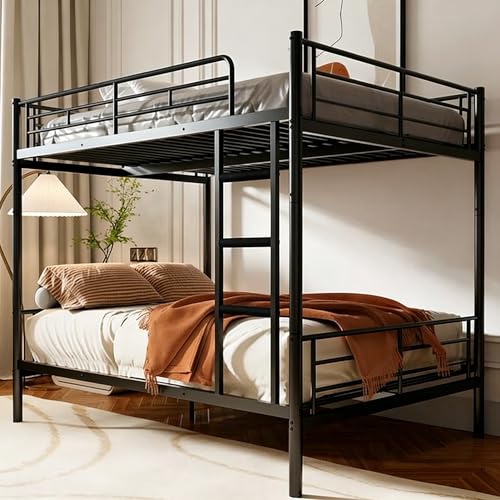
Double Over Double Bunk Beds for Adults
Two full-size sleeping surfaces stacked into one footprint. A practical, space-smart solution for adult households, guest rooms, vacation properties, and shared living spaces — provided the frame is engineered for grown-up weight and daily use.
Jump to Buying GuideWho this guide is for: You already know you want a double over double bunk bed and you need to understand frame construction, mattress fit, ceiling clearance, safety rails, and long-term durability before you commit. This page walks you through each decision point so you can choose confidently.
What Exactly Is a Double Over Double Bunk Bed?
A double over double bunk bed pairs two full-size (double) mattresses in a single vertical frame. Unlike a twin-over-twin configuration, which is the standard children's bunk format, a double over double setup accommodates four adult sleepers in roughly the floor area of one full-size bed. That makes it a serious space-planning tool rather than a novelty.
Adults who choose this configuration usually fall into one of a few camps: owners of compact homes or studio apartments who need a dedicated guest zone, vacation rental operators maximizing sleeping capacity, or households with adult siblings or roommates sharing a room. The format also works well in multi-generational homes where a flexible second bedroom is needed.
The key distinction from standard bunks is the load requirement. Adult sleepers demand a frame with higher weight capacity, a reinforced ladder, a taller guardrail, and a mattress support system that will not sag under concentrated pressure. This is why you will often see these models described as durable bunk beds for adults — the structural grade matters far more than the styling.
Why Adults Choose Full-Size Bunk Configurations
The appeal is straightforward but worth spelling out, because it shapes which model you should buy.
- Sleeping capacity without sprawl. Four adults sleep in a footprint that would otherwise sleep two. For guest rooms that are used intensely a few weekends a year, this is an efficient trade.
- Guest-room flexibility. A room can serve as a home office or reading room most of the time and convert to a four-person sleeping space when family visits.
- Property and rental use. Vacation rentals, cabins, and shared houses benefit from higher bed count per square foot. Heavy-duty and commercial-grade frames are the appropriate grade for rental turnover.
- Separation options. Many adult models are detachable, so you can split the bunk into two freestanding full-size beds if your layout changes. This is a strong argument for choosing a detachable design over a fixed one.
- Full-size comfort. Each sleeper gets a genuine full mattress rather than a narrow twin bunk surface, which matters for adult comfort and mattress selection.
If your room is tight but you want to explore variations, the broader category of double bunk beds includes configurations with different lower-bunk features and ladder placements. The main guide to double over double bunk beds for adults on our site is also worth reading alongside this page for additional model comparisons.
How to Think About Build Grades
Rather than comparing figures, it helps to sort adult bunk beds into build tiers. Each tier reflects relative construction quality, structural robustness, and the intended intensity of use. Use this framework consistently when you evaluate listings.
Starter Tier
Best for occasional guest use in a low-traffic room. Usually lighter-gauge metal or softwood construction with simpler joinery. Adequate for light adults and infrequent sleeping, but you should inspect the weight rating carefully and expect a shorter service life under daily use.
Balanced Tier
The practical sweet spot for most households. Reinforced corner brackets, thicker rails, and a more substantial ladder. Well-specified for the category and capable of daily adult use when assembled correctly and placed on a level floor.
High-End Tier
Solid hardwood or high-grade steel with precision joints, deeper guardrails, and often a detachable design. This is the tier to prioritize for rental properties, heavy daily use, or households where the bed must last many years. A long-term investment in stability.
A fourth informal tier — professional-grade or commercial-grade — exists for institutional and hospitality settings. These frames typically exceed residential requirements and are built for continuous turnover. For a family home, the high-end tier is usually the sensible ceiling.
Construction Details That Actually Matter
Adult bunk beds fail or feel unsafe for predictable reasons. Checking these specific points before purchase will separate a solid frame from a wobbly one.
Frame Material and Joints
High-grade steel frames with welded or bolted corner brackets resist lateral movement better than thin tubular metal. Solid hardwood frames — oak, maple, or dense pine — offer excellent rigidity when the joinery is reinforced with corner blocks or metal plates. Particle board and thin MDF should be treated with caution in a load-bearing bunk application, regardless of how the finish looks.
Weight Capacity and Load Distribution
Look for an explicit adult weight rating per bunk, not a combined figure. The upper bunk carries the greater structural demand because of dynamic load — a sleeper shifting position concentrates force on the frame. Slat spacing matters too: slats should be closely spaced and thick enough that a full mattress does not sag between them. A center support rail under each bunk is a strong positive signal.
Guardrails and Ladder
Adult bunk beds need taller and longer guardrails than children's models, because the mattress is larger and the sleeper is heavier. The ladder should be rated for adult weight, have wide flat steps rather than thin rungs, and attach firmly to the frame — not hook loosely over the top rail. A ladder that shifts underfoot is the most common safety complaint in adult bunk reviews.
Mattress Thickness and Rail Clearance
Thick mattresses are the hidden safety issue in adult bunk beds. A deep pillow-top mattress can raise the sleeping surface above the guardrail, negating its purpose. The standard recommendation is a low-profile mattress, typically 6 to 8 inches thick, which keeps the sleeper below the rail line and preserves headroom on the lower bunk. If you already own thick mattresses, verify the rail height before buying the frame.
Configuration Comparison at a Glance
This table compares the main adult bunk formats by intended use rather than by any financial measure, so it stays relevant over time.
| Configuration | Tier | Best For | Key Consideration |
|---|---|---|---|
| Double over double, fixed frame | Mid-range to premium | Permanent guest rooms and shared adult bedrooms | Most structurally rigid; cannot be split later |
| Double over double, detachable | Premium to high-end tier | Households expecting layout changes | Converts to two full beds; check hardware quality |
| Double over double with stairs | Premium | Older adults or anyone uneasy on a ladder | Wider footprint; stairs double as storage in some models |
| Double loft bunk | Mid-range to premium | Small rooms needing floor space beneath | Single sleeping surface up top; open area below |
| Twin over twin adult bunk | Entry-level to mid-range | Teens and lighter adults in compact rooms | Smaller footprint but narrower sleeping surface |
If vertical clearance is your main constraint, explore double loft bunk beds as an alternative format. For rooms with genuinely limited floor area, double loft beds for small rooms addresses the specific planning challenges.
Room Planning and Ceiling Height
Ceiling height is the single most common reason a double over double bunk bed does not work in a given room. Plan this before anything else.
As a working rule, aim for roughly 30 to 34 inches of clearance between the top of the lower mattress and the underside of the upper bunk. That is enough for most adults to sit up and get in and out without repeated head contact. Above the top bunk, you want comfortable headroom for getting in and out of bed — many adult users find that anything below 24 inches of clearance feels cramped, and 30 inches or more is preferable.
In practice, most adult double over double bunk beds fit comfortably in rooms with 8-foot ceilings, provided the mattresses are low-profile. Rooms with sloped ceilings, ceiling fans, or pendant lights need careful measurement. Also verify door swing clearance and window access — you should never block an egress window with a bunk bed.
Floor Space and Placement
A full-size mattress is roughly 54 by 75 inches. The frame adds a few inches on each side, so budget close to a 60 by 80 inch footprint. Place the bunk against a solid wall where possible for lateral stability, and keep at least a couple of feet of clearance on the ladder side. Leave space around the frame for making the beds — changing linens on an upper full-size bunk is easier with access from more than one side.
Pre-Purchase Checklist
- Measure ceiling height and subtract the frame height, mattress thickness, and guardrail height to confirm clearance between bunks and above the top bunk.
- Confirm an explicit adult weight rating per bunk, not a combined figure, and check whether a center support rail is included.
- Verify rail height relative to your mattress thickness. Low-profile mattresses of 6 to 8 inches are the safest pairing.
- Inspect the ladder attachment method — fixed and bolted is preferable to hooked-on.
- Check whether the model is detachable if you may want two separate beds later.
- Review the assembly hardware — cam locks, through-bolts, and metal corner plates are stronger than simple screws into softwood.
- Confirm the frame material is high-grade steel or solid hardwood rather than composite board.
- Plan mattress sourcing — you need two full-size low-profile mattresses; browse dual firmness mattresses if the two sleepers have different comfort preferences.
- Allow for linens and bedding — two full-size bedding sets are required; quality bedding and linens will make the beds easier to maintain.
- Place the bunk against a wall and avoid blocking windows, doors, and vents.
Choosing Mattresses for Both Bunks
A double over double bunk bed needs two full-size mattresses, and the mattress choice directly affects safety, comfort, and how well the frame performs.
Thickness first. Low-profile mattresses in the 6 to 8 inch range keep the sleeper below the guardrail and preserve lower-bunk headroom. A thick hybrid or pillow-top mattress will likely sit above the rail and reduce clearance. If you strongly prefer a deeper mattress, choose a frame with extra-tall rails and verify the dimensions in writing.
Support type second. Innerspring and hybrid mattresses distribute weight well on slatted bases, but confirm the slat spacing meets the mattress manufacturer's warranty requirement. Memory foam is an excellent match for bunk frames because it conforms to the sleeper and does not require a box spring, which would add unwanted height. Latex offers durability and a responsive feel. If the two sleepers differ in firmness preference, a dual firmness approach lets each bunk be tuned separately.
Edge support matters more on a bunk. A mattress with weak edges flexes under a sleeper getting in and out of a narrow upper bunk. Look for reinforced edge construction if the mattress will be used on the top level.
For a broader overview of support options, our guides on mattresses and mattress toppers cover how to fine-tune comfort after purchase. A topper is often the simplest way to adjust firmness on one bunk without replacing both mattresses.
Safety Practices for Adult Bunk Beds
Adult bunk beds are safe when installed and used correctly, but a few habits make a meaningful difference.
- Anchor the frame to the wall if the manufacturer provides anti-tip hardware. This is especially important in rooms with carpet, which allows slight frame movement.
- Re-tighten hardware after the first month and then periodically. New frames settle, and loose bolts are the leading cause of wobble.
- Use the ladder every time. Climbing on the footboard or side rail is the most common cause of bunk bed injuries among adults.
- Never exceed the rated capacity on either bunk, and do not allow multiple people on the upper bunk.
- Keep the top bunk clear of heavy items and avoid hanging shelving or bags from the guardrail.
- Check the guardrail height annually as mattresses compress and bedding shifts over time.
If you are weighing the bunk format against a convertible alternative for a room that serves multiple purposes, daybeds that convert to a double bed offer a different trade-off: less sleeping capacity but a more flexible daytime footprint.
When a Double Over Double Bunk Bed Is Not the Right Choice
Honest guidance includes the limits of the format. A double over double bunk bed may not suit your situation if any of the following apply:
- Ceiling height under about 8 feet. Clearance becomes uncomfortable and head contact is likely on the lower bunk.
- Daily use by sleepers with mobility limitations. Ladder access to the upper bunk is a genuine barrier. A double over double bunk bed for adults with integrated stairs is a partial solution, but two separate beds are safer.
- Rooms where the bed must be moved regularly. Full-size bunk frames are heavy and not designed for frequent repositioning.
- Households that need the room to read as open and airy. A bunk tower dominates a room visually; if that is a concern, a day bed for adults with trundle preserves a more spacious feel.
- Sleepers who need a very thick mattress. The guardrail geometry of most bunk frames is designed around low-profile mattresses.
Assembly and Placement Tips
Assembly quality determines whether the frame feels solid or shaky for years. Two people are strongly recommended, and three are better for the upper section of a full-size bunk.
- Assemble on a level floor. Use a spirit level to confirm; shimming a leg is far easier than living with a rocking frame.
- Leave all bolts finger-tight until the frame is square, then tighten in a diagonal pattern.
- Attach the ladder last, after the frame is anchored and stable.
- Position the bunk with the long side against a wall and the ladder on the side with the most open floor space.
- Keep the frame away from radiators, heating vents, and direct sunlight to protect the finish and avoid warping.
If you are planning a broader bedroom layout around the bunk, browse bedroom decor ideas, and consider dressers and cute bedside tables that fit the remaining floor area without crowding the ladder zone.
Frequently Asked Questions
Are double over double bunk beds strong enough for adults?
Yes, when built with high-grade steel or solid hardwood and rated for adult weight capacities. Look for reinforced corner joints, thick guardrails, and a ladder rated for adult use. Heavy-duty and commercial-grade frames are the safest choices for adult sleepers.
What mattress size fits a double over double bunk bed?
A double over double bunk bed uses two full-size (double) mattresses, one for each level. Choose a mattress with a low profile, typically 6 to 8 inches thick, so the guardrail remains effective and the top bunk stays within safe height limits.
How much ceiling height do I need for a double over double bunk bed?
Plan for at least 8 feet of ceiling height. Most adult double over double bunk beds need roughly 30 to 34 inches of clearance between the top of the lower mattress and the underside of the upper bunk, plus additional headroom above the top bunk.
Is a double over double bunk bed suitable for guest rooms?
It can be an excellent guest room solution, sleeping four adults in the footprint of a single full-size bed. The trade-off is vertical space and the need for a sturdy ladder, so confirm your ceiling height and room layout before committing.
Can a double over double bunk bed be separated into two beds?
Many models are designed as detachable bunk beds, allowing you to split them into two full-size beds later. This flexibility is useful if your room layout changes or if you eventually move the beds into separate bedrooms.
How do I stop a bunk bed from squeaking?
Squeaks almost always come from loose hardware or metal-on-metal contact. Re-tighten all bolts, add nylon washers at metal joints if the frame allows, and confirm the frame is level. Place felt pads under the legs on hard floors to reduce vibration noise.
Ready to Compare Adult Bunk Bed Options?
Our recommended selection below focuses on full-size adult bunk configurations with reinforced frames, adult-rated ladders, and detachable designs where available. Each listing includes the build tier and intended use so you can match the bed to your room and household.
View Recommended ModelsA double over double bunk bed is a serious piece of furniture, not a compromise. When the frame is rated for adults, the mattresses are low-profile, and the room has adequate vertical clearance, it delivers four full-size sleeping surfaces in a footprint that leaves the rest of the room usable. Measure first, prioritize build grade over styling, and the configuration will serve your household for years.