Extra Long Twin Over Twin Bunk Beds: The Complete Buying Guide
Quick answer: Extra long twin over twin bunk beds pair two 38″ × 80″ sleeping surfaces in a stacked footprint. They are the right choice when standard 75-inch twin bunks leave taller sleepers hanging off the end. Below you will find sizing, frame types, mattress compatibility, safety requirements, and a clear framework for choosing the right setup for your room and your sleepers.
Why Extra Long Twin Bunks Exist
A standard twin mattress measures 38 inches wide and 75 inches long. That works well for children, but teenagers and adults often find their feet touching or overhanging the foot of the bed. Extra long twin mattresses extend the length to 80 inches — the same length as a full, queen, or king mattress — while keeping the narrow 38-inch width that makes bunk beds practical.
The result is a bunk bed that fits in a compact footprint yet accommodates taller sleepers comfortably. This is why extra long twin over twin bunk beds are popular in college dormitories, guest rooms, vacation properties, teen bedrooms, and adult shared spaces where floor area is limited but sleeper height is not.
If you are specifically comparing length options for grown sleepers, our guide to extra long twin beds for adults covers standalone versions in more depth.
Standard Twin vs. Extra Long Twin: Side-by-Side
Before choosing a bunk bed, confirm which mattress length the frame is built for. The two formats are not interchangeable.
| Specification | Standard Twin | Extra Long Twin |
|---|---|---|
| Width | 38 inches | 38 inches |
| Length | 75 inches | 80 inches |
| Best suited to | Children and shorter sleepers | Teens and adults, especially taller sleepers |
| Mattress availability | Widest selection | Good selection, slightly narrower than standard twin |
| Bedding availability | Widest selection | Specialty sizing required |
| Frame compatibility | Fits standard twin frames | Requires extra long twin frames |
The five-inch difference is small on paper but significant in practice. It is the difference between a sleeper resting fully on the mattress and one who is constantly adjusting position to stay supported.
Frame Types for Extra Long Twin Over Twin Bunks
Extra long twin bunk beds are available in several construction styles, each with distinct strengths. The right choice depends on the room, the sleepers, and how permanent the setup needs to be.
Metal Frames
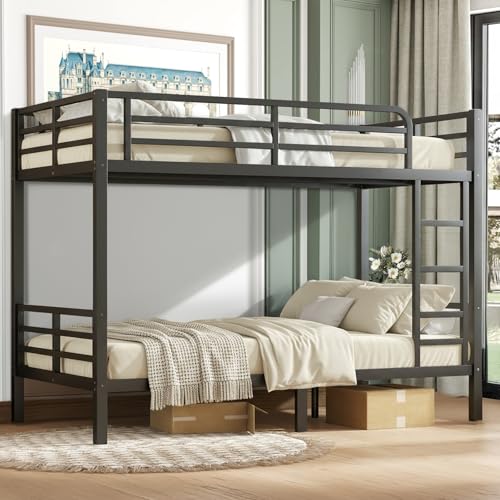
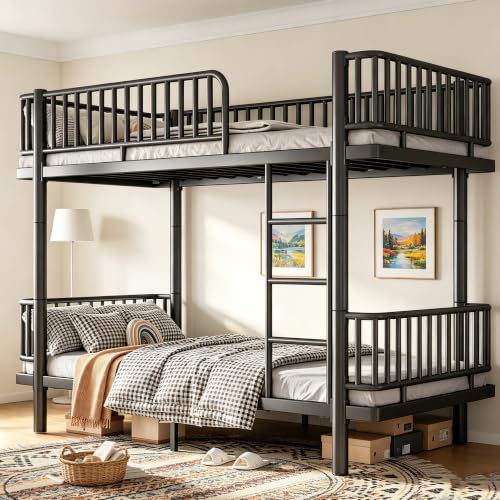
Metal bunk beds are the most common format in this category. High-grade steel construction with a rust-proof finish handles heavy daily use, and many models are rated for adults. Look for reinforced corner joints, a stable ladder attachment, and full-length guardrails on the top bunk. Metal frames tend to be the most straightforward to assemble and disassemble, which helps in rentals, dorms, or rooms that get rearranged.
Solid Wood Frames
Wooden extra long twin over twin bunk beds offer a warmer look and often blend better with bedroom decor. Solid wood or high-quality hardwood construction with reinforced slats provides a solid build with minimal squeaking when properly assembled. Wood frames are generally heavier, so plan for two people during assembly and placement.
Convertible and Modular Designs
Some models split into two standalone extra long twin beds, and a few include a trundle or desk component. Convertible designs are a long-term investment because the bed can adapt as needs change — from shared kids' room to separate guest beds, for example.
Loft and Staircase Variants
If the top bunk will be used by younger children or by anyone who finds a vertical ladder awkward, consider a bunk with built-in stairs or a loft configuration. These designs add footprint but improve accessibility. If you are exploring related formats, our guide to low bunk beds twin over twin covers lower-profile options that work well in rooms with limited ceiling height.
Mattress Compatibility: The Most Common Mistake
The single most common error with extra long twin bunk beds is buying standard twin mattresses. A 75-inch mattress in an 80-inch frame leaves a five-inch gap at the foot of the bed. On the top bunk, that gap is a genuine safety concern because it creates a space where a sleeper or bedding can become caught.
Follow these rules when selecting mattresses:
- Match the length exactly. The mattress must be 80 inches long for an extra long twin frame.
- Keep the profile moderate. A mattress that is too thick can rise above the guardrail on the top bunk, reducing its protective value. A profile in the 6 to 8 inch range is typically the safest choice for bunk use.
- Check the weight rating. Bunk bed frames are rated per bunk. Confirm that the mattress plus sleeper weight stays within the frame's stated capacity.
- Consider firmness for the top bunk. A firmer mattress reduces the sensation of movement and is easier to climb onto safely.
Safety note: Never place a mattress that is shorter or narrower than the frame on a bunk bed. The frame is engineered around a specific mattress dimension, and a mismatch compromises the guardrail and ladder geometry.
For a broader look at mattress selection across formats, see our bed-in-a-box comparison, which explains how compressed mattresses perform in bunk settings.
Safety Checklist for Extra Long Twin Bunks
Bunk bed safety comes down to a short list of verifiable features. Confirm each one before purchase:
- Full-length guardrails on the top bunk on both sides, with no gap wider than a few inches at any point.
- A weight capacity rating stated for the top and bottom bunks separately.
- A ladder that attaches securely and hooks over the frame rather than resting against it.
- Reinforced slats or a solid platform that supports the mattress evenly without sagging.
- Stable footing — check for leveling feet or a design that sits flat on the floor without rocking.
- Age guidance — most manufacturers specify a minimum age for top bunk use, commonly six years.
Assembly quality matters as much as the specification sheet. Re-tighten all fasteners after the first week of use, and check them periodically afterward.
Room Planning: Ceiling Height and Clearance
Extra long twin over twin bunk beds add length as well as height. Two dimensions deserve attention before ordering:
- Ceiling height: Allow enough headroom above the top bunk for a sleeper to sit up without contacting the ceiling. A minimum of 30 inches above the top mattress is a reasonable target, with more being better.
- Bunk clearance: The space between the bottom mattress and the underside of the top bunk should be comfortable for the person using the lower bunk. Around 30 to 34 inches is typical; adults should look for models at the higher end or a loft design.
Also measure the room's length against the bed's 80-inch mattress footprint plus frame overhang, and leave clearance for the ladder and for opening doors or drawers.
Bedding and Accessories for Extra Long Twin Bunks
Standard twin bedding will not fit correctly on an 80-inch mattress. Sheets, comforters, and bedspreads need to be sized for extra long twin. Our collection of extra long twin bedspreads and comforters covers the correct dimensions and fit.
Additional accessories worth considering:
- Waterproof mattress protectors sized for extra long twin, especially on the bottom bunk.
- A bedside shelf or clip-on caddy for the top bunk, since there is rarely space for a nightstand.
- A reading light that mounts to the frame rather than requiring a table.
- Anti-slip mattress grips to keep the mattress centered in the frame.
Who Should Choose Extra Long Twin Over Twin Bunks?
This configuration is a strong fit for several specific situations:
- Teen siblings sharing a room who have outgrown standard twin length but still need to conserve floor space.
- Guest rooms and vacation rentals that need to sleep two adults in a compact footprint.
- College and dormitory settings where extra long twin is already the standard mattress size.
- Adult shared housing where two people need separate sleeping surfaces in one room.
- Multi-generational homes where a grandparent or taller family member uses the lower bunk.
If both sleepers are adults and one is significantly taller or heavier, verify the per-bunk weight rating carefully. For situations where you need more width rather than more length, our guide to bunk beds for adults twin over full explains the trade-offs of a wider lower bunk.
Those furnishing a shared room from scratch may also find our comfortable space-saving beds overview useful for comparing bunk beds against other compact formats.
Assembly and Maintenance Tips
Extra long twin bunk beds are larger than standard twin bunks, so plan assembly accordingly:
- Assemble in the room where the bed will live, or confirm that the assembled frame fits through doorways and stairwells.
- Use two people for the top bunk section — the 80-inch length makes single-person lifting awkward.
- Tighten fasteners in a diagonal pattern to keep the frame square.
- Re-check all bolts after the first week, then every few months.
- Inspect guardrails and ladder hooks periodically for looseness or wear.
Frequently Asked Questions
What is the difference between a standard twin and an extra long twin bunk bed?
A standard twin mattress is 38 inches wide by 75 inches long; an extra long twin is 38 inches wide by 80 inches long. The extra five inches of length matter most for taller sleepers, who otherwise tend to hang off the end of a standard bunk.
Do extra long twin over twin bunk beds require special mattresses?
Yes. These frames are built to the 80-inch length and need extra long twin mattresses. A standard 75-inch twin mattress leaves a gap at the foot of the frame, which is a safety hazard on the top bunk.
Are extra long twin bunk beds safe for adults?
Many models are rated for adults, but confirm the per-bunk weight capacity, the presence of full-length guardrails on the top bunk, and the sturdiness of the ladder and frame. Adult-rated models typically use reinforced metal or solid wood construction.
How much clearance is there between the bunks?
Clearance varies by model. Around 30 to 34 inches between the bottom mattress and the underside of the top bunk is a comfortable target. Adults should look for models at the higher end or choose a loft design.
Can extra long twin over twin bunk beds be separated into two beds?
Some models are convertible and split into two standalone extra long twin beds. This is a useful feature if your space or sleeping arrangements may change over time.