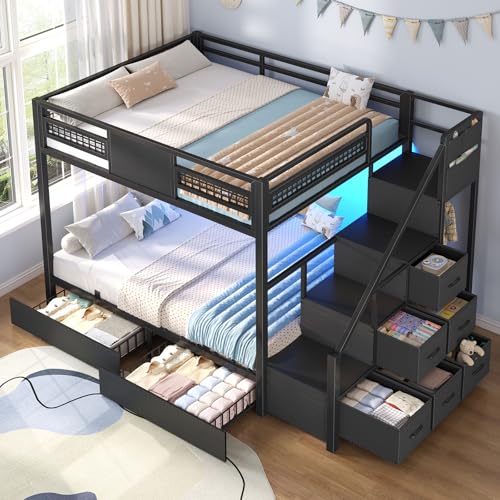
Full Double Bunk Beds for Adults: The Complete Buying Guide
Two full-size sleeping surfaces, one footprint. Learn how adult-rated bunk beds differ from kids' models, what weight limits and clearances actually matter, and how to choose a frame that stays solid for years.
Explore Buying FactorsQuick summary: Full double bunk beds for adults are not simply oversized children's bunks. They use reinforced frames, higher weight ratings, and generous bunk clearances. The three decisions that matter most are frame construction, per-bunk weight capacity, and the access method (stairs vs ladder). Everything else follows from those.
Why Full Over Full Bunks Suit Adult Sleepers
A full-size mattress offers roughly 53 by 75 inches of sleeping surface, which is a meaningful upgrade over a twin. For adults, that extra width reduces the feeling of confinement on a top bunk and makes the bottom bunk genuinely usable as a primary bed. A full over full bunk bed pairs two of these surfaces vertically, which is why it appeals to guest rooms, shared apartments, vacation properties, and multigenerational households.
The catch is that most bunk beds sold today are designed around children. Adult sleepers need frames that address three physical realities: greater body weight, larger body length, and a higher center of gravity when climbing. That is why the category has split into clearly defined tiers. Entry-level frames often meet minimum safety standards but are not rated for adult use, while heavy-duty full-size bunk beds are explicitly engineered with thicker posts, reinforced corner joints, and published adult weight ratings.
If your room layout points toward a larger footprint, the related category of full over queen bunk beds with trundle combines two different mattress sizes and adds a third pull-out sleeping surface. That configuration suits households that host different combinations of guests, but it demands more floor space and careful measurement before purchase.
Frame Construction: What Separates Adult-Grade From Kids' Models
Frame material and joinery are the clearest signals of whether a bunk is built for adults. Three construction types dominate the market, and each has distinct strengths.
Metal frames use high-grade steel tubing or angle iron. Heavy-duty models typically feature thicker gauge steel, welded corner brackets rather than simple bolts, and a rust-proof finish. Metal frames tend to have a slimmer visual profile and are often the choice for spaces where a lighter look is preferred. They are also easier to disassemble and move. The trade-off is that lower-tier metal frames can flex or squeak over time, so the gauge of the steel and the quality of the joints matter more than the metal label itself.
Solid wood frames use hardwood posts and rails, frequently in pine, oak, or rubberwood. Solid wood offers warmth and blends into bedroom decor more naturally. Commercial-grade solid wood bunks are the most stable option for adult use when properly joined with mortise-and-tenon or reinforced bolt systems. Softer woods can dent under heavy use, so check the species and the joint construction.
Upholstered and platform-style bunks add padded rails and sometimes integrated storage. These are less common for adult full-over-full configurations but appear in premium and luxury tiers. The upholstery is cosmetic; the underlying frame still determines strength, so ask about the structural material beneath the fabric.
| Tier | Typical Construction | Best For |
|---|---|---|
| Entry-level | Thinner metal tubing or softwood; bolted joints; basic slat support | Light use, occasional guest sleeping, older children and lighter adults |
| Mid-range | Thicker gauge steel or hardwood; reinforced brackets; better slat spacing | Regular adult use in guest rooms and shared apartments |
| Premium / heavy-duty | High-grade steel or solid hardwood; welded or mortise joints; adult weight ratings published per bunk | Nightly adult sleeping, long-term investment, multigenerational households |
| Commercial-grade | Oversized posts, through-bolted rails, institutional safety rails | Rental properties, vacation homes, high-turnover shared housing |
Weight Capacity and Bunk Clearance: The Numbers That Matter
Two specifications determine whether a full double bunk bed is genuinely adult-appropriate, and both are frequently overlooked in listings.
Per-bunk weight capacity. Each bunk has its own rating, and the top bunk is usually the limiting factor. Choose a frame whose stated top-bunk rating comfortably exceeds the weight of the heaviest person who will sleep there. Heavy-duty models publish higher ratings than entry-level frames, and commercial-grade frames go higher still. Do not assume that a frame rated for two children is rated for two adults.
Bunk clearance. This is the distance from the bottom mattress surface to the underside of the top bunk. For adults, aim for at least 30 to 34 inches. At the lower end, an adult can lie down comfortably but will need to duck when sitting up. At the higher end, sitting up in bed is comfortable and reading in the bottom bunk becomes realistic. Higher clearance generally means a taller overall frame, so confirm ceiling height before ordering.
A third figure worth checking is the top rail height above the top mattress. Safety rails should extend several inches above the mattress surface, and adult sleepers should confirm the rails are tall enough for the mattress thickness they plan to use.
Pre-Purchase Checklist
- Confirm the per-bunk weight rating for the top and bottom bunks separately.
- Measure ceiling height and subtract the frame height to verify headroom on the top bunk.
- Check bottom-bunk clearance and decide whether you need to sit up in bed.
- Measure the mattress thickness the frame supports; overly thick mattresses reduce rail effectiveness.
- Decide between stairs and a ladder based on who will use the top bunk nightly.
- Verify the frame meets current bunk bed safety standards for adult use.
- Check whether a box spring is required or the frame uses a slat foundation.
- Measure doorways and stairwells for delivery access.
Stairs, Ladders, and Safe Access for Adults
Access design is where many adult bunk bed purchases succeed or fail. A vertical ladder is compact but demanding, especially for nightly use or for anyone with knee, hip, or balance concerns. Angled ladders are somewhat easier but still require careful foot placement.
Stairs are the more comfortable and safer choice for adults. They behave like a short staircase, distribute weight more evenly, and reduce the risk of slips during middle-of-the-night trips. The trade-off is floor space. However, many stair models integrate storage drawers into each step, which recovers much of the footprint. If space is the constraint, full-size bunk beds with stairs are worth prioritizing over ladder models even at the cost of a few extra inches.
Regardless of access type, look for full-length safety rails on the top bunk, a sturdy ladder that hooks or bolts securely rather than resting loosely, and rounded edges on rails and steps. For households with younger adults or teens sharing the room, the same features apply.
Room Layout, Footprint, and Storage
A full over full bunk occupies roughly the same floor area as a single full-size bed, which is the core appeal. But the vertical footprint introduces layout considerations that a standard bed does not.
- Wall placement. Bunks are most stable and safest when one long side sits against a wall. Leave enough gap on the access side for a ladder or stairs.
- Ceiling fans and light fixtures. Confirm no fixture hangs low enough to be reachable from the top bunk.
- Storage. Under-bunk space can hold drawers, a trundle, or open storage bins. Stair models often include built-in drawers.
- Windows. Avoid placing the top bunk directly against an operable window without a guard, especially in upper-floor rooms.
For rooms where floor space is genuinely tight, short bunk beds for small rooms reduce overall height while keeping the stacked configuration, though they typically offer less bottom-bunk clearance. Adult sleepers should weigh that trade-off carefully.
Mattress Selection for Full Over Full Bunks
Bunk mattresses are not interchangeable with standard mattresses. Thickness matters because safety rails are designed around a specific mattress height. A mattress that sits too high reduces the effective rail height; one that sits too low can leave gaps at the frame edge.
Most adult bunk frames use a slat foundation and do not require a box spring. Memory foam and hybrid mattresses work well on slat systems, provided the slats are closely spaced. Innerspring mattresses are also compatible but check that the frame's slat spacing meets the mattress manufacturer's warranty requirements. For the bottom bunk, where clearance is limited, a thinner profile mattress helps preserve headroom.
If you are furnishing a guest room around the bunk, complementary pieces such as a small bedside chest of drawers or a floating bedside shelf with drawer can keep the room functional without crowding the bunk's access side.
Configuration Options Worth Considering
Full over full is one point in a broader family of adult bunk configurations. Understanding the alternatives helps you confirm it is the right choice.
- Full over full with trundle. Adds a third sleeping surface that pulls out from the bottom. Useful for sleepovers and flexible guest rooms.
- Twin over full. A twin top bunk with a full bottom bunk. Common in rooms where one sleeper is smaller or where top-bunk clearance is constrained.
- Queen over queen. Larger surfaces for couples or tall adults. Requires substantially more floor space and ceiling height.
- L-shaped configurations. Two bunks arranged perpendicular to each other, often used to define separate sleeping zones in a shared room.
Related configurations such as queen over queen metal bunk beds and twin over queen size bunk beds follow the same construction and safety principles described in this guide, with different mattress footprints.
Safety Standards and Installation
Adult bunk beds should meet recognized bunk bed safety standards covering rail height, mattress support, ladder attachment, and structural strength. Reputable manufacturers publish compliance information; treat missing or vague safety documentation as a warning sign.
Installation quality matters as much as the frame. Assemble on a level floor, tighten all bolts to the manufacturer's specification, and re-check fasteners after the first few weeks of use. Attach the frame to the wall with the supplied anti-tip hardware if the design allows. Never modify the frame by removing rails or drilling new holes, as this can void safety certifications.
Plan for two people during assembly. Full over full frames are large and awkward to position, and top-bunk rails and ladders are easier to attach before the frame is fully upright.
Can adults safely sleep on full double bunk beds?
Yes. Adult-rated full over full bunk beds are engineered with reinforced frames and higher weight capacities than children's models. The key is choosing a heavy-duty frame explicitly rated for adult use, and confirming the top bunk weight limit meets or exceeds the weight of the intended sleeper.
How much headroom do adults need on the bottom bunk?
Aim for at least 30 to 34 inches of clearance between the bottom mattress surface and the underside of the top bunk. Adults who sit up in bed should target the higher end of that range to avoid bumping their heads.
Are stairs better than a ladder for adult bunk beds?
Stairs are generally safer and more comfortable for adults, especially for nightly use. They take up more floor space than a ladder, so measure your room carefully. Many stair models include built-in storage drawers, which offsets the footprint.
What weight capacity should I look for in adult bunk beds?
Look for a per-bunk weight rating that comfortably exceeds the weight of the heaviest sleeper. Heavy-duty and commercial-grade frames typically publish higher ratings than entry-level models. Always check the manufacturer's stated rating for each bunk separately.
Do full double bunk beds require a box spring?
Most modern adult bunk beds use a slat system and do not require a box spring. Slat foundations work best with memory foam and hybrid mattresses. Check the manufacturer's mattress recommendations, as some frames are designed for specific mattress types and thicknesses.
Ready to Compare Adult Bunk Bed Options?
Review the recommended full double bunk beds below, filtered for adult-capable frames and heavy-duty construction.
View Recommended Models