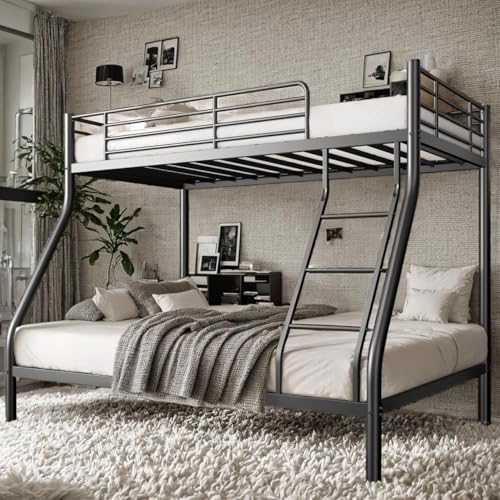
Bunk Beds Double Bottom Single Top: The Complete Buyer's Guide
Everything you need to know about double-over-single bunk beds — configurations, safety, mattress compatibility, and how to choose the right setup for your home.
Start ExploringWhy this configuration stands out: A bunk bed with a double bottom and single top delivers a smart balance of sleeping capacity and floor-space efficiency. The lower double berth suits couples or older children who want extra room, while the upper single berth keeps the overall footprint compact. This guide walks you through every decision point before you buy.
What Is a Double Bottom Single Top Bunk Bed?
A bunk bed with a double bottom and single top — sometimes written as a double-over-single bunk — pairs a wider lower berth with a narrower upper berth. The lower level typically fits a full or double mattress, while the upper level fits a twin or single mattress. This asymmetric layout differs from the classic twin-over-twin bunk, where both berths are the same size.
The appeal is straightforward: the lower double berth provides generous sleeping space for adults, older children, or guests, while the upper single berth adds a second sleeping spot without requiring the floor area of two full beds. For households balancing limited square footage with the need to sleep three people comfortably, this configuration is a practical middle ground.
If you are still comparing bunk styles broadly, our bunk bed buying guide covers frame types, layout choices, and planning fundamentals that apply across configurations.
Key Benefits and Who It Suits
The double-bottom single-top layout solves a specific set of problems. Here is where it tends to shine:
- Sleeping three in one footprint: The double lower berth can sleep two smaller children or one adult comfortably, and the single upper berth adds a third sleeping position. This makes the setup popular for guest rooms, vacation homes, and shared kids' rooms.
- Flexible for mixed-age households: Younger children often prefer the lower double berth, while older children can use the upper single berth once they meet the manufacturer's age and weight guidance.
- Efficient use of vertical space: By stacking sleeping areas, the bed frees up floor space for desks, storage, or play areas. This is especially valuable in small bedrooms and multi-use rooms.
- Accommodates adult guests: The lower double berth is generally comfortable for adults, which makes the bed more versatile than a twin-over-twin design.
- Strong resale and reuse potential: A well-built double-over-single frame often remains useful as children grow, and many models can be separated into individual beds — a feature worth checking before purchase.
This configuration is less ideal for rooms with very low ceilings or for households where both sleepers need equal berth width. If you are weighing alternatives, our overview of double-on-bottom twin-on-top bunk beds explores a closely related layout, and our guide to twin-over-full bunk beds covers the reverse arrangement.
Common Configurations Compared
Bunk beds come in several size pairings. The table below compares the most common ones so you can see where the double-bottom single-top design fits.
| Configuration | Lower Berth | Upper Berth | Best For | Typical Tier |
|---|---|---|---|---|
| Double bottom, single top | Full / double | Twin / single | Mixed-age kids, guest rooms, three sleepers | Mid-range to premium |
| Twin over twin | Twin | Twin | Same-age siblings, smallest footprint | Entry-level to premium |
| Twin over full | Full | Twin | Older child below, younger above | Mid-range |
| Full over queen | Queen | Full | Teens and adults, maximum capacity | Premium to luxury |
| Queen bottom, full top | Queen | Full | Adult-focused guest rooms | High-end tier |
Note that "double" and "full" are often used interchangeably in bedding. When shopping, confirm the exact mattress dimensions the frame supports. Our guides to bunk beds with a double on the bottom and full-size top and bottom bunks provide additional context on sizing variations.
Mattress Compatibility and Sizing
Mattress fit is one of the most overlooked factors in bunk bed satisfaction. A mattress that is too thick can compromise guardrail height on the upper berth, while an undersized mattress can leave gaps around the frame. Follow these guidelines:
- Upper berth: Use a twin or single mattress that matches the frame's specified dimensions. Many manufacturers recommend a thinner profile for the top bunk to keep the guardrail effective. Check the bed's manual for the maximum mattress thickness.
- Lower berth: A standard double or full mattress usually fits, but confirm the frame's weight capacity and recommended thickness. A mattress that sits too high can interfere with the upper bunk's support structure.
- Foundation type: Some frames use slats, others use a box foundation or platform base. Match the mattress type to the foundation — memory foam, hybrid, and innerspring models each have different support needs.
- Weight capacity: Verify both per-berth and total weight limits. Adult use on the upper berth requires a frame rated accordingly.
For households managing tighter budgets without sacrificing safety, our guide to budget mattresses explains how to prioritize support and durability. If you need a thinner top-bunk mattress, our article on bunk beds for thick mattresses covers the opposite scenario and the clearance issues to watch for.
Safety Features to Prioritize
Safety should drive every decision when bunk beds are involved, especially in homes with children. Look for the following:
- Full-length guardrails on the upper bunk: The rail should extend along the entire length of the mattress, with no more than a small gap at the ladder opening.
- Sturdy ladder attachment: The ladder should hook or bolt securely to the frame, not rest loosely. Flat rungs are easier to climb than rounded ones.
- Reinforced frame joints: Look for bolted or mortise-and-tenon joinery rather than staples or thin brackets. Heavy-duty hardware is a good sign of durable construction.
- Slat spacing and thickness: Closely spaced, thick slats support the mattress and reduce sagging. Check that slats are secured and cannot shift.
- Age and weight guidance: Most manufacturers specify a minimum age for the upper bunk, often six years, and a maximum weight per berth. Follow these limits strictly.
- Corner and edge finishing: Rounded edges and smooth finishes reduce the risk of scrapes, particularly on ladders and guardrails.
If the bed will be used by adults, confirm that the frame is rated for adult weight on both levels. Our guide to bunk beds that can hold adults covers capacity ratings and structural considerations in more detail.
Room Planning and Clearance
Before ordering, measure your room carefully. Bunk beds occupy vertical space, and ceiling height is the most common constraint.
- Ceiling clearance: Allow adequate headroom above the upper mattress — a common recommendation is at least 30 to 36 inches between the mattress surface and the ceiling. Rooms with eight-foot ceilings usually work, but confirm with the specific bed's height.
- Upper bunk to lower bunk clearance: The gap between the bottom of the upper frame and the top of the lower mattress should allow comfortable sitting. Check the bed's published dimensions.
- Floor footprint: A double-over-single frame is wider than a twin-over-twin, so verify that the footprint fits your room and leaves space for doors, closets, and walkways.
- Ladder placement: The ladder needs clear floor space for safe mounting and dismounting. Plan furniture placement around it.
For rooms with low or sloped ceilings, our guides to bunk beds for 8-foot ceilings and bunk beds for sloped ceilings offer practical layout solutions. Small rooms benefit from our roundup of bunk beds for small rooms.
Frame Materials and Build Quality
The material and construction of the frame determine how long the bed lasts and how stable it feels. The main options are:
| Material | Strengths | Considerations | Typical Tier |
|---|---|---|---|
| Solid wood | Durable, warm appearance, repairable | Heavier; check for kiln-dried hardwood | Mid-range to premium |
| Metal | Strong, slim profile, easy to clean | Look for rust-proof finish and reinforced joints | Entry-level to mid-range |
| Engineered wood | Consistent finish, lighter weight | Verify core quality and edge banding | Entry-level to mid-range |
| Upholstered | Soft edges, integrated look | Check fabric durability and frame beneath | Premium to luxury |
Regardless of material, inspect the hardware. Bolted connections with lock washers outperform stapled joints. For wood frames, solid hardwood rails and posts are a strong indicator of long-term durability. For metal frames, a powder-coated or rust-proof finish protects against wear.
Buying Checklist
Use this checklist to evaluate any double-bottom single-top bunk bed before you commit:
- Confirmed mattress sizes and maximum thickness for both berths.
- Full-length guardrail on the upper bunk with no oversized gaps.
- Securely attached ladder with flat, slip-resistant rungs.
- Published weight capacity per berth that matches your users.
- Frame dimensions and ceiling clearance verified against your room.
- Joinery and hardware inspected — bolted or mortise-and-tenon preferred.
- Optional features evaluated: storage drawers, trundle, desk, separability into two beds.
- Assembly requirements and tools reviewed before delivery.
If you are considering beds that can be split into separate units later, our guide to bunk beds that can be separated explains which mechanisms to look for. For small rooms that need extra storage, see bunk beds for small rooms with storage.
Ready to Compare Double-Over-Single Bunk Beds?
Browse our curated selection of bunk beds with a double bottom and single top, and check availability on trusted retail platforms.
View Recommended ModelsFrequently Asked Questions
What is a double bottom single top bunk bed?
It is a bunk bed configuration where the lower berth accommodates a double or full-size mattress while the upper berth holds a single or twin-size mattress. This layout maximizes sleeping capacity in a compact footprint and suits mixed-age households or guest rooms.
Are double bottom single top bunk beds safe for children?
Yes, provided the bed meets current safety standards, includes full-length guardrails on the upper bunk, and is used with appropriately sized mattresses. The lower double berth is generally accessible to younger children, while the upper single berth is best suited to older children within the manufacturer's age and weight guidelines.
What mattress thickness works best for a double bottom single top bunk?
Upper bunks typically require a thinner mattress, often in the range recommended by the manufacturer, to keep the guardrail effective. The lower double berth can usually accommodate a standard-height double mattress. Always follow the bed's specific mattress thickness guidance.
Can a double bottom single top bunk bed be separated into two beds?
Many models offer a separability feature, allowing the frame to split into a standalone double bed and a single bed. Check the product specifications for this capability before purchasing, and review our guide to bunk beds that can be separated for details on how the mechanism works.
How much ceiling height is needed for this bunk configuration?
A common recommendation is at least 30 to 36 inches of headroom above the upper mattress surface. Most rooms with eight-foot ceilings work, but confirm the bed's published height and your room's exact ceiling measurement before ordering.