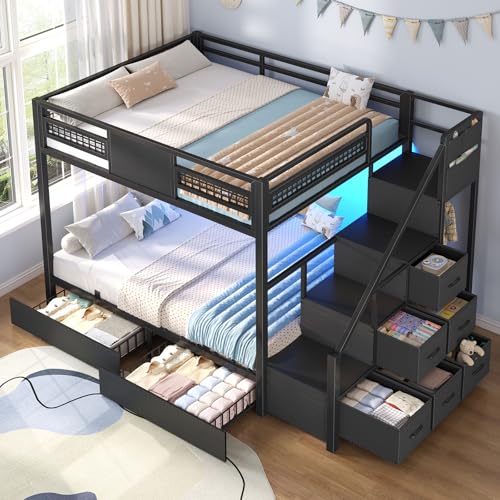
Full Over Full Bunk Beds with Drawers: The Complete Guide
Maximize your bedroom space with two full-sized sleeping areas and built-in storage drawers. Learn everything you need to know before choosing the perfect bunk bed for your home.
Why full over full bunk beds with drawers are a smart choice: When you need to sleep two people comfortably without sacrificing floor space, a full over full bunk bed delivers. Add under-bed drawers, and you gain valuable storage for clothing, bedding, or toys — all in one compact footprint.
This guide covers drawer configurations, safety requirements, frame materials, weight capacity considerations, and practical buying tips so you can make a confident decision for your family's bedroom setup.
What Are Full Over Full Bunk Beds with Drawers?
A full over full bunk bed stacks two full-sized mattresses — typically 54 inches wide by 75 inches long each — one above the other. The "with drawers" designation means the bottom frame includes integrated storage compartments that slide out from beneath the lower bunk. This combination is especially practical because full-sized beds accommodate adults and older children comfortably, while the drawers eliminate the need for a separate dresser or storage chest.
These beds are popular in shared children's rooms, teen bedrooms, guest rooms, vacation cabins, and any space where you want to sleep two people without dedicating the entire room to beds. If you are specifically comparing configurations, you may also want to explore standard full over full bunk beds without drawers to see how storage affects the overall footprint.
Key Features to Evaluate
Drawer Configuration
Most models offer two to four drawers beneath the bottom bunk. Some include a combination of drawers and open cubbies. Consider whether you need deep drawers for bulky items or shallower drawers for folded clothing.
Safety Guardrails
The top bunk must have full-length guardrails on both sides. Check that the rail height meets safety standards and that the ladder attaches securely. Some premium models include reinforced guardrails with wider gaps for easier access.
Weight Capacity
Weight ratings vary significantly. Entry-level models may support around 200 pounds per bunk, while heavy-duty and commercial-grade frames can handle 400 pounds or more per sleeping surface. Always verify the rating before purchase, especially for adult use.
Frame Material
Wood frames offer a warm, traditional look and are available in pine, oak, and engineered wood. Metal frames provide a more industrial aesthetic with high durability. Both types can be sturdy — the key is joint construction and material thickness.
Ladder and Access
Ladders should be sturdy, with flat steps or rungs that are comfortable underfoot. Some models offer angled ladders for easier climbing, while others include stairs with built-in storage — a worthwhile upgrade for younger children or adults who prefer easier access.
Convertibility
Some full over full models can be separated into two independent full beds. This is useful as children grow or if your needs change. Convertible designs typically use stacked posts with removable bolts rather than a single welded frame.
Drawer Storage: What to Expect
The drawers are often the deciding factor for buyers choosing this bed style over a standard bunk. Here is what you should know about storage configurations across different product tiers:
Entry-Level Tier
Entry-level models typically include two drawers made from engineered wood with simple metal glides. Drawer depth is usually moderate — enough for folded clothing or small toys. The drawer fronts may be unfinished or painted, and the interior may not be fully lined. These are a solid choice for light use in a child's room.
Mid-Range Tier
Mid-range models often step up to three or four drawers with smoother ball-bearing glides, dovetail or reinforced joints, and better interior finishing. Some include a mix of drawers and open shelving, giving you flexibility for different types of storage. Drawer depth and width tend to increase, making them more practical for adult clothing.
Premium and High-End Tier
Premium full over full bunk beds with drawers may feature full-extension drawers, soft-close mechanisms, solid wood drawer boxes, and premium hardware. Some high-end models integrate the drawers into a staircase design or include a combination of drawers, shelves, and trundle space. If long-term durability and smooth operation are priorities, these features are worth considering.
Safety Standards and Best Practices
Bunk bed safety is non-negotiable, especially when children are involved. Here is a checklist to guide your evaluation:
- Guardrails on the top bunk must be present on both sides and run at least five inches above the mattress surface. Check that the guardrail does not have gaps wider than 3.5 inches to prevent entrapment.
- Ladder attachment should be secure and positioned so it does not obstruct the drawer openings. Some models offer hooks or brackets that keep the ladder firmly in place.
- Slat foundation should be strong enough to support the mattress without sagging. Check the number of slats and their thickness — more slats generally mean better weight distribution.
- Weight capacity ratings should be clearly stated. Never exceed the manufacturer's recommended limit. For adult use, look for models rated for at least 250 pounds per bunk.
- Age recommendations — most safety organizations advise that children under six should not sleep on the top bunk. Follow the manufacturer's guidance.
- Assembly quality — ensure all bolts, screws, and connectors are tightened properly. Check periodically for loosening, especially in households with active children.
For families with older children or teens, you may also want to review full over full bunk beds designed for adults to compare weight ratings and frame durability.
Comparing Full Over Full Bunk Bed Configurations
The table below compares common configurations to help you identify which style aligns with your storage needs and room layout:
| Configuration | Best For | Storage Type | Access Style |
|---|---|---|---|
| Full over full with drawers | Shared bedrooms, guest rooms | 2–4 under-bed drawers | Standard ladder |
| Full over full with storage stairs | Younger children, added safety | Staircase with built-in compartments | Angled stairs |
| Full over full with trundle | Sleepovers, extra guests | Trundle bed + drawers | Standard ladder |
| Full over full with stairs and storage | Maximum storage and safety | Stairs + drawers combination | Staircase with handrail |
If you are interested in a staircase design, explore full over full bunk beds with stairs and storage for a closer look at how staircase compartments can replace a dresser entirely.
Material and Durability Considerations
The frame material affects both the appearance and lifespan of your bunk bed. Here is a breakdown of common options:
Wood Frames
Wood is the most popular choice for full over full bunk beds with drawers because it blends well with bedroom decor and can be painted or stained. Pine is common in entry-level and mid-range models — it is lightweight but can dent under heavy impact. Hardwoods like oak, maple, or birch offer greater durability but are typically found in premium and high-end tiers. Engineered wood with veneer is often used for drawer fronts and side panels to keep the structure stable.
If you prefer a wood finish, you may also like wood full over full bunk beds for a more traditional look.
Metal Frames
Metal frames — typically steel or iron — offer high strength-to-weight ratios and are often easier to clean. They are a strong choice for households with active children. Powder-coated finishes resist rust and scratches. The trade-off is that metal frames can be noisier if joints are not tight, so check for models with reinforced connection points and rubberized ladder rungs.
Joint Construction
Regardless of material, the joints are where durability is won or lost. Look for mortise-and-tenon joints or metal-on-metal bolt connections in wood frames. Avoid models that rely solely on screws into end grain, which can loosen over time. For metal frames, check for welded joints rather than bolted-only assemblies.
Sizing and Room Fit
A full over full bunk bed is larger than a twin over twin bunk, so measuring your space carefully is essential. A standard full mattress is 54 inches wide and 75 inches long. The bed frame adds a few inches on each side. Here is what to account for:
- Ceiling height — You need enough clearance between the top bunk mattress and the ceiling for comfortable sitting. A minimum of 30 to 34 inches is generally recommended.
- Drawer clearance — Ensure there is enough space in front of the bed for drawers to open fully. Full-extension drawers need more clearance than standard drawers.
- Ladder placement — The ladder may extend into the room. Confirm it does not block a doorway, closet, or traffic path.
- Door and stair access — Measure doorways and stairwells before delivery. Some models ship in multiple boxes, but assembled frames may not fit through narrow passages.
Who Should Consider This Bed Style?
Full over full bunk beds with drawers are particularly well-suited for:
- Families with two children sharing a room — Full-sized bunks give each child ample sleeping space as they grow.
- Guest rooms and vacation homes — Sleep two adults comfortably while keeping storage for linens and extra bedding on hand.
- Teen bedrooms — Full bunks provide the comfort of a standard bed while freeing up floor space for desks, seating, or exercise equipment.
- Small apartments or condos — The combination of sleeping and storage in one footprint is efficient for compact living.
- Multi-generational households — When an adult or older child needs a full-sized sleeping surface, a full over full configuration avoids the cramped feeling of a twin bunk.
If you are weighing different full-sized bunk options, compare full size bunk beds with drawers to see how drawer placement and frame heights vary across models.
Practical Buying Tips
Use these guidelines to streamline your decision:
- Verify mattress compatibility — Some bunk beds are designed for specific mattress thicknesses. A mattress that is too thick can compromise guardrail height; one that is too thin may not provide adequate support.
- Check the slat spacing — Slats should be spaced no more than three inches apart for foam mattresses and no more than four inches for spring mattresses.
- Review assembly requirements — Some models require two adults for safe assembly. Check whether tools are included and whether the manufacturer offers a video guide.
- Confirm drawer glide quality — Ball-bearing glides are smoother and more durable than simple metal slides. Soft-close mechanisms are a nice upgrade if the bed will be used frequently.
- Look for convertible features if flexibility matters — A bed that separates into two full beds can adapt as your family's needs change. See full over full bunk beds that separate for models designed with this in mind.
Frequently Asked Questions
Ready to Explore Full Over Full Bunk Beds with Drawers?
Browse our curated selection of top-rated models with storage drawers, sturdy frames, and safety-focused designs. Compare features and find the right fit for your bedroom.
View Recommended Models