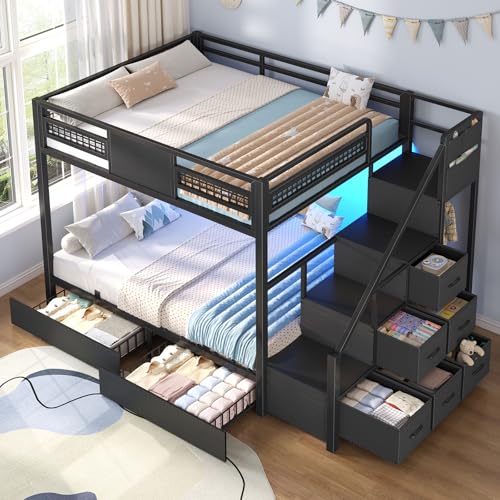
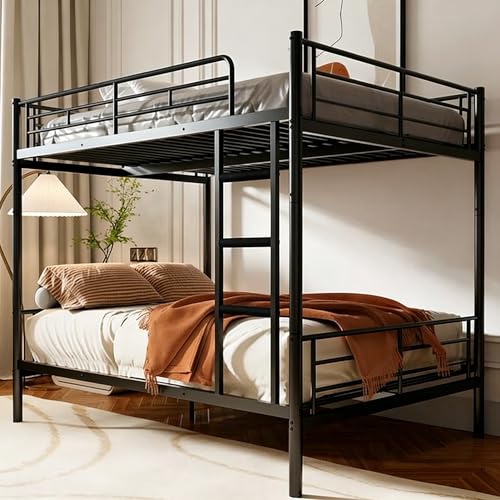
Full Over Full Bunk Beds: The Complete Buying Guide
Two full-size sleeping surfaces in the footprint of one. Compare wood, metal, detachable, storage-stair, and trundle models to find the right fit for your family, teens, or adult household.
Why full over full bunk beds deserve a closer look: A full over full bunk bed delivers two genuine full-size sleeping surfaces without doubling the floor space footprint. For families with older children, teens, or adults sharing a room, this configuration offers more personal sleeping room than twin-over-twin designs while remaining a practical long-term investment. This guide walks through frame materials, safety requirements, storage options, and the key decisions that separate a solid choice from a regrettable one.
What Exactly Is a Full Over Full Bunk Bed?
A full over full bunk bed stacks two full-size mattresses — each measuring approximately 54 inches wide by 75 inches long — in a vertical configuration. The bottom bunk rests near floor level, while the top bunk is elevated and accessed via a ladder or integrated stairs. Unlike twin-over-twin bunks that prioritize compactness, full over full models prioritize sleeping comfort and generous personal space.
The result is a piece of furniture that effectively doubles sleeping capacity while occupying roughly the same floor area as a single full bed. This makes it a compelling option for guest rooms, shared bedrooms, vacation properties, and multi-generational households. If you are still weighing bunk configurations, our broader guide to full size bunk beds covers the wider category and helps you compare layouts.
It is worth distinguishing this configuration from related designs. A full over full bunk bed for adults typically emphasizes reinforced frames and higher weight ratings, while a full over queen size bunk bed trades symmetry for a larger lower sleeping surface. Understanding these distinctions early prevents costly missteps.
Who Should Choose a Full Over Full Bunk Bed?
The ideal buyer profile for a full over full bunk bed is broader than many shoppers assume. Consider these scenarios:
- Families with older children or teens: Growing children need more sleeping room than a twin comfortably provides. Full-size surfaces accommodate restlessness and longer bodies without feeling cramped.
- Adult siblings or roommates: Adults sharing a room benefit from full-size mattresses that support proper spinal alignment and reduce the feeling of sleeping in a child's bed.
- Guest and vacation rooms: A single full over full bunk bed converts a modest room into a comfortable space for four guests when paired with convertible or detachable designs.
- Multi-generational homes: Grandparents visiting or adult children returning home need dignified, supportive sleeping surfaces — not fold-out afterthoughts.
- Small-footprint homes: Apartments and compact homes gain meaningful sleeping capacity without sacrificing an entire room to a second bed.
If your household includes very young children, a lower-profile option such as full size low bunk beds may be safer and easier to manage. Conversely, households needing three or more sleeping surfaces should explore full over full triple bunk beds or configurations with a full trundle.
Frame Materials: Wood, Metal, and Everything Between
Frame material dictates durability, aesthetic, weight capacity, and long-term maintenance. There is no universally superior choice — only the right match for your household.
Wood Frames
Wood full over full bunk beds remain the most popular choice for family bedrooms. Solid pine, rubberwood, and engineered hardwood composites offer a warm aesthetic that blends with farmhouse, transitional, and traditional interiors. Key considerations include joinery quality (mortise-and-tenon and dovetail joints outperform simple screws), finish durability, and whether the wood is kiln-dried to resist warping. Our guide to full over full bunk beds in wood explores species, finishes, and structural details in depth.
Metal Frames
Metal full over full bunk beds — typically steel or aluminum — deliver exceptional strength-to-weight ratios and a cleaner, more contemporary profile. High-grade steel frames with reinforced welding and rust-proof finishes are common in commercial-grade and dormitory settings. They tend to resist scratches and moisture better than wood but can transmit more motion and occasionally squeak if fasteners loosen. Our dedicated full over full metal bunk beds guide covers weight ratings and assembly considerations.
Upholstered and Hybrid Frames
Some premium models incorporate upholstered panels or mixed materials (wood frame with fabric accents) to soften the visual profile. These are typically mid-tier to high-end tier options and demand more careful cleaning routines, especially in households with pets or young children.
Material at a glance: Wood offers warmth and repairability; metal offers strength and a slim profile. Entry-level frames in either material may use thinner stock or simpler joinery, while top-tier models use reinforced corner blocks, thicker rails, and commercial-grade hardware.
Comparing Full Over Full Bunk Bed Configurations
Configuration matters as much as material. The table below maps common designs to their best-fit households and relative market positioning. Use it as a starting framework rather than a final verdict.
| Configuration | Tier Positioning | Best For | Key Consideration |
|---|---|---|---|
| Standard fixed full over full | Entry-level to mid-range | Families with teens; guest rooms | Confirm top-bunk clearance and rail height |
| Full over full bunk beds that separate | Mid-range to premium | Households anticipating layout changes | Verify separation hardware and independent stability |
| Convertible bunk beds | Mid-range to high-end tier | Growing families; long-term flexibility | Check conversion instructions and part availability |
| Detachable bunk beds | Premium | Renters; frequent movers | Confirm tool requirements and hardware storage |
| Bunk beds with stairs | Mid-range to premium | Younger children; households prioritizing safety | Stair footprint reduces adjacent floor space |
| Storage stairs models | Premium | Rooms with limited storage | Verify drawer load ratings and slide quality |
| Drawer-equipped models | Mid-range to premium | Bedrooms without closets | Confirm drawer clearance from walls |
| High weight capacity models | High-end tier to commercial-grade | Adults; heavy sleepers | Look for reinforced slats and published ratings |
Safety Requirements You Should Not Overlook
Bunk bed safety is not a marketing talking point — it is a structural and behavioral requirement. Before purchasing, verify the following:
- Guardrails on the top bunk: At least one guardrail per side, with no more than 5 inches of gap between the rail and the mattress surface. Guardrails must extend at least 5 inches above the mattress top.
- Ladder or stair attachment: The access method must be securely fastened to the frame and positioned so it does not obstruct walkways.
- Weight capacity: Published weight ratings should exceed the intended sleeper's weight with margin. Adults should prioritize models rated for higher capacities — see our high weight capacity full over full bunk beds roundup.
- Slat strength: Metal slats or closely spaced wood slats prevent mattress sag and improve load distribution.
- Ceiling clearance: Maintain at least 30 inches between the top bunk mattress surface and the ceiling. Never place a bunk bed beneath a ceiling fan.
- Wall anchoring: Some models recommend or require wall anchoring for added stability. Follow the manufacturer's instructions precisely.
For families with younger children, stairs generally reduce fall risk compared to ladders. Our guide to full over full bunk beds with stairs and storage compares integrated stair designs and their safety features.
Choosing the Right Mattress for a Full Over Full Bunk Bed
The mattress is not an afterthought — it determines comfort, safety, and the useful life of the frame. Key guidelines:
- Top bunk: Use a mattress between 6 and 8 inches thick so that guardrails remain effective. A mattress that sits too high renders guardrails ineffective.
- Bottom bunk: Standard full-size mattresses up to 10 inches thick generally fit, but confirm the platform height and clearance.
- Firmness: Medium-firm mattresses suit most sleepers and reduce the motion transfer that can occur in stacked configurations. Sleepers with back pain may benefit from a firmer surface — our flippable mattresses guide covers reversible designs.
- Edge support: Bunk mattresses benefit from stronger edge support to prevent sagging near rails and ladders.
Many shoppers prefer models that include mattresses to simplify assembly and fit. Review our roundup of full over full bunk beds with mattress included for options that bundle sleeping surfaces with the frame.
Room Dimensions and Space Planning
A full over full bunk bed demands planning beyond the bed's own footprint. Account for the following:
- Footprint: Approximately 54 inches wide and 75 inches long for the sleeping area, plus several inches for the frame and rails.
- Ladder or stair clearance: At least 24 to 30 inches of open space in front of ladders and stairs.
- Drawer extension: Models with drawers require clearance of roughly 18 to 24 inches when drawers are fully extended.
- Ceiling height: Standard 8-foot ceilings can accommodate most bunk beds, but verify total bed height plus ceiling clearance.
- Ventilation: Leave small gaps from walls to improve airflow and reduce condensation on wood frames.
For rooms that also need storage furniture, consider whether a storage-equipped bunk reduces the need for a standalone dresser. Our full over full bunk beds with storage guide surveys drawer, nook, and shelf-integrated options.
Full Over Full Bunk Beds for Adults: What Changes
Adult use places different demands on a bunk bed. The most important shifts are structural: thicker frame members, reinforced slats, higher weight ratings, and more robust ladder designs. Aesthetic considerations also matter — many adults prefer cleaner lines, muted finishes, and metal frames over playful children's designs.
Our full over full bunk beds for adults guide covers weight ratings, mattress pairing, and room planning for adult households. For rooms that need to flex between single and double occupancy, convertible bunk beds allow the unit to become two independent full beds. Adult-focused options with enhanced capacity are detailed in our full over queen bunk beds for adults guide.
Assembly, Care, and Long-Term Maintenance
Proper assembly and routine maintenance extend the life of any bunk bed:
- Assembly: Follow instructions precisely, and use all provided hardware. Re-tighten bolts after the first two weeks of use, then every few months.
- Wood care: Dust regularly, avoid prolonged moisture exposure, and treat scratches with a matching touch-up product. Keep wood frames away from direct radiator heat.
- Metal care: Wipe with a damp cloth; avoid abrasive cleaners that strip protective coatings. Inspect welds and joints periodically.
- Mattress rotation: Rotate mattresses every few months to distribute wear evenly and prevent sagging.
- Hardware inspection: Check guardrails, ladders, and slats for looseness on a monthly basis, especially in homes with active children.
For families moving or rearranging rooms, detachable bunk beds simplify transport and reduce the risk of damage during moves.
Alternatives Worth Comparing
Full over full bunks are not the only path to sleeping two comfortably. Depending on room constraints and household needs, consider:
- Futon bunk beds: The lower surface converts from seating to sleeping, ideal for rooms that double as lounges.
- Floor bunk beds: A lower-profile arrangement that reduces fall risk and works well for younger children.
- L-shaped bunk beds: A perpendicular layout that can suit corner placements or rooms with unusual dimensions.
- Trundle models: Add a third sleeping surface for sleepovers without permanently occupying floor space.
- Full double beds: Two separate full beds side by side — simpler but requiring more floor area.
- Triple bunk configurations: For households needing three full-size sleeping surfaces in one vertical arrangement.
A Practical Buying Checklist
Before finalizing a purchase, confirm each of the following:
- Frame material and joinery quality match your household's activity level.
- Published weight ratings meet or exceed intended sleeper weights.
- Guardrail height and gap spacing meet safety standards.
- Ladder or stairs are securely attached and accessible.
- Mattress thickness recommendations align with your selected mattresses.
- Room dimensions accommodate the footprint, access clearance, and ceiling height.
- Assembly instructions are clear, and hardware is complete.
- Warranty terms and replacement-part availability are acceptable.
- Detachable or convertible features align with future room-layout plans.
- Finish and design complement the room's existing decor.
If you are furnishing a child's room and exploring adjacent categories, our guides to full size loft beds and full size day beds with trundle may offer useful comparisons. For households considering multiple bunk beds, our full and twin size bunk beds guide explains mixed-size configurations.
Frequently Asked Questions
What is a full over full bunk bed?
A full over full bunk bed features two full-size mattresses stacked vertically, providing two full sleeping surfaces within the footprint of a single full bed. This configuration suits families with older children, teens, or adults who need generous sleeping space.
Are full over full bunk beds suitable for adults?
Yes, many full over full bunk beds are engineered for adults with high weight capacities and reinforced frames. Models rated for higher weights and equipped with sturdy ladder access are ideal for adult use, though ceiling height and room dimensions should be considered carefully.
Can full over full bunk beds be separated?
Several full over full bunk beds that separate allow the top and bottom units to be used as two independent full beds. This convertible feature is valuable when children grow older or when the room layout changes.
How much clearance is needed above a full over full bunk bed?
A minimum of 30 to 36 inches of clearance between the top and bottom mattresses is recommended for comfortable sitting and safe sleeping. Additionally, ensure at least 30 inches of space between the top bunk and the ceiling for safety.
What mattress thickness works best for full over full bunk beds?
Most full over full bunk beds support mattresses between 6 and 8 inches thick on the top bunk to maintain safety rail height, while the bottom bunk can accommodate standard full-size mattresses up to 10 inches thick. Always check the manufacturer's recommended mattress height.
Ready to compare real options? Browse our curated selection of full over full bunk beds below to compare frame materials, configurations, and storage features side by side.