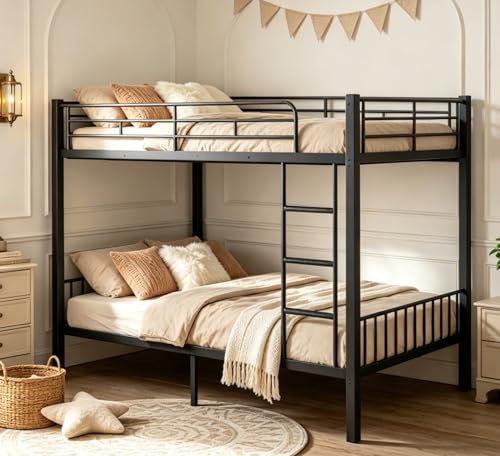
Heavy Weight Capacity Bunk Beds
Everything you need to know about choosing reinforced bunk beds rated for adults and larger sleepers — frame strength, weight ratings, safety features, and practical buying advice.
Why this guide matters: Standard bunk beds often carry surprisingly low per-bunk weight ratings that leave adults and larger sleepers with creaking frames and safety concerns. This guide explains what separates genuine heavy-duty bunk beds from ordinary models, so you can choose a reinforced frame that stays solid, quiet, and safe for years of nightly use.
What Makes a Bunk Bed “Heavy Weight Capacity”?
A heavy weight capacity bunk bed is engineered with a reinforced structure that distributes load across the entire frame rather than concentrating it on a few weak points. The term is not a marketing label — it reflects measurable design choices in materials, joinery, and support systems.
When shoppers research bunk beds, the per-bunk weight rating is the single most important number to verify. Entry-level models frequently support only around 200 to 250 pounds per sleeping surface. Mid-tier and high-end tier reinforced models commonly reach 400 to 500 pounds per bunk, while professional-grade and commercial-grade frames may be rated for 600 to 1,000 pounds or more per tier.
Core structural differences
- Frame gauge and material: Heavy-duty steel frames use thicker gauge tubing and reinforced corner brackets, while solid wood frames rely on dense hardwoods and mortise-and-tenon joinery.
- Support system: Slatted bases with closely spaced, thick slats — or metal grid platforms — spread weight evenly and prevent sagging.
- Fastening hardware: High-grade bolts, lock washers, and metal-to-metal connections resist loosening far better than simple screws or cam locks.
- Cross-bracing and center supports: Diagonal braces and center support legs dramatically improve stability and load capacity.
- Guardrails and ladder design: Wider guardrails, taller safety rails, and wide, securely hooked ladders are standard on heavy-duty models.
If you are comparing frame types more broadly, our guide to wood bunk beds and the overview of bunk beds with solid wood construction explain how timber frames differ from metal ones in strength and feel.
Understanding Weight Ratings Before You Buy
Weight ratings are usually stated per bunk — not per bed. A frame advertised as supporting 800 pounds may mean 400 pounds per sleeping surface, so always read the specification carefully. Reputable manufacturers list the rating on the product page and in the assembly manual.
| Tier | Typical Per-Bunk Rating | Best For | Frame Characteristics |
|---|---|---|---|
| Entry-level | 200–250 lbs | Children and teens | Thin tubular metal or lightweight wood; basic slats |
| Mid-range | 300–400 lbs | Average adults; light daily use | Thicker steel or solid wood; reinforced corners |
| High-end tier | 400–500 lbs | Larger adults; heavy daily use | High-grade steel, center supports, dense slats |
| Commercial-grade | 600–1,000+ lbs | Adults, hospitality, rental use | Reinforced steel frame, welded joints, heavy hardware |
Remember that the mattress weight counts toward the load. A thick memory foam or hybrid mattress can add meaningful weight to the top bunk, so factor that into your margin of safety. A good rule of thumb is to choose a frame rated at least 25 to 30 percent above the combined weight of the sleeper and mattress.
Frame Materials: Steel vs. Solid Wood
Both metal and wood can deliver excellent weight capacity — the difference lies in construction quality rather than material alone.
High-grade steel frames
Metal bunk beds built with thick-gauge steel tubing and welded joints offer exceptional strength-to-weight ratios. Reinforced corner plates and metal-to-metal bolt connections resist wobble and loosening. A quality steel frame with a rust-proof finish and weather-resistant coating is a long-term investment that handles heavy loads with minimal flex. Look for models with center support legs and cross-bracing.
Solid wood frames
Hardwood frames — particularly those using oak, maple, or high-density pine — deliver impressive load-bearing capacity when joined with mortise-and-tenon or dovetail techniques. Solid wood construction feels warmer and quieter than metal but generally requires more careful assembly. Our article on bunk beds with solid wood construction covers joinery and finish considerations in detail.
Materials to approach with caution
Particle board, MDF, and very thin tubular frames are common on entry-level models and rarely suited to heavy sleepers. They may be fine for occasional guest use or children, but for a primary adult bed, these materials tend to creak, flex, and loosen over time.
Safety Features That Matter on Heavy-Duty Bunk Beds
Higher loads demand stricter safety standards. The following features are non-negotiable on a bunk bed intended for adults or heavier sleepers:
- Full-length guardrails on the top bunk: At least 5 inches high and extending at least 5 inches above the mattress top, per common safety guidance.
- Wide, securely hooked ladder: Flat rungs and hooks that prevent the ladder from shifting under weight.
- Wall anchoring: Strongly recommended, especially for taller or top-heavy configurations. Kits are usually included.
- Metal-to-metal fasteners: Bolts and lock washers rather than screws alone, plus re-tightening after the first month of use.
- Center support legs and cross-bracing: Essential on full-over-full and queen configurations to prevent mid-frame sag.
- Non-toxic finish: Low-VOC or water-based finishes are preferable, especially in shared bedrooms.
If the bunk will share a room with a younger child, consider a bunk bed with a crib on bottom or the safer full-over-full low bunk beds that keep the top tier closer to the floor.
Which Bunk Configuration Fits Your Room?
Heavy-duty bunk beds come in several layouts, each with trade-offs in footprint, headroom, and load distribution.
Twin-over-twin
The classic configuration and the most space-efficient. Heavy-duty twin-over-twin frames rated for adults are widely available in steel and solid wood. Best for smaller rooms and guests.
Full-over-full
Two full-size sleeping surfaces offer generous comfort for adults. These frames must be built with substantial reinforcement, and center supports are essential. Our guide to full size bunk beds with mattress options explains what to look for.
Full-over-queen and twin-over-full
These asymmetrical layouts combine a larger lower bunk with a standard upper one. The full over queen bunk beds guide and the L-shaped twin over full overview walk through structural considerations for mixed-size bunks.
Loft and L-shaped configurations
Loft bunks free up floor space, while L-shaped and triple bunks suit larger families. For adult-oriented options, explore loft bunk beds for adults and triple bunk beds L-shaped models — just confirm per-bunk ratings carefully, as capacity varies more in complex layouts.
Space-saving alternatives
If floor space is tight, a bunk bed for small rooms or a loft bed for small rooms may be more practical. For mixed-use guest spaces, trundle beds with storage offer additional sleeping without a second tier.
Who Needs a Heavy Weight Capacity Bunk Bed?
High-capacity bunks are not only for larger sleepers. They are a sensible choice for anyone who values durability, quietness, and long service life:
- Adults sharing a room or guest space: Adult-rated frames eliminate the creaking and sagging common in child-rated bunks.
- Larger or taller sleepers: A frame rated well above your body weight provides comfortable safety margin.
- Rental properties and guest houses: Commercial-grade frames withstand frequent use and reduce maintenance.
- Multi-generational homes: Grandparents or adult family members using the top bunk need properly rated support.
- Heavy mattress users: Thick hybrid and memory foam mattresses add weight; a reinforced frame prevents sag.
- Families with active teens: Climbing, jumping, and roughhousing are far safer on a reinforced structure.
For adult-focused layouts and design inspiration, see the custom bunk beds for adults guide and the twin bunk beds for adults overview.
Feature Comparison: What to Prioritize
| Feature | Why It Matters for Heavy Loads | Priority |
|---|---|---|
| Per-bunk weight rating | The clearest indicator of load capacity; choose 30% above sleeper + mattress weight | Essential |
| Center support legs | Prevents mid-frame sag on full and queen sizes | Essential |
| Metal-to-metal fasteners | Resists loosening and wobble under repeated load | High |
| Wall anchoring kit | Improves stability, especially for tall frames | High |
| Full-length guardrails | Critical for top-bunk safety for all ages | Essential |
| Close-spaced thick slats | Distributes weight evenly and protects the mattress | High |
| Built-in storage or trundle | Adds function but must not compromise frame rigidity | Optional |
| Ladder with flat rungs | Comfortable and secure climbing for adults | High |
If storage is a priority, the bunk beds with storage and trundle collection shows how manufacturers integrate drawers without sacrificing structural integrity. For lighter-duty space savers, bunk beds with trundle options are worth reviewing.
Assembly, Placement, and Long-Term Care
Proper installation matters as much as the frame itself. Follow these practical steps to get the most from a heavy-duty bunk bed:
- Assemble on a level surface and use all supplied hardware — never substitute shorter bolts.
- Anchor to a wall stud where possible, especially for taller frames and top bunks.
- Re-tighten all fasteners after the first two to four weeks of use, then check every few months.
- Keep the top bunk clear of heavy overhead items and avoid attaching shelving to the frame.
- Use a mattress that fits snugly — gaps between mattress and guardrail reduce safety.
- Inspect welds, joints, and slats annually for cracks or loosening.
Placement also matters: allow clearance for the ladder, keep the frame away from ceiling fans and light fixtures, and ensure the room has adequate ventilation. A stable floor and level feet prevent uneven stress on the frame.
Common Mistakes to Avoid
- Confusing combined and per-bunk ratings. Always confirm the per-surface figure.
- Ignoring mattress weight. A dense mattress can consume a meaningful share of the load rating.
- Choosing particle board to save weight. Lightweight materials often sacrifice load capacity.
- Skipping wall anchoring. Tall, heavy frames benefit substantially from anchoring.
- Overlooking ladder security. A shifting ladder is a fall hazard for adults too.
- Not checking ceiling height. Top-bunk sleepers need comfortable sitting headroom.
Related buying guides on SleepWisePicks
- Heavy-duty furniture: what to look for in reinforced construction
- Bunk beds with a ladder and slide: safety and layout tips
- Bunk beds with a desk: combining sleep and study space
- Bunk beds with a couch on bottom: multi-use guest layouts
- Bunk beds with mattresses included: what to expect
- Children’s bunk beds: choosing safe frames for younger sleepers
- Full over queen bunk beds: structural considerations
- Loft bunk beds for adults: maximizing vertical space
Frequently Asked Questions
What weight capacity qualifies a bunk bed as heavy-duty?
Heavy-duty bunk beds typically support 400 pounds or more per sleeping surface, with premium and commercial-grade models often rated for 500 to 1,000 pounds per tier. Always verify the manufacturer’s stated per-bunk rating rather than a combined figure.
Can adults safely use heavy weight capacity bunk beds?
Yes. Adult-rated bunk beds with reinforced steel or solid wood frames, sturdy guardrails, and properly secured ladders are designed for adult use. Look for models explicitly rated for adults and check the per-bunk weight limit before purchase.
Which frame material is strongest for high weight capacity bunk beds?
High-grade steel and solid wood construction are the strongest options. Reinforced metal frames with thick gauge tubing and solid wood frames with mortise-and-tenon joinery offer the best durability. Avoid particle board and thin tubular frames for heavy sleepers.
Do heavy-duty bunk beds require special assembly or anchoring?
Most heavy-duty models require careful assembly with all provided hardware. Anchoring to the wall is strongly recommended for top-heavy or taller configurations. Follow the manufacturer’s instructions precisely and re-tighten fasteners after the first few weeks of use.
Is a metal or wood frame better for a heavy sleeper?
Both can work well when built to a high standard. High-grade steel frames tend to be more compact and rigid, while solid wood frames offer a quieter, warmer feel. Prioritize construction quality — gauge, joinery, and reinforcement — over material alone.
How much headroom should I leave above the top bunk?
Aim for at least 30 to 36 inches between the top mattress surface and the ceiling so an adult can sit up comfortably. Leave similar clearance between tiers if the lower bunk is also used by an adult.
Ready to Choose a Reinforced Bunk Bed?
Browse vetted heavy weight capacity bunk beds with verified per-bunk ratings, reinforced frames, and adult-friendly safety features.
Explore Recommended Options