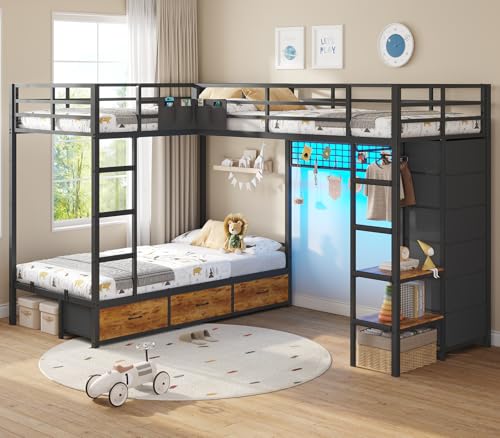
Triple Bunk Beds L Shaped: The Complete Buyer's Guide
Maximize your bedroom space with a smart corner configuration. Learn how L shaped triple bunk beds work, what to look for, and how to choose the safest, most durable option for your family.
Explore the GuideWhy choose an L shaped triple bunk bed? If you need to sleep three without sacrificing floor space, an L shaped triple bunk bed is one of the most efficient layouts available. By placing the third bed perpendicular to the main bunk stack, this design turns an awkward corner into a functional sleep zone — ideal for siblings sharing a room, guest rooms, vacation homes, or multi-child households.
What Is an L Shaped Triple Bunk Bed?
An L shaped triple bunk bed is a three-person sleeping arrangement built around a perpendicular footprint. Instead of stacking all three beds vertically, the design typically combines a traditional bunk bed (two beds stacked) with a third bed that extends outward at a 90-degree angle — forming an "L" shape when viewed from above. This configuration is sometimes called a corner triple bunk or a perpendicular triple bunk.
The result is a layout that fits neatly into a room corner, freeing up central floor space for play, study, or storage. Unlike a straight triple bunk, which can feel tall and narrow, the L shaped design distributes weight and visual mass more evenly, making the room feel less top-heavy.
Common L Shaped Triple Bunk Configurations
- Twin over twin bunk + twin extension: The most common layout for children and teens. Two twin beds stacked vertically, with a third twin bed extending perpendicular from the lower bunk.
- Full over full bunk + twin extension: A larger option for families who want more sleeping surface. The lower full bed and the extension bed can double as seating during the day.
- Twin over full bunk + twin extension: A balanced mid-tier configuration that mixes bed sizes for flexibility. See our guide to L shaped bunk beds twin over full for more detail on this layout.
- Loft bed + two perpendicular beds below: A space-maximizing variant where the upper bunk sits above one lower bed, and the third bed extends outward at floor level.
Key Benefits of L Shaped Triple Bunk Beds
Choosing an L shaped triple bunk bed is as much a spatial decision as a practical one. Here are the main advantages families and buyers consistently report:
- Efficient corner use: The perpendicular layout fills dead corner space that standard furniture often wastes.
- Three sleepers, one footprint: Sleeps three people without the vertical height of a straight triple bunk, which can feel cramped in rooms with low ceilings.
- Defined play or study zone: The open floor area created by the L shape is ideal for a desk, toy storage, or a reading nook.
- Flexible sleeping arrangements: Siblings, sleepovers, and guest rooms all benefit from three dedicated sleeping spots.
- Visual balance: The perpendicular design distributes the visual weight of the furniture, making the room feel less crowded than a tall stacked bunk.
Safety Features to Look For
Safety should be the first filter when comparing L shaped triple bunk beds. Because three people — often children — share the structure, the frame, guardrails, and ladder design matter more than on a single bed.
Essential Safety Checklist
- Full-length guardrails: Upper bunks must have guardrails on all open sides. Look for rails that extend at least 5 inches above the mattress surface.
- Sturdy, wide ladder: A ladder with flat, non-slip steps and a secure attachment point is safer than a narrow rung-style ladder.
- Reinforced frame joints: Corner brackets, metal-to-metal connections, and reinforced slats prevent wobble and premature wear.
- Weight capacity ratings: Check the manufacturer's stated weight limit for each bunk. Higher-tier models typically publish conservative, well-tested ratings.
- No sharp edges: Rounded corners and sanded surfaces reduce injury risk, especially in children's rooms.
- Age guidance: Most manufacturers recommend top bunks for children aged six and older. Follow this guidance strictly.
Materials and Build Quality
L shaped triple bunk beds are available in several material categories, each with distinct trade-offs in durability, weight, and maintenance. Use the table below to compare tiers and construction types — note that these are quality descriptors, not numeric ratings.
| Tier | Typical Material | Best For | Durability Notes |
|---|---|---|---|
| Entry-level | MDF, particle board, light metal tubing | Guest rooms, light use, temporary setups | Adequate for occasional use; check weight limits carefully |
| Mid-range | Solid pine, reinforced metal, engineered wood with metal joints | Family homes, daily use by children and teens | Solid build with good stability; regular hardware checks recommended |
| Premium | Solid hardwood, high-grade steel, reinforced slats | Long-term family use, heavier sleepers, adults | Durable construction designed to resist wobble over years of use |
| Luxury / commercial-grade | Hardwood with premium joinery, heavy-duty steel, commercial fixings | High-traffic homes, vacation rentals, adult use | Professional-grade stability and longevity; built for frequent use |
For buyers who prioritize natural materials and longevity, bunk beds with solid wood construction are a worthwhile investment. Metal frames, meanwhile, are often lighter and easier to disassemble — our overview of wood bunk beds compares the two approaches in more depth.
How to Choose the Right L Shaped Triple Bunk Bed
Use this step-by-step framework to narrow your options before you buy.
1. Confirm Your Room Dimensions
Measure the corner where the bed will sit, including ceiling height, window placement, and door swing. L shaped triple bunk beds need clearance on both legs of the L, plus space for the ladder. A room of at least 10 × 10 feet is the practical minimum for twin-size configurations; larger rooms suit full-size and queen-size variants.
2. Decide on Bed Sizes
Twin configurations are the most common and fit most children's rooms. If adults or older teens will use the bed, consider full-over-full or twin-over-full layouts. Our guide to L shaped bunk beds twin over full explains how the size mix affects comfort and clearance.
3. Choose the Orientation
L shaped bunks can be built as left-hand or right-hand configurations. Check which orientation matches your room's corner and door placement before ordering, and confirm the manufacturer offers the mirror version if needed.
4. Prioritize Safety and Build
Re-read the safety checklist above. Favor models with full guardrails, reinforced joints, and clearly published weight limits. If the bed will be used by adults, review options for twin bunk beds for adults and bunk beds full over queen, which offer larger sleeping surfaces.
5. Consider Storage and Extras
Many L shaped triple bunk beds integrate storage drawers or trundle options. If floor space is tight, a model with under-bed storage can replace a separate dresser. See bunk beds with storage and trundle and trundle beds with storage for related ideas.
6. Plan for Assembly and Maintenance
Triple bunks involve more parts than a single bed. Check whether assembly is included, how long it typically takes, and whether the frame can be disassembled for moving. Re-tighten hardware every few months, and inspect guardrails and ladders regularly.
L Shaped Triple Bunk vs. Other Triple Bunk Layouts
Understanding how the L shape compares to alternatives helps you choose with confidence.
| Layout | Footprint | Best For | Considerations |
|---|---|---|---|
| L shaped triple bunk | Corner-based, wider than tall | Medium to large rooms, siblings, low ceilings | Requires corner clearance; more floor area than a straight triple |
| Straight triple bunk | Narrow, tall stack | Small rooms with high ceilings | Taller climb; can feel top-heavy; check ceiling height |
| Loft bed + two beds below | Vertical with open floor beneath | Rooms needing a study or play zone | Higher top bunk; best for older children and teens |
| Futon bunk + trundle | Compact with convertible seating | Guest rooms and multi-use spaces | Less dedicated sleeping space per person |
For very tight rooms, bunk beds for small rooms and loft beds for small rooms may be more practical than a full L shaped triple. If you have a larger space, custom bunk beds for adults can be tailored to your exact dimensions.
Who Should Consider an L Shaped Triple Bunk Bed?
L shaped triple bunks suit a wide range of households, but they are especially practical for:
- Families with two or three children sharing a room — three dedicated beds without three separate frames.
- Guest rooms and vacation homes — maximize sleeping capacity in a single room.
- Multi-generational homes — flexible configurations can accommodate different age groups.
- Teen and adult shared spaces — premium and heavy-duty models support adult use.
- Small apartments and condos — the corner layout preserves central floor space.
If the room will also host younger children, explore children's bunk beds for age-appropriate safety features. For households that need extra sleeping capacity for visitors, a bunk bed with trundle can add a fourth spot without expanding the footprint.
Care and Maintenance Tips
- Inspect hardware monthly: Tighten bolts and screws, especially at the joints where the L extension connects to the main bunk.
- Check guardrails and ladders: Ensure rails are firmly attached and ladder steps are not loose or worn.
- Use appropriate mattresses: Follow the manufacturer's mattress thickness guidance — overly thick mattresses can reduce guardrail effectiveness.
- Clean according to material: Dust wood frames with a dry cloth; wipe metal frames with a damp cloth and dry immediately.
- Avoid jumping on bunks: Reinforce this rule with children to extend the life of the frame and reduce injury risk.
Frequently Asked Questions
What is an L shaped triple bunk bed?
An L shaped triple bunk bed is a space-saving furniture arrangement that sleeps three people using a perpendicular layout. It typically combines a bunk bed with a third bed extending outward at a 90-degree angle, forming an L configuration that fits neatly into corners.
Are L shaped triple bunk beds safe for children?
Yes, when properly assembled and used according to manufacturer guidelines. Look for models with full-length guardrails on upper bunks, sturdy ladders, and reinforced frames. Always follow age and weight recommendations, and never allow children under six on top bunks.
What room size works best for an L shaped triple bunk bed?
L shaped triple bunk beds work well in medium to large bedrooms, typically needing a footprint of at least 10 by 10 feet to allow safe access and clearance. They are ideal for corner placement, maximizing floor space for play or study areas.
Can adults use triple bunk beds L shaped?
Yes, many L shaped triple bunk beds are available in full-size and queen-size configurations designed for adults. Check weight capacity ratings and choose models built with heavy-duty materials for adult use.
Final Thoughts
An L shaped triple bunk bed is one of the smartest ways to sleep three in a shared room without turning the space into a tower of beds. By prioritizing safety features, matching the configuration to your room dimensions, and choosing a build tier that fits your household's daily use, you can turn an awkward corner into a practical, comfortable sleep zone that lasts for years.
If you are still comparing layouts, browse our related guides on triple bunk beds L shaped, bunk beds with a couch on bottom, and bunk beds with a crib on bottom to find the configuration that best matches your family's needs.