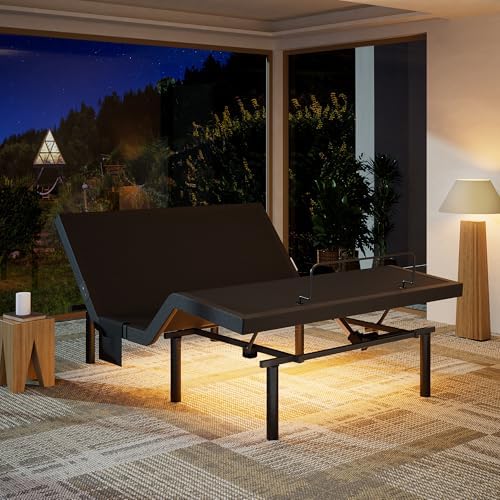
Beds That Accommodate Adjustable Bases
Everything you need to know before pairing an adjustable base with a bed frame — clearance, support, headboard fit, and the frame types that actually work.
Explore Compatible BedsWhy this guide matters: An adjustable base can transform how you sleep, but the wrong bed frame can block articulation, stress the mechanism, or void your warranty. If you already know you want an adjustable base, this guide helps you choose a bed that fits it properly — so you can buy with confidence.
What Makes a Bed Compatible With an Adjustable Base?
Not every bed frame is built to host an adjustable base. A compatible bed generally needs four things: an open interior, a flat support surface, adequate clearance for the base to articulate, and a headboard that does not interfere with the hinge line. Traditional beds with a built-in box spring or a fixed center rail often fail one or more of these requirements. If you are comparing frame styles, our guide to bed frames that are compatible with adjustable beds breaks down the options in more detail.
The base itself also matters. Some adjustable bases are designed to sit inside a standard frame, while others are standalone platforms with their own legs. Knowing which type you own — or plan to buy — is the first step toward picking the right bed. For a broader overview of frame categories, see our bed frames hub.
Compatibility Checklist: Four Things to Verify
1. Open Interior
The frame must have an open center so the base can sit inside or on top without obstruction. Beds with solid decking or integrated box springs are usually not suitable.
2. Flat Support Surface
Slats or a platform deck should provide a flat, stable surface. Uneven or widely spaced slats can cause the base to rock or flex.
3. Clearance for Articulation
Most bases need several inches of interior height and side clearance to raise the head and foot sections. Check the base manufacturer's specifications.
4. Headboard Clearance
A frame-mounted or wall-mounted headboard is ideal. Headboards attached to the base itself can limit articulation and should be avoided.
Frame Types That Work Well With Adjustable Bases
Several frame styles are commonly paired with adjustable bases. Platform beds are the most popular choice because they offer a flat, open surface and clean lines. Panel beds and upholstered frames can also work if the interior is open and the headboard attaches to the frame rather than the base. Storage beds are trickier — drawers or lift-up mechanisms may reduce interior clearance, so verify dimensions carefully. Our article on bed frames that fit adjustable beds covers the nuances of each style.
If you are furnishing a full bedroom around your adjustable base, matching pieces such as a bedroom set for adjustable beds can simplify the process. And if you plan to raise the base for easier entry and exit, bed risers for adjustable beds are worth considering — but only if the frame and base are both rated for the added height.
Sizing and Fit: Matching Base to Bed
Adjustable bases come in standard mattress sizes, from twin to California king. The bed frame's interior dimensions should match the base footprint with a small tolerance — typically a quarter to half an inch on each side. Oversized frames can let the base slide; undersized frames can pinch the mechanism. If you are choosing between sizes, compare the base's exact footprint against the frame's interior dimensions rather than relying on the mattress size alone. For larger rooms and split-king setups, beds larger than California king may be worth exploring.
Which Mattress Pairs Best With an Adjustable Base?
Flexible mattresses are essential. Memory foam, latex, and most hybrid mattresses bend well and are typically compatible with adjustable bases. Traditional innerspring mattresses with rigid coils — especially those designed for a box spring — may not articulate smoothly and can shorten the life of the base. If you are still deciding on a mattress, our bed-in-a-box comparison covers flexible options that work well with adjustable setups. Also confirm that your mattress warranty allows use on an adjustable base; some manufacturers require a specific foundation type.
Setup Tips for a Smooth Installation
- Remove the box spring. Adjustable bases replace the box spring entirely. Using both can interfere with articulation.
- Measure twice. Confirm interior frame dimensions, base footprint, and clearance before assembly.
- Check the headboard attachment. Frame-mounted headboards are best. If your headboard attaches to the base, verify it does not block the hinge line.
- Level the floor. A level surface prevents rocking and reduces stress on the base mechanism.
- Keep cords clear. Route power cords away from moving parts and pinch points.
Who Should Choose a Bed Compatible With an Adjustable Base?
Adjustable bases are popular with side sleepers, people managing back pain, readers, and anyone who wants to elevate their head or legs for comfort. They are also common in home-care settings, where a bed that supports a adjustable base can make daily routines easier. If you are shopping for a care environment, our guide to bed rails for home care may be relevant. For general comfort and support, see our recommendations for beds for people with back pain.
Common Mistakes to Avoid
The most frequent error is buying a frame with a fixed center rail or a solid deck — both can block the base. Another is ignoring headboard clearance, which leads to the base hitting the headboard when raised. Finally, some shoppers assume any platform bed works without checking interior height; a low-profile platform may not leave enough room for the base to articulate. Taking ten minutes to verify dimensions prevents most of these issues.
Frequently Asked Questions
Do adjustable bases need a special bed frame?
They need a frame with an open, flat platform or adequate slat support and enough clearance to articulate. Many standard platform beds work, but traditional box-spring setups and frames with fixed center rails often do not.
Can I put an adjustable base inside a regular bed frame?
Yes, if the frame has an open interior, a flat support surface, and sufficient clearance. Remove the box spring, verify interior dimensions against the base footprint, and confirm the headboard does not interfere with the hinge line.
Do I need a headboard with an adjustable base?
A headboard is optional but recommended. Choose one that attaches to the frame rather than the base, or use a wall-mounted headboard, so the base can articulate freely.
What mattress works best with an adjustable base?
Flexible mattresses such as memory foam, latex, and hybrid models work best. Traditional innerspring mattresses with rigid coils or a thick box spring may not bend properly.
How much clearance does an adjustable base need?
Requirements vary by model, but most bases need roughly 6 to 10 inches of interior height and a few inches of side clearance. Always check the base manufacturer's specifications.
Ready to Compare Compatible Beds?
Browse our curated selection of beds that accommodate adjustable bases, chosen for open interiors, solid support, and practical clearance.
View Recommended Options