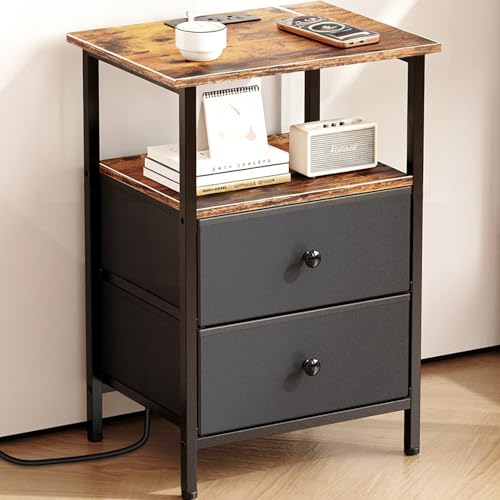
Bedside Table With USB Port: The Complete Buyer's Guide
Everything you need to know before choosing a nightstand with built-in charging — port types, charging speed, storage, safety, and how to match it to your bed and room.
Why a Bedside Table With a USB Port Makes Sense
A bedside table with a USB port combines two things most bedrooms already need: a place to set your nightly essentials and a convenient way to charge a phone, tablet, or smartwatch without hunting for an outlet. Instead of stretching a cable across the room or balancing a device on the edge of the mattress, you plug in at arm's reach and leave the device where it needs to stay overnight.
The practical benefit is real. Overnight charging is the norm for most people, and a bedside table with integrated ports removes the daily friction of plugging in, unplugging, and rerouting cables. For anyone who uses their phone as an alarm or reads on a tablet before sleep, keeping the device within reach while it charges is genuinely useful.
That said, USB nightstands vary widely in quality, port types, and storage. This guide walks through the decisions that matter so you can choose a model that fits your room, your devices, and your daily routine.
Types of USB Ports and Charging Speeds
The charging features on a bedside table are the first thing to evaluate. Not all "USB ports" are equivalent, and the difference can be significant for how fast and how well your devices charge.
Standard USB-A
The most common port on entry-level nightstands. Fine for overnight charging of phones and small devices, but usually slower than newer standards.
USB-A + USB-C
A mid-range combination that covers older and newer devices at the same time. USB-C ports on these models often support faster charging.
Fast-Charge USB-C
Premium models include higher-output USB-C ports rated for fast charging. Best if you rely on a modern phone or tablet that supports quick top-ups.
Wireless Charging Pad
Some high-end nightstands include an integrated wireless pad on the tabletop. Convenient for phones, but requires a compatible device.
Check the stated output of each port before buying. Higher-output ports charge faster, while lower-output ports still work well for slow overnight charging. If you want the option to charge two devices at once, look for a model with at least one USB-A and one USB-C port. For more charging-friendly nightstand options, our guide to a narrow bedside table with charging station covers compact models designed for tight spaces.
Choosing the Right Size and Height
Size and height matter as much as the charging features. A nightstand that sits too low or too high is awkward to use, no matter how good the ports are.
As a general guideline, the tabletop should sit level with or slightly below your mattress surface. Measure from the floor to the top of your mattress, then look for a table that lands close to that number. On a queen platform bed with a taller profile, you may need a taller nightstand; on a queen size bed with a lower frame, a shorter one will look more balanced.
Width and Depth
- Narrow nightstands typically measure under 18 inches wide. Good for tight gaps between the bed and the wall.
- Standard nightstands measure roughly 18 to 24 inches wide and suit most bedrooms.
- Wide nightstands exceed 24 inches and offer more storage, but need more wall space.
For a compact room, our guide to a narrow bedside table with charging station is a useful reference, and the overview of a bedside table set of 2 shows how matched pairs work for symmetrical bedroom layouts. If you prefer a smaller footprint, the small bedside table set of 2 covers options that fit tight spaces while keeping a consistent look.
Storage and Drawer Options
A bedside table with a USB port still needs to do the job of a bedside table: hold a lamp, a book, glasses, and whatever else you keep within reach at night. Look at the storage layout carefully, because drawers and shelves affect both usefulness and where the charging hardware can be placed.
Open Shelf Only
Simple and open. Good for a lamp and a book, less good if you want to hide small items or clutter.
One Drawer + Shelf
A practical balance for most bedrooms. The drawer hides small items; the shelf holds a lamp and current reading.
Two or Three Drawers
More storage for bedside clutter, but the drawer depth often limits what fits. Confirm internal dimensions before buying.
Mixed Open and Closed Storage
Drawers plus an open shelf or cubby. A flexible layout that works in shared bedrooms and guest rooms.
If the charging hardware is built into the back or side of the table, make sure it does not interfere with drawer operation. On compact models, the ports are often on the rear edge of the tabletop, which keeps cables out of the way but can make them slightly harder to reach.
Materials and Build Quality
Nightstands take less abuse than beds or dressers, but they still need to be sturdy enough to hold a lamp, a stack of books, and the occasional leaning device. Material choice affects durability, appearance, and how well the piece fits the rest of your bedroom furniture.
Engineered Wood
A common entry-level and mid-range choice. Lightweight, consistent finish, and often the most feature-rich for the tier.
Solid Wood
Premium materials with a solid build and a longer service life. Pairs well with matching bedroom furniture.
Metal Frame
Durable construction that suits modern and industrial bedrooms. Often used for slim, space-saving designs.
Mixed Materials
Wood with metal legs or accents. A flexible look that fits both modern and traditional bedroom styles.
Whichever tier you choose, look for these build details: reinforced drawer slides that close smoothly, a stable base that does not rock, and a cord channel or notch to route the charging cable neatly. Our guides to a pedestal bedside table, an art deco bedside tables, and a Japanese style bedside table show how these features vary across design styles, and country style bedside tables covers classic layouts that work well in bedrooms with wood furniture.
Safety and Electrical Details
A bedside table with built-in electrical components deserves the same attention as any other charging device in your home. Before buying, confirm the following:
- Certification labeling. The electrical components should carry the relevant safety certifications for your region.
- Cord length and routing. Make sure the power cord reaches a wall outlet without strain, and check that it does not run across walkways.
- Port accessibility. Ports should be reachable without moving the table, and should not be covered by a lamp or books.
- Heat management. Charging hardware should not get hot during normal use. Keep the area around the ports clear.
- No water exposure. Keep drinks and lotion away from the ports and the power cord.
If you use a lamp on the same tabletop, check the combined load capacity of the tabletop and confirm that the electrical components are rated for the devices you plan to plug in. Avoid stacking multiple power strips on a single nightstand, which can overload the circuit and defeat the point of a dedicated charging port.
Matching a USB Nightstand to Your Bedroom Layout
Nightstands work best when they feel intentionally placed. A few layout considerations help the table look and function as part of the room rather than an afterthought.
If you have a master bedroom with a wide bed, a symmetrical pair of matched nightstands creates balance. For a modern bedroom with a low platform bed, a slimmer nightstand that sits just below the mattress line keeps the look clean. In a small bedroom, a narrow table with a single drawer often fits better than a full set, and a reading bedside lamp with a compact base saves tabletop space.
Consider how the table interacts with other bedside elements. A purple bedside table or a purple bedside rug introduces a color accent that ties the bedside area together, and a bedside table set of 2 provides a matching pair for larger bedrooms. If the room is a studio apartment bed layout, a narrow bedside table with charging station is often the most space-efficient choice.
For a wider design perspective, our overview of modern bedroom furniture and the guide to small bedroom solutions cover how nightstands fit into the broader room plan. If you are furnishing a guest room or vacation property, vacation home furnishings offers guidance on practical, low-maintenance furniture choices.
Common Mistakes to Avoid
- Buying for looks only. Check port types, output, and cord routing before you commit to a design.
- Skipping the height check. A nightstand that does not match your mattress height is awkward to use, no matter how good the charging setup.
- Overloading a small table. A narrow nightstand with a large lamp and a stack of books leaves no room for a phone. Match the tabletop area to what you actually keep by the bed.
- Ignoring cord management. A visible tangle of charging cables undermines the convenience. Choose a model with a rear notch or built-in cable channel.
- Assuming all USB ports are equal. Check the stated output if you use fast-charging devices; standard ports will charge them more slowly.
Frequently Asked Questions
What should I look for in a bedside table with a USB port?
Check the charging output of the USB ports, whether they include USB-C, how the power cord is routed, and whether the table has enough drawer or shelf space for your nightly essentials. Also confirm the height matches your mattress so items are easy to reach from bed.
Are USB charging nightstands safe to use overnight?
Yes, when the nightstand is certified to relevant electrical safety standards and you follow the manufacturer's guidance. Avoid covering charging ports, keep the power cord away from heat sources, and do not exceed the stated output of the ports.
What height should a bedside table be?
A common guideline is for the tabletop to sit level with or slightly below your mattress surface, usually around 22 to 28 inches from the floor depending on your mattress height. Measure from the floor to the top of the mattress and look for a nightstand that lands close to that figure.
Do USB nightstands work with fast-charging phones?
Some do and some do not. Check the stated charging output of each port; fast-charging models are labeled with higher wattage. If fast charging matters to you, look specifically for USB-C ports rated for higher output rather than standard USB-A ports.
Ready to Choose Your USB Nightstand?
Use the checklist above to confirm port types, charging output, height, and storage. Once those details are clear, browsing the models below becomes a straightforward comparison.