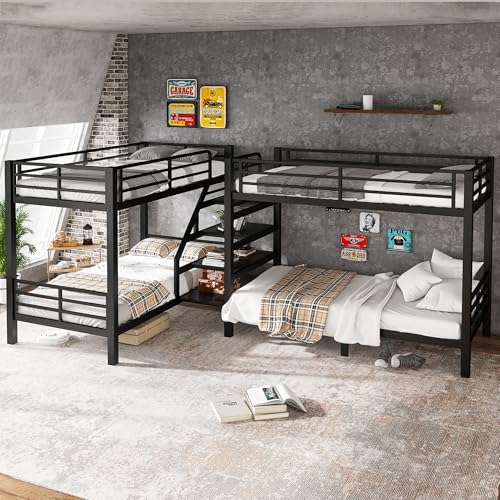
L Shaped Bunk Beds with Stairs: The Complete Guide
Smart space planning, safer access, and built-in storage — discover whether an L shaped bunk bed with stairs is the right sleeping solution for your home, and learn how to choose one with confidence.
EXPLORE RECOMMENDED MODELSWhy this guide matters: An L shaped bunk bed with stairs is more than furniture — it is a layout decision that affects safety, daily routine, and how much usable floor space your room retains. This guide explains the design logic, safety standards, storage configurations, and purchasing criteria so you can make an informed choice before you buy.
What Is an L Shaped Bunk Bed with Stairs?
An L shaped bunk bed with stairs is a multi-level sleeping system in which two beds are arranged perpendicular to each other, forming an "L" footprint. Instead of a vertical ladder, access to the upper bunk is provided by a built-in staircase. The combination of the L configuration and the staircase delivers three practical advantages: it reduces the overall floor footprint compared with two separate beds, it removes the climbing risk associated with ladders, and it often creates usable storage or play space beneath the upper level.
This format is a natural evolution of the broader category covered in our L shaped bunk beds guide, and it is especially relevant for families comparing stair-access designs against ladder-based alternatives. If you are weighing stair access specifically, this page concentrates on that variant.
L Shaped Bunk Bed with Stairs vs. Ladder Bunk Beds
Understanding the trade-offs between stairs and ladders helps you decide whether this design suits your household.
- Safety for younger children: Stairs with handrails and textured treads are generally easier and safer to use than vertical ladders, particularly for children under eight years old.
- Ease of use for adults and guests: Stair access is more comfortable for adults, older family members, and overnight guests who may find ladders awkward, especially in the dark.
- Space consumption: A staircase projects further into the room than a ladder. This is offset by the L configuration, which typically recovers floor area elsewhere. For rooms where every inch matters, compare with models designed specifically for compact spaces in our L shaped bunk beds for small rooms overview.
- Storage potential: Staircases can conceal drawers or cubbies, adding organisation that a ladder cannot provide.
- Installation: Stair-equipped models usually involve more assembly steps and benefit from two people during setup.
Who Should Choose This Design?
L shaped bunk beds with stairs serve a wide range of households. Consider the following use cases:
- Families with younger children: The staircase provides a safer route to the top bunk, and the L shape accommodates two sleepers without dominating the room. For age-specific considerations, see our L shaped children's beds resource.
- Teenagers and young adults: The design offers a semi-private arrangement, with one bed slightly separated from the other. Adult-capable models are discussed in our L shaped bunk beds for adults article.
- Guest rooms and holiday homes: The configuration sleeps two comfortably while retaining floor space for other furniture.
- Small bedrooms: The perpendicular layout is a proven strategy for compact rooms — see L shaped bunk beds for small rooms for layout diagrams and planning advice.
Key Design Features to Evaluate
1. Staircase Construction and Safety
The staircase is the defining component of this bed type. Look for wide, deep treads with non-slip surfacing, a continuous handrail on at least one side, and a landing platform at the top with a guardrail. Stair pitch should be gentle enough for a child to descend facing forward. Check that the stair unit is fixed to the bed frame rather than freestanding.
2. Frame Material and Weight Capacity
Solid wood and high-grade steel are the most durable frame materials. Engineered wood can be a reasonable choice in the mid-tier, provided the joints are reinforced. Always confirm the manufacturer's stated weight capacity for each bunk — adult-capable models typically specify higher limits and should be verified before purchase.
3. Guardrails and Entrapment Safety
The upper bunk should have guardrails on all open sides, with gaps small enough to prevent entrapment. Safety standards in most markets specify maximum gap dimensions; confirm that the model you consider complies with the relevant standard in your region. Mattress thickness should not exceed the manufacturer's recommendation, as an over-thick mattress can reduce guardrail effectiveness.
4. Storage Integration
Many stair units incorporate drawers or open cubbies, and some models add under-bed storage or shelving. If storage is a priority, our L shaped bunk beds with storage guide explores configurations in more depth. A slide-out option is another space-saving variation, covered in L shaped bunk beds with slide.
5. Mattress Compatibility
Check the recommended mattress height for both bunks. Standard twin and full mattresses are common, but some models require low-profile mattresses to maintain safe guardrail clearance. Confirm dimensions before ordering.
Quality Tiers: How the Market Is Structured
L shaped bunk beds with stairs are available across distinct quality tiers. The table below uses neutral tier descriptors rather than numeric figures, so the guidance stays valid over time.
| Tier | Typical Characteristics | Best For |
|---|---|---|
| Entry-level | Engineered wood or lighter steel frames, simpler stair units, limited storage, basic guardrails. Solid choice for the tier when the bed is used occasionally. | Guest rooms, holiday homes, short-term needs |
| Mid-range | Solid wood or reinforced steel, smoother stair mechanisms, integrated drawers, better hardware and finishes. Competitive within its class for daily use. | Families with children using the bed daily |
| Premium | Hardwood construction, precision joinery, generous storage, deeper stair treads, superior safety detailing and longer warranties. A long-term investment. | Primary bedrooms, adult use, high-frequency daily use |
| Luxury / flagship tier | Custom finishes, designer styling, commercial-grade hardware, maximum weight capacities, and premium safety engineering throughout. | Design-led interiors, commercial hospitality use |
As a general rule, mid-range models typically offer noticeably better stair stability and hardware durability than entry-level options, while premium tiers add refined finishes and higher weight ratings.
Room Planning: Will It Fit?
Because the L configuration projects in two directions, measure the room carefully before ordering. Key considerations:
- Footprint: Record the length and depth of both arms of the L, and add clearance for the staircase approach.
- Ceiling height: Allow adequate headroom for the upper bunk occupant and for standing near the bed. Check the manufacturer's recommended minimum ceiling height.
- Door and window clearances: Ensure the staircase does not obstruct doors, radiators, or window access.
- Circulation: Leave a comfortable walking path around the bed. Layout ideas for tight spaces appear in our small rooms guide.
- Alternative L formats: If you need a different bunk geometry, compare L shaped bunk beds twin over queen configurations, which combine a twin upper with a queen lower.
Pre-Purchase Checklist
- Confirm weight capacity for each bunk against intended users
- Verify the model complies with the applicable safety standard in your region
- Measure room footprint, ceiling height, and stair clearance
- Check recommended mattress thickness for both bunks
- Confirm stair tread depth, non-slip surface, and handrail presence
- Review assembly requirements and whether professional installation is advised
- Plan for two-person assembly and a clear workspace
Assembly and Maintenance Tips
Stair-equipped bunk beds are heavier and more complex than single beds, so assembly benefits from careful sequencing. Follow the manufacturer's instructions, tighten all hardware at the end, and re-check fixings after the first month of use. Periodically inspect stair treads for looseness and apply a non-slip treatment if the surface wears. Keep the area around the staircase free of clutter. If you are comparing overall bed designs before committing, our broader L shaped bunk beds category page and the L shaped loft beds guide provide useful context.
Frequently Asked Questions
What is an L shaped bunk bed with stairs?
It is a multi-level sleeping arrangement where the two beds are positioned at a right angle, and access to the upper bunk is provided by a built-in staircase rather than a ladder. This design maximizes floor space and improves safety.
Are L shaped bunk beds with stairs safe for children?
Yes, when properly constructed and installed, they are among the safest bunk bed designs. Stairs with handrails and non-slip treads are generally safer than ladders, especially for younger children. Always verify that the bed meets relevant safety standards and follow age recommendations.
What room size is best for an L shaped bunk bed with stairs?
These beds work well in medium to small bedrooms because the L configuration frees up floor space compared to two separate beds. A room with at least 10 by 10 feet of usable floor area typically accommodates one comfortably, though exact requirements vary by model.
Can adults use L shaped bunk beds with stairs?
Yes, many models are engineered with weight capacities and dimensions suitable for adults. Look for models labeled for adult use with reinforced frames, higher weight limits, and adequate headroom. Always check the manufacturer's specifications.
Do L shaped bunk beds with stairs include storage?
Many models incorporate storage into the staircase, such as drawers or cubbies built into each step. Some designs also feature under-bed storage, bookshelves, or trundle options. Storage-integrated stairs are a popular choice for maximizing organization in smaller rooms.
Final Thoughts
An L shaped bunk bed with stairs is a practical, safety-conscious investment for households that need to sleep two people in a compact footprint. Prioritise frame material, stair construction, guardrail compliance, and weight capacity over cosmetic details, and measure your room before ordering. With the right model, the design delivers comfortable sleeping, safer access, and useful storage in one integrated piece of furniture.
If you are still narrowing down your options, explore our related guides on L shaped bunk beds with trundle, L shaped bunk beds with slide, and L shaped bunk beds with storage to compare additional configurations.