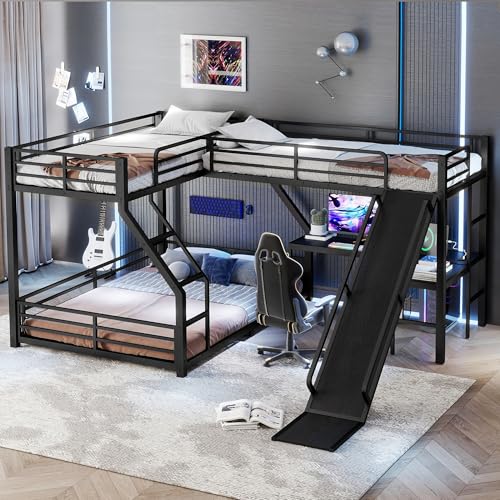
Why L-shaped bunk beds with a slide stand out: An L-shaped bunk bed with a slide combines three big wins for a family home — a compact L-shaped footprint that fits into a corner, an engaging slide that turns bedtime into playtime, and dual sleeping capacity without expanding the room's footprint. This guide explains exactly what to check before you buy.
What Is an L-Shaped Bunk Bed With Slide?
An L-shaped bunk bed with a slide is a multi-level sleeping system arranged at a 90-degree angle so that the two beds form an L instead of stacking directly on top of each other. The upper bed is typically accessed by a built-in ladder or an angled staircase, and a slide is attached to the upper platform so children can glide down to the floor. The lower bed can run parallel to the upper bed or extend outward at the corner, depending on the model.
The configuration is popular because it solves a real problem: in a small bedroom, a traditional bunk bed still occupies a rectangular footprint against one wall, while an L-shaped arrangement uses the corner and frees up the center of the room for play, study, or storage. Adding a slide takes the design a step further — the bed becomes a piece of play furniture that encourages children to use their bedroom actively rather than only at bedtime. If you are comparing this format against other corner-friendly options, our overview of L-shaped bunk beds explains the broader category, while this page focuses specifically on models that include a slide.
Most L-shaped bunk beds with a slide are sold for children's rooms and are built from solid wood, engineered wood, or metal. The slide is usually made of smooth plastic or laminated wood and mounts to the upper rail with a reinforced bracket. Because the slide projects outward, these beds need a little more open floor space than a plain bunk — a detail we cover in the measuring section below.
Key Benefits for Families
1. Space efficiency in a corner
The L shape hugs two walls, which means the bed's footprint uses dead corner space instead of consuming an entire wall. In a rectangular bedroom, this often leaves room for a desk, wardrobe, or play area that a straight bunk bed would crowd out.
2. Play value that supports routine
The slide transforms the bed into something children want to use. Parents consistently report that a slide helps with bedtime resistance because the bed feels like a reward rather than a restriction. For families who are also looking at play-and-sleep hybrids, our guide to L-shaped loft beds covers another popular format.
3. Two sleeping spaces without two beds
An L-shaped bunk bed with slide typically sleeps two children, making it a practical choice for siblings sharing a room or for sleepovers. The lower bed is usually a full-size or twin-size mattress, while the upper is a twin.
4. Better use of vertical and corner space
Because the upper bed sits at an angle to the lower, the corner beneath the upper platform often becomes usable storage or a small reading nook. Some models add drawers or shelving to that area — see our roundup of L-shaped bunk beds with storage for examples.
5. A natural transition bed
Families often move from a toddler bed to an L-shaped bunk with slide because the lower bed can be used first and the upper bed introduced later as the child grows. If you are planning that progression, our guide to kids beds covers size and safety stages in more detail.
Design & Configuration Options
Not all L-shaped bunk beds with slides are configured the same way. Understanding the main variations helps you match the bed to your room and your children's ages.
| Configuration |
How It Works |
Best For |
| Twin-over-twin L-shape |
Two twin beds at a 90-degree angle; upper accessed by ladder or stairs |
Siblings of similar age; smaller rooms |
| Twin-over-full L-shape |
Upper twin bed above a full-size lower bed arranged in an L |
Mixed-age siblings; sleepovers |
| Loft with slide |
Upper bed raised high with open play space below and a slide |
Play-focused rooms; single sleeper with guest space |
| Stairs + slide combo |
Angled staircase on one side, slide on the other |
Younger children who need easier access |
| Slide + trundle |
L-shaped bunk with a pull-out trundle for a third sleeper |
Stair access is worth considering if your children are young or if the upper bunk will be used nightly. Our comparison of L-shaped bunk beds with stairs explains the trade-offs between stairs and ladders in more depth. If a third sleeping spot matters, the L-shaped bunk beds with trundle format adds a pull-out bed without increasing the footprint.
Safety Features You Must Check
Safety is the single most important factor when buying any bunk bed, and the slide adds a few extra checks. Before purchasing, confirm the following:
- Guardrails on all sides of the upper bed: The upper bunk should have full-length guardrails on every open side, with a gap of no more than a few inches between the guardrail and the mattress top. The slide opening counts as an open side and must be guarded when the slide is not in use, or designed so the slide entrance is the only access point.
- Reinforced slide brackets: The slide attaches to the bed frame and carries a child's full weight plus motion. Look for metal reinforcement plates, through-bolts rather than screws alone, and a slide rated for the same weight as the upper bunk.
- Stable, wide base: An L-shaped frame is inherently more stable than a straight bunk because it braces against two walls, but confirm the frame has cross-bracing and a low center of gravity. Heavy-duty construction matters more than decorative styling.
- Ladder or stair attachment: The ladder should hook over the bed rail and sit flat on the floor, not lean loosely. Stairs should have handrails and non-slip treads.
- Non-toxic finish: Children's furniture should use low-VOC or water-based finishes. Check for certifications on the product listing.
- Weight limits: Each sleeping surface has its own weight rating. Confirm both the upper and lower bed ratings before purchase, and never exceed them.
- Slide exit clearance: The bottom of the slide must have a clear, padded landing zone with no sharp furniture edges nearby.
Practical tip: If your children are under six years old, pediatric guidance generally recommends against using the top bunk. The slide is fun, but it does not change the age guidance for upper-bunk sleeping. Many families use the lower bed first and open the upper bed later.
Age & Weight Suitability
L-shaped bunk beds with slides are most commonly intended for children aged six and older for the upper bunk, with the lower bunk suitable for younger children once they have outgrown a toddler bed. Weight ratings vary by model and material — metal and solid-wood frames generally carry higher ratings than engineered-wood frames — so always read the manufacturer's specification for each sleeping surface.
For teenagers and adults, standard children's bunk beds are usually not appropriate. If you need a larger L-shaped format for older users, our guide to L-shaped bunk beds for adults covers heavier-duty options, and the L-shaped bunk beds for small rooms page addresses compact adult-friendly layouts.
Measuring Your Room Before You Buy
The L shape saves space, but the slide adds a projection that many buyers underestimate. Measure carefully using this checklist:
- Wall length for each arm of the L. Measure both walls that will hold the bed. Each arm of the L needs enough length for the mattress plus frame, and the corner must be square.
- Slide projection. Measure from the upper bed rail to the end of the slide, then add clearance for the landing zone. This distance is typically the largest single measurement in the room plan.
- Ceiling height. The upper bunk plus a child sitting up needs clearance. Confirm the model's total height fits your ceiling with room to spare, especially if the bed has a tall headboard or canopy posts.
- Door and window clearance. The slide should not block a door swing, a window, or a radiator. Keep the slide landing away from hard flooring edges.
- Ladder or stair zone. Leave open floor space at the foot of the ladder or stairs so a child can step off safely.
- Mattress thickness allowance. Guardrail height is measured from the mattress top, so a thicker mattress reduces the effective guardrail. Check the maximum mattress thickness the bed supports.
If space is genuinely tight, compare the slide model against the small-room L-shaped bunk beds options, which often trade the slide for a lower profile. Families with two children of different sizes may also want to look at twin-over-queen L-shaped bunk beds, which give the lower sleeper a larger mattress.
Understanding Product Tiers
L-shaped bunk beds with slides sit across several market tiers. Because specifications matter more than labels, here is how the tiers generally differ in build and features — use this to match a model to your needs.
| Tier |
Typical Build |
Best For |
| Entry-level tier |
Engineered wood or lighter metal frame, basic ladder, standard slide with plastic brackets |
Occasional use, guest rooms, first bunk bed for a growing child |
| Mid-range tier |
Solid wood or reinforced metal frame, through-bolted slide brackets, full guardrails, optional stairs |
Daily use by two children; the most common family choice |
| Premium tier |
Hardwood frame, commercial-grade hardware, integrated storage, premium slide with extended landing |
Long-term investment; families planning to pass the bed between children |
| Luxury tier |
Custom hardwood, themed design, professional-grade fasteners and finishes |
Statement bedrooms; buyers who prioritize design and longevity |
A well-specified mid-range model is usually the sweet spot for daily family use: it offers durable construction and reinforced slide mounting without the decorative overhead of the top tiers. Entry-level models can work well for occasional use or a second bedroom, but check the slide bracket design carefully — that is where lighter builds cut corners first.
Materials & Build Quality
Three materials dominate this category, each with trade-offs:
Solid wood
Solid wood frames (pine, rubberwood, or hardwood) are the most common choice for premium and mid-range L-shaped bunk beds with slides. They absorb motion well, hold fasteners securely, and can be refinished. Look for kiln-dried wood and joinery that uses bolts rather than staples at stress points.
Engineered wood
Engineered wood (MDF or particleboard with laminate) is common in entry-level and some mid-range models. It offers a smooth, uniform finish and consistent dimensions, but it is heavier per unit of strength and less forgiving of moisture. Check that slide brackets are bolted through a reinforced panel rather than screwed into the panel face.
Metal
Metal frames — typically steel with a powder-coated finish — are durable and easy to clean. High-grade steel with rust-proof finish is the standard to look for. Metal models often have a slimmer profile, which helps in tight corners, but they can be noisier than wood unless the frame includes vibration dampers or tight-fitting joints.
Across all materials, the details that signal quality are consistent: through-bolts at the slide mount, cross-bracing on the lower frame, non-slip ladder treads, and a finish that is smooth to the touch with no exposed sharp edges.
Choosing the Right Mattress
The mattress you pair with an L-shaped bunk bed affects both comfort and safety, because guardrail effectiveness depends on mattress height. Key rules:
- Respect the maximum thickness. Most bunk beds specify a maximum mattress thickness so the guardrail stays above the recommended height. A thicker mattress can leave a child too close to the top of the rail.
- Firm is safer on the upper bunk. A firmer mattress reduces the chance of a child rolling toward the rail and keeps the sleep surface stable on the platform.
- Match mattress size to each bunk. Twin-over-twin models need two twin mattresses; twin-over-full models need a twin and a full. Do not substitute a larger mattress into a smaller frame.
- Consider breathability. Children sleep warm, and bunk beds trap heat near the ceiling. A breathable foam or hybrid mattress helps.
If you are also outfitting the rest of the room, our guides to latex mattresses and linen sheets cover comfort and breathability in more depth. For the lower bunk, a mattress protector is worth adding given how often children use the bed as a play surface.
Assembly, Care & Maintenance
L-shaped bunk beds with slides are larger and heavier than standard beds, so assembly deserves planning:
- Assemble in the room. Fully assembled L-shaped frames often will not fit through a standard doorway. Build the bed in its final position or assemble the two arms separately and join them in place.
- Two adults minimum. Upper platforms and slide assemblies are awkward to lift alone; a second person prevents both injury and frame damage.
- Re-tighten after two weeks. New furniture settles. Check every bolt, especially the slide brackets, after the first two weeks of use and then seasonally.
- Inspect the slide regularly. Check the mounting brackets, the slide surface for cracks, and the landing zone for wear. Tighten any loosened fasteners immediately.
- Clean according to finish. Painted and laminate surfaces wipe clean with a damp cloth; solid wood benefits from occasional furniture polish. Avoid soaking engineered wood.
Keeping the area around the slide clear is part of maintenance, not just tidiness — a clear landing zone is a safety feature. If the room also holds toys and books, the storage ideas in our kids bedroom storage ideas guide help keep the floor open.
Ready to compare models? Browse our recommended L-shaped bunk beds with slide below and check availability for your room size.
See Recommended Models
Frequently Asked Questions
What age is an L-shaped bunk bed with slide suitable for?
Most manufacturers recommend the upper bunk for children aged six and older, and the lower bunk for younger children once they have outgrown a toddler bed. Always check the specific model's age guidance and weight limits, and follow pediatric advice against upper-bunk use for children under six.
How much floor space does the slide need?
The slide projects outward from the upper bed rail, so it needs clear floor space equal to its length plus a landing zone. Measure the slide projection and add clearance for the child to stand up at the bottom. This is usually the largest measurement in the room plan, so measure before ordering.
Can an L-shaped bunk bed with slide be used by adults?
Standard children's models are not designed for adult weight. Adults should look at dedicated adult-rated L-shaped bunk beds with higher weight capacities. Our guide to L-shaped bunk beds for adults covers heavier-duty formats.
Is the slide removable?
Many models have a slide that can be detached from the upper rail when not in use, and some can be mounted on either side. Check the product specification — removable slides usually need the guardrail to cover the opening once the slide is off.
What mattress thickness is safe on the upper bunk?
Follow the manufacturer's maximum mattress thickness specification. The guardrail must remain above the recommended height relative to the mattress top. A thicker mattress reduces effective guardrail height and is a common safety mistake.
Ladder or stairs — which is better with a slide?
Stairs are easier and safer for younger children and for nightly use; ladders take less floor space and suit older children. With a slide already projecting into the room, a ladder often fits more easily, but stairs remain the better choice if the upper bunk is used every night.
How do I know the frame is sturdy enough?
Look for through-bolted joints at stress points, cross-bracing on the lower frame, metal reinforcement plates at the slide mount, and weight ratings listed for each sleeping surface. Solid wood and high-grade steel frames with rust-proof finish generally offer the most durable construction.
Can I put the slide on either side of the bed?
Many models offer reversible slide mounting, but not all. This matters because the slide needs a clear landing zone and should not block a door or window. Check the specification or assembly instructions before ordering.
Final checklist before you buy: measure both walls of the corner and the slide projection; confirm ceiling height; verify upper-bunk age guidance and weight ratings; check guardrail height relative to your planned mattress thickness; confirm the slide landing zone is clear; and read the assembly requirements. If you are still deciding between formats, compare this bed with the L-shaped beds for twins and L-shaped children's beds options before committing.