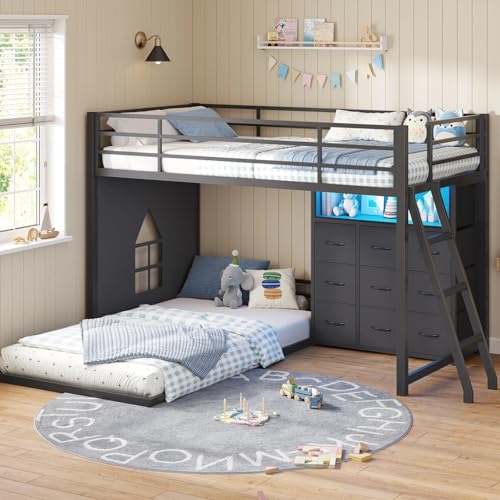
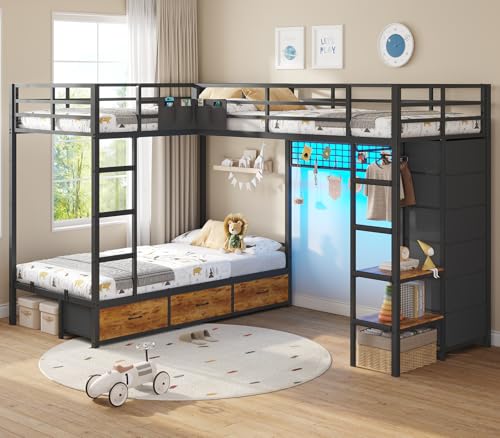
What Are L Shaped Bunk Beds?
L shaped bunk beds are a space-savvy variation of traditional bunk beds. Instead of stacking one mattress directly above the other, the two sleeping tiers are arranged at a right angle, creating an "L" footprint. The upper bunk typically sits over one end of the lower sleeping area, while the rest of the lower bed extends outward along the adjacent wall. This corner-friendly design turns a dead corner into usable sleeping space and often frees up floor area for play, study, or storage.
Many models are available for children and adults. Families with growing kids often pair an L shaped bunk bed with a staircase-equipped design for easier access, while adults and teens may prefer the openness of an L shaped loft bed that adds a desk or seating area underneath.
If you are still weighing the general style against other options, our overview of L shaped beds for twins is a useful starting point, and our broader guide to kids beds covers additional layout ideas for shared rooms.
Key Benefits of the L Configuration
An L shaped bunk bed solves several common bedroom problems at once. Because the upper and lower sleeping areas are offset, the room feels less boxed-in than with a classic stacked bunk. The corner placement often leaves a clear central floor zone, which is especially valuable in narrow bedrooms and shared spaces.
- Space efficiency: Uses the corner rather than a full wall run, preserving floor space for daily activities.
- Flexible sleeping capacity: Houses two sleepers without the visual weight of a tall stacked bunk.
- Better airflow and daylight: The offset layout keeps the lower sleeping area less enclosed.
- Design versatility: Works well in shared kids' rooms, teen bedrooms, guest rooms, and small apartments.
- Storage potential: Many designs include under-bed drawers, built-in shelving, or a desk beneath the lofted section.
For compact spaces, the benefits are amplified. Our guide to L shaped bunk beds for small rooms explores layouts that make the most of every square foot, while models with built-in storage add function without extra furniture.
Popular Configurations & Layouts
L shaped bunk beds come in several configurations, each suited to a different room and user profile. The right choice depends on ceiling height, available floor area, the age of the sleepers, and how often the upper bunk will be used.
Twin Over Twin
The classic arrangement: a twin upper bunk offset over a twin lower bed. This works well for siblings sharing a room and keeps the footprint compact. Many twin-over-twin models are convertible, so the beds can later be separated.
Twin Over Full
Ideal when an older child or adult needs a larger lower sleeping surface. Twin-over-full L shaped bunks offer more room on the lower tier while still preserving the corner layout.
With Stairs or a Slide
A staircase improves access and often incorporates extra storage steps. Families with younger children frequently choose L shaped bunk beds with stairs for safer climbing. For a playful touch, a model with a slide adds a fun exit point without sacrificing the bed's structural footprint.
With Trundle or Storage
A trundle adds a third sleeping surface for sleepovers, while under-bed drawers keep clothes and bedding organized. Explore L shaped bunk beds with trundle and storage-focused designs to match your room's needs.
Loft-Style and Adult Versions
Lofted L shaped designs elevate one bed to create room for a desk, seating, or storage below. Adult-friendly and teen-oriented options are covered in our guide to L shaped bunk beds for adults and the separate twin-over-queen configuration.
Safety Features to Prioritize
Because L shaped bunk beds involve an elevated sleeping surface, safety should be the first filter in your decision. Look for full-length guardrails on the upper bunk, with no gaps large enough for a child to slip through. The ladder or staircase should attach securely to the frame and have anti-slip steps.
- Guardrails: Full-length rails on the upper bunk with secure locking mechanisms.
- Sturdy access: A wide, firmly attached ladder or staircase with textured steps.
- Weight ratings: Check the manufacturer's weight limit for each tier and stay within it.
- Stable assembly: Reinforced joints, center support legs, and anti-tip hardware for wall anchoring where recommended.
- Certification: Confirm the model meets recognized safety standards for bunk beds.
Also consider ceiling height and fan clearance above the upper bunk, and avoid placing the bed directly under a ceiling fixture. For families comparing styles, our guide to L shaped children's beds highlights child-focused safety details.
Size & Mattress Compatibility
Most L shaped bunk beds are built around standard mattress sizes. Twin and full mattresses are the most common, though twin-over-queen and other combinations exist. Always confirm the manufacturer's recommended mattress thickness—bunk beds typically require a thinner profile mattress so the guardrail remains effective.
| Configuration | Typical Mattress Sizes | Best For |
|---|---|---|
| Twin over Twin | Twin (upper and lower) | Siblings sharing a room |
| Twin over Full | Twin (upper), Full (lower) | Teens and mixed-age siblings |
| Twin over Queen | Twin (upper), Queen (lower) | Adults and guest rooms |
| Loft L Shape | Twin or Full | Teens and adults wanting under-bed space |
Measure your room before ordering, including doorways and stairwells, so the assembled frame can be delivered and placed. If the room is tight, L shaped twin beds for small rooms and twin beds with drawers offer space-conscious choices.
Frame Materials & Build Quality
The frame material affects stability, longevity, and the overall look of the room. Solid wood and high-grade steel are the most common options, while engineered wood and metal hybrids appear in mid-range models.
- Solid wood: Warm appearance, strong joinery, and good long-term durability. Pine, oak, and rubberwood are frequent choices.
- Metal: High-grade steel frames are heavy-duty and stable, and they often feature cleaner lines suited to modern rooms.
- Engineered wood: Common in entry-level and mid-range designs; check that the panels are reinforced at stress points.
- Upholstered accents: Some premium models include padded panels for a softer, more finished look.
Independent reviews matter here. Look for models described as having reinforced slats, center support legs, and a solid build. Rust-proof finishes help metal frames hold up over time, and long-term investment consideration should include the availability of replacement parts and a clear warranty.
Who Should Choose an L Shaped Bunk Bed?
L shaped bunk beds suit a wide range of households. They are particularly valuable when two people share a room and floor space is limited, or when a family wants to add sleeping capacity to a guest room without crowding it.
- Families with children: Siblings close in age often share happily, and the corner layout keeps the play area open.
- Teens: A lofted L shape creates room for a desk or seating beneath the upper bunk.
- Small apartments and guest rooms: Doubles sleeping capacity in compact footprints.
- Vacation homes and cabins: Efficient for accommodating multiple guests in one room.
If you are furnishing a shared kids' room, pair the bed with kids bedroom storage ideas to keep clutter controlled. For small, design-forward rooms, Japanese beds and Japan beds on floor layouts offer a contrasting low-profile approach worth comparing.
Buying Checklist
Before you commit, run through this practical checklist. It helps you avoid returns, assembly headaches, and mismatched mattress issues.
- Measure the room and ceiling: Confirm the assembled footprint and required headroom above the upper bunk.
- Confirm mattress sizes: Verify the exact mattress dimensions and maximum thickness recommended for the model.
- Check safety features: Guardrails, ladder or stair attachment, and weight ratings for each tier.
- Review assembly requirements: Check whether tools are included and whether professional assembly is recommended.
- Plan storage: Decide between under-bed drawers, stairs with built-in cubbies, or a separate storage solution.
- Read the warranty: Frame warranty length and replacement part availability indicate long-term support.
- Consider future flexibility: Convertible designs that separate into individual beds extend the product's useful life.
Pro tip: If two children will share the room for years, a convertible twin-over-full L shaped bunk is often the most adaptable choice. The larger lower tier accommodates a growing teenager, while the upper twin stays useful for a younger sibling or guest.
Frequently Asked Questions
What are L shaped bunk beds?
L shaped bunk beds are a corner-friendly bunk configuration where the two sleeping levels are arranged at a right angle rather than stacked directly on top of each other. This layout frees up floor space and often includes a built-in ladder or staircase.
Are L shaped bunk beds safe for children?
Yes, when properly assembled and used according to the manufacturer's guidelines. Look for models with full-length guardrails, a sturdy ladder or staircase, and certification to recognized safety standards. Always check the weight limits for each tier.
What is the difference between L shaped bunk beds and standard bunk beds?
Standard bunk beds stack one mattress directly above the other, while L shaped bunk beds offset the upper and lower sleeping areas at an angle. The L configuration typically creates more usable floor space and can fit into corners more efficiently.
Can L shaped bunk beds be separated into two beds?
Many L shaped bunk bed designs are convertible, allowing you to separate them into a standalone loft bed and a standard bed. This flexibility is helpful as children grow or when bedroom layouts change.
Ready to Find Your Perfect L Shaped Bunk Bed?
Browse our curated selection of L shaped bunk beds with safety-certified frames, space-saving layouts, and configurations for kids, teens, and adults.
Explore Recommended Options