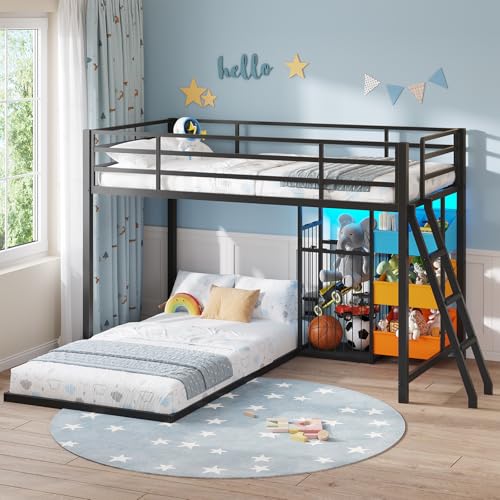
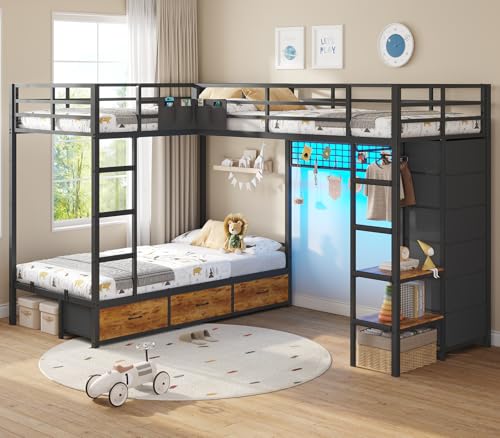
L Shaped Bunk Beds for Small Rooms: The Smart Space-Saving Solution
Maximize every square foot with a corner-friendly bunk layout. Learn how L shaped bunk beds free up floor space, add storage, and keep siblings happy in compact bedrooms.
Explore Top PicksWhy L shaped bunk beds work in tight spaces: Instead of stacking beds straight up, an L shaped design turns a corner into two sleeping zones. That leaves the middle of the room open for desks, play, or wardrobes — a genuine advantage in small bedrooms, guest rooms, and shared kids' rooms.
What Exactly Is an L Shaped Bunk Bed?
An L shaped bunk bed places two sleeping platforms at a 90-degree angle. The upper bunk typically sits above one side while the lower bunk extends perpendicular to it, forming an L footprint that hugs the corner of a room. Unlike a traditional straight bunk, the sleeper on the bottom is not directly beneath the top bunk, which can feel more open and less enclosed.
This configuration is closely related to other space-saving designs such as standard L shaped bunk beds and L shaped loft beds, which combine sleeping space with a raised play or study area. For very small rooms, the L shape is often the most efficient way to sleep two people without blocking windows or doors.
Key Benefits of L Shaped Bunk Beds in Small Rooms
- Corner efficiency: Utilizes the awkward corner that a standard bed leaves empty, freeing up central floor space.
- Separate sleep zones: Each sleeper gets their own orientation, which can reduce the feeling of being boxed in.
- Storage integration: Many models include built-in drawers, shelves, or a trundle, further reducing the need for extra furniture.
- Flexible room layout: The open side of the L can host a desk, a reading nook, or a wardrobe.
- Good for siblings: Two children can share a small room while keeping distinct personal spaces.
If you are furnishing a compact kids' room, pairing an L shaped bunk with smart kids bedroom storage ideas can transform a cramped space into a functional, tidy retreat.
Common Layouts and Configurations
L shaped bunk beds come in several variations, and the right one depends on ceiling height, room shape, and who will be sleeping in them.
| Configuration | Best For | Space Consideration |
|---|---|---|
| Twin over queen L shaped bunk | Mixed-age siblings or a teen sharing with a younger child | Needs a longer wall on one side; larger footprint than twin-over-twin |
| L shaped bunk with stairs | Younger children and families who value safety | Stairs add depth; often include drawers for extra storage |
| L shaped bunk with storage | Rooms with no space for a separate dresser | Drawers or shelves are built into the frame, so measure clearance |
| L shaped bunk with trundle | Guest rooms and sleepover-friendly kids' rooms | Trundle pulls out into floor space; keep that zone clear |
| L shaped bunk with slide | Playful children's rooms with a bit more floor area | The slide requires open space at the end of the lower bunk |
How to Choose the Right L Shaped Bunk Bed
Before you commit, work through these practical checks. They will save you from a return and a frustrating assembly day.
1. Measure the Room Honestly
Sketch the room on paper and mark doors, windows, radiators, and ceiling slopes. An L shaped bunk needs two adjacent walls of sufficient length. Leave at least a small gap around the frame for airflow and cleaning.
2. Check Ceiling Height
The upper bunk needs enough headroom for the sleeper to sit up without hitting the ceiling. If the room has a sloped ceiling, position the taller side against the high wall. Models such as L shaped twin beds for small rooms are designed with lower profiles for exactly this scenario.
3. Decide on Access: Ladder or Stairs
Ladders conserve floor space; stairs are safer for young children and often include storage. If the room is truly tiny, a ladder model with a sturdy handrail is usually the more practical choice.
4. Plan for Mattresses
Bunk beds specify a maximum mattress height to keep guardrails effective. A standard 6 to 8 inch bunk mattress is typical. If you are also shopping for the rest of the room, our guide to kids beds covers mattress and frame pairings in more detail.
5. Consider the Sleepers' Ages
Young children should always use the lower bunk until they are old enough for the upper level. Teens and adults may prefer a larger configuration, such as L shaped bunk beds for adults or a queen-inclusive design.
Quick Checklist Before Buying
- Two adjacent walls long enough for each platform
- Enough ceiling height above the upper bunk
- Clear floor space for ladder, stairs, or trundle pull-out
- Full-length guardrails on the top bunk
- Weight rating suitable for each sleeper
- Storage needs: drawers, shelves, or trundle
- Assembly space and tools available
Understanding Quality Tiers
L shaped bunk beds are available across a range of build qualities. Rather than focusing on numbers, think about where each tier sits in the market and what it typically delivers.
- Entry-level tier: Basic metal or composite frames with straightforward assembly. Suitable for light use and younger children.
- Mid-range tier: Solid wood or reinforced metal construction, better guardrails, and optional storage. A balanced choice for most families.
- Premium tier: Hardwood frames, smoother finishes, integrated stairs with drawers, and more refined joinery.
- Luxury tier: Furniture-grade craftsmanship, custom finishes, and designs intended as long-term investments for the home.
For most small-room applications, the mid-range tier offers the best balance of durability, safety features, and design flexibility. Higher tiers make sense when the bed will be used for many years or needs to match existing furniture.
Safety Considerations for L Shaped Bunk Beds
Bunk bed safety is largely about correct assembly and sensible use. Keep these points in mind:
- Always attach the bed to the wall using the supplied anti-tip hardware.
- Check that the upper bunk has full-length guardrails on all open sides.
- Ensure the ladder or stairs are firmly fixed and reach the floor.
- Follow the manufacturer's age and weight recommendations.
- Re-tighten fasteners after the first few weeks and periodically thereafter.
- Keep the area around the bed clear, especially near ladders and trundles.
If you are setting up a room for younger children, combine these safety measures with age-appropriate furniture choices. Our kids beds guide includes additional notes on low-height options and guardrail standards.
Styling a Small Room Around an L Shaped Bunk
The L shape creates natural zones. Use the open corner for a small desk or a reading chair, and keep the color palette light to make the room feel larger. A few well-placed indoor plants add life without taking up floor space. If the room has an industrial or modern theme, browse industrial bedroom ideas for complementary textures and finishes.
For storage that does not crowd the bed, consider slim drawers under the lower bunk and wall-mounted shelves above the desk area. Keeping the central floor clear is the single biggest factor in making a small room feel comfortable.
Related Space-Saving Alternatives
If an L shaped bunk is not quite right, these related options are worth exploring:
- L shaped twin beds with storage — ideal when two separate twins are preferred but space is tight.
- L shaped twin beds with drawers — adds hidden storage without a separate dresser.
- L shaped children's beds — scaled for younger sleepers.
- JR loft bunk beds — a lower-height loft option for smaller children.
- L shaped beds for twins — a broader look at twin-focused L configurations.
Frequently Asked Questions
What is an L shaped bunk bed and how does it save space?
An L shaped bunk bed arranges two sleeping platforms at a right angle rather than stacking them directly on top of each other. This corner-hugging layout frees up the center of a small room for play, study, or storage, while still giving two people separate sleeping spaces.
Are L shaped bunk beds safe for children?
Yes, when properly assembled and used as intended. Look for full-length guardrails on the upper bunk, a secure ladder or built-in stairs, and a frame rated for the weight of each sleeper. Always follow the manufacturer's age and weight guidelines and check fasteners periodically.
Can an L shaped bunk bed fit in a room with a sloped ceiling?
Often yes. Because the two sleeping platforms sit at different heights and orientations, you can sometimes position the lower bunk under the slope while the upper bunk sits against the taller wall. Measure ceiling height at both corners before choosing a model.
What mattress thickness works best with L shaped bunk beds?
Most bunk beds specify a maximum mattress height so the guardrail stays effective. A standard bunk mattress around 6 to 8 inches thick usually works well. Avoid extra-thick mattresses on the upper bunk, as they can reduce guardrail protection.
Should I choose a ladder or stairs for an L shaped bunk bed?
Stairs are easier for younger children and often include built-in storage drawers. Ladders take up less floor space and suit older kids and teens. If the room is very tight, a ladder model preserves more usable floor area.
Ready to Reclaim Your Floor Space?
Browse our recommended L shaped bunk beds for small rooms below. Each pick is selected for space efficiency, safety features, and practical storage.
See Recommended Models