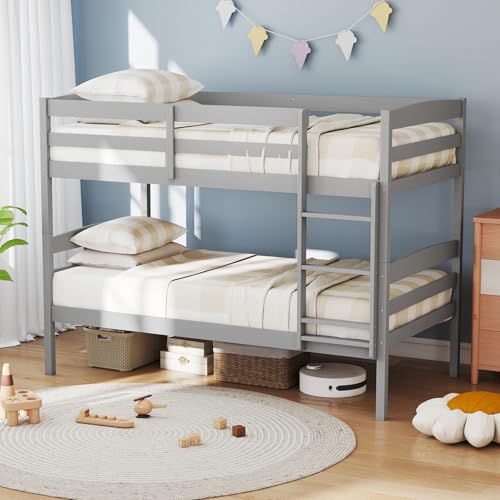
Twin Over Twin Detachable Bunk Beds: The Complete Buying Guide
Two beds in one smart footprint. Learn how separable twin bunk beds work, what to check before buying, and how to choose a design that adapts as your family's needs change.
Independent research for shoppers who want flexibility, safety, and long-term practicality.
What Are Twin Over Twin Detachable Bunk Beds?
Twin over twin detachable bunk beds are stacked twin-size sleeping platforms engineered so the top and bottom units can be separated into two freestanding twin beds. Unlike a fixed bunk bed, which is built as a single rigid frame, a detachable model includes a connector system — usually bolts, bracket plates, or interlocking posts — that can be unfastened when you want independent beds.
This category sits at the intersection of space-saving furniture and long-term flexibility. Families often buy a detachable bunk when children share a room, then split it later when they move into separate rooms or when a guest room is needed. If you are still comparing configurations, our overview of twin over twin bunk beds that can be separated covers the broader field of separable designs.
Most detachable models follow standard twin dimensions: roughly 38 inches wide by 75 inches long per sleeping surface. That consistency matters because it means standard twin bedding, mattress protectors, and sheet sets fit each half once the bunk is split. You can explore matching options in our guide to twin beds if you want to understand the base size before committing.
How the Separation Mechanism Works
The separation system is the single most important engineering detail on a detachable bunk. It determines how easy the conversion is, how stable the stacked configuration feels, and whether the frame will hold up after repeated assembly. There are three common approaches.
Bolt-on connector plates
Metal plates join the top and bottom posts with bolts. This is the most common and generally the most rigid design. Separation requires a wrench or hex key, so it is a deliberate project rather than a quick change. The trade-off is stability: a well-bolted connector plate minimizes sway in the stacked setup.
Interlocking post systems
The top bunk's posts slot into receivers on the bottom frame, sometimes secured with a locking pin. These are quicker to separate but vary widely in rigidity. Mid-range and premium models usually add a secondary locking bolt to remove play. When shopping, look for a system that locks in two directions rather than relying on gravity alone.
Tool-free bracket designs
A smaller number of models use spring-loaded or cam-lock brackets marketed as tool-free. These are convenient but should be inspected carefully. A tool-free system is only as good as its locking tolerance; any wobble in the stacked position is a warning sign.
Buying tip: Ask how many fasteners secure each corner. Four contact points per side is the minimum for a stable stacked bunk. Fewer points or exposed single bolts are a sign of entry-level construction.
Why Choose a Detachable Design
A detachable bunk is essentially two purchases in one. That flexibility drives most of its appeal, but it is worth being specific about the scenarios where it genuinely pays off.
- Changing family needs: Siblings who share a room today may need separate rooms later. A detachable bunk converts without a second furniture purchase.
- Guest room versatility: Keep the bunk stacked for daily use, then split it into two twins when visitors arrive. This is a common arrangement in homes that double up guest and kids' spaces.
- Moving and storage: Two smaller frames are easier to transport and store than one large fixed bunk. If you move frequently, this matters.
- Small-room staging: In a tight room, the stacked form frees floor space. If you later move to a larger room, the split form fills it without looking sparse.
For households weighing a bunk against other space-saving layouts, it helps to compare against alternatives. Our guides to twin bunk beds for small rooms and twin beds for small rooms explain when a bunk beats two separate beds and when it does not.
There is also a resale argument. A detachable bunk serves a wider range of buyers than a fixed bunk, because it can be marketed as either a bunk or two twins. That broader appeal tends to make it a more durable long-term investment within its category.
Key Features to Evaluate Before Buying
Detachable bunks vary enormously in build quality. The features below separate a frame that will last through a childhood from one that will loosen within a year.
Frame material and joinery
Solid wood and high-grade steel are the two durable options. Engineered wood can work if the connector hardware is reinforced with metal inserts rather than screwing directly into particle board. Look for mortise-and-tenon or doweled joints on wooden frames, and welded — not merely bolted — corner joints on metal frames. Our overview of types of beds explains how these constructions differ across the wider market.
Guardrails and ladder
The top bunk needs a full-length guardrail on both sides, with no more than a few inches of gap at either end. The ladder should hook over the frame rather than rest against it, and it should have flat, wide treads. A ladder that shifts under weight is a safety problem, not a convenience issue.
Weight capacity per bunk
Check the rated capacity for the top and bottom separately. The top bunk's rating is usually lower. If teenagers or adults will use the bed, confirm both halves meet the intended load. Our article on twin beds for adults covers capacity expectations for grown users.
Separation hardware quality
Look for thick connector plates, captive nuts, and bolts that thread into metal rather than wood. Hardware should be included and clearly labeled. A model that ships without a parts diagram is harder to reassemble correctly after separation.
Finish and edge treatment
Rounded edges and a non-toxic finish matter on furniture used by children. A rust-proof finish is important on metal frames in humid climates. Avoid sharp exposed bolt ends at the connector points.
Safety Checklist for Detachable Bunk Beds
Bunk bed safety comes down to assembly discipline and periodic checks. A detachable model adds one more variable — the connector — so the checklist is slightly longer than for a fixed bunk.
- Assemble exactly as specified. Use every fastener in the diagram. Skipping a connector bolt to save time is the most common cause of wobble.
- Re-tighten after the first week. New hardware settles. A follow-up tightening after initial use prevents loosening.
- Check connectors monthly. On detachable models, inspect the separation hardware for play, stripped threads, or bent plates.
- Respect the top-bunk age guidance. Most manufacturers recommend the top bunk for children six years and older. Follow the label.
- Keep the guardrail effective. Do not stack pillows or thick mattresses that raise the sleeper above the guardrail line.
- Anchor where possible. Some frames include wall-anchor kits. Use them, especially in homes with active children.
- Place away from ceiling fans and light fixtures. Leave clearance above the top bunk for sitting up safely.
Safety note: If you separate the bunk, reassemble each half as a standalone bed using the manufacturer's instructions. Do not leave a half-assembled connector plate exposed on a freestanding bed.
Mattress Guidance for Twin Over Twin Detachable Bunks
Mattress choice affects both comfort and safety on a bunk. The top bunk is the constraint: a mattress that is too thick reduces the effective height of the guardrail. Most manufacturers specify a maximum thickness, commonly 8 to 10 inches.
Use the same thickness range on both bunks for visual consistency and predictable support. A firm-to-medium feel works well for children and teenagers, while adults using the split configuration may prefer a medium or medium-firm twin. If you plan to separate the bunk, treat each half as a normal twin bed and choose accordingly.
For matching bedding after separation, our guides to twin beds sets and twin beds with frame and mattress explain how to coordinate sizes. If the bunk will later become a guest setup, consider a mattress protector for each half to extend useful life.
Design Tiers Compared
Detachable bunks fall into recognizable market tiers. The table below compares them by construction focus rather than by any numeric figure, so the guidance stays relevant over time.
| Tier | Typical Construction | Separation Hardware | Best For |
|---|---|---|---|
| Entry-level | Engineered wood with metal reinforcement; simpler joinery | Basic bolt-on plates; fewer contact points | Occasional use, light sleepers, short-term room setups |
| Mid-range | Solid wood or welded steel; reinforced corner joints | Multi-bolt connector plates with captive nuts | Daily use by children and teens; families planning to split later |
| High-end tier | Hardwood or heavy-duty steel; precision joinery | Engineered locking systems with secondary bolts | Long-term daily use, frequent separation, adult-capable setups |
Mid-range models usually offer the best balance: the separation hardware is robust enough for repeated conversion, and the frame is rigid enough that the stacked configuration feels solid. Entry-level frames can work for light use but tend to develop play at the connectors over time. High-end tier frames are worthwhile when the bed will serve adults or when the bunk will be split and re-stacked regularly.
Room Planning and Placement
Measure twice before ordering. A stacked twin over twin bunk occupies roughly the footprint of a single twin bed, but the vertical clearance and ladder clearance matter just as much as floor area.
- Ceiling height: Leave enough headroom above the top mattress for a child to sit up. Check the manufacturer's recommended minimum ceiling height.
- Ladder clearance: The ladder needs open floor space in front of it. Do not place the bunk so the ladder blocks a door or closet.
- Wall clearance: Leave a small gap from the wall to avoid pinching fingers and to allow for the frame's slight movement.
- Split configuration planning: If you intend to separate the bunk, sketch where both twin beds will sit. Two twins need more floor area than one stacked bunk, so plan the future layout now.
For tight rooms, our guide to twin over twin bunk beds with storage shows how integrated drawers and shelving change the footprint math. If stairs are preferred over a ladder, see twin over twin bunk beds with stairs and storage.
Care and Maintenance
A detachable bunk needs slightly more attention than a fixed frame because the connector hardware is a wear point. A simple routine keeps it safe and extends its life.
- Monthly: Check connector bolts and tighten any that have loosened. Inspect the ladder hooks for wear.
- Quarterly: Clean and lightly lubricate metal connector threads if the manufacturer allows it. Wipe wooden frames with a damp cloth and dry immediately.
- After separation: Store the connector hardware in a labeled bag attached to the frame, so reassembly is straightforward.
- Seasonally: Rotate mattresses if the manufacturer recommends it, and check guardrail attachments.
If the bunk will be stored or moved, disassemble fully and keep the parts diagram with the hardware. A detachable bunk reassembled with missing fasteners is less stable than a fixed bunk ever was.
Frequently Asked Questions
What are twin over twin detachable bunk beds?
They are stacked twin-size beds built with a connector system that lets the top and bottom units be separated into two independent twin beds. Most use bolt-on plates, interlocking posts, or bracket systems that can be unfastened when needed.
Are detachable bunk beds safe for children?
Yes, when assembled correctly and used within the manufacturer's weight limits. Look for a secure locking mechanism, full-length guardrails on the top bunk, and a hooked ladder. Re-tighten connectors periodically and follow the top-bunk age guidance.
Can twin over twin detachable bunk beds be separated into two beds?
Yes, that is their defining feature. Some designs require basic tools for separation, while others use tool-free connector systems. Either way, each half becomes a standalone twin bed once the connector is released.
What mattress thickness works best for detachable bunk beds?
Most manufacturers recommend a maximum of 8 to 10 inches for the top bunk to keep the guardrail effective. Use the same range on the bottom bunk for balance and consistent support, and always check the specific model's mattress guidelines.
How do I choose between a detachable bunk and a fixed bunk?
Choose detachable if you expect to separate the beds later, move frequently, or want dual-purpose guest and kids' use. Choose fixed if the bunk will stay stacked permanently and you want the most rigid possible frame with the fewest fasteners to monitor.
Ready to Compare Detachable Bunk Options?
Browse recommended twin over twin detachable bunk beds below and compare features side by side. Every listing links to current availability so you can check configurations, dimensions, and safety details before deciding.
Compare Features