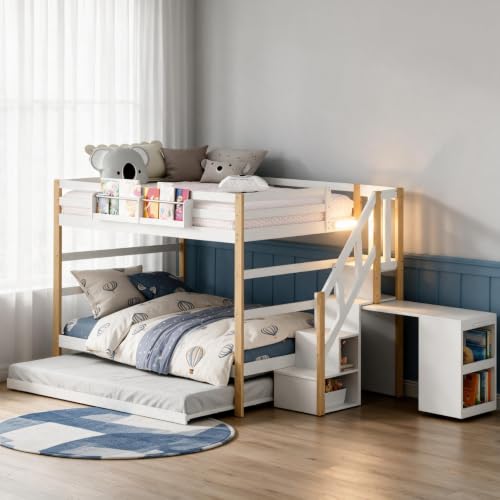
Wood Bunk Beds with Desk: The Complete Space-Saving Sleep & Study Solution
Everything you need to know before choosing a wood bunk bed with a built-in desk — from frame construction and safety standards to desk ergonomics and mattress compatibility.
Explore the Buyer's GuideWhy wood bunk beds with desk? For families managing compact bedrooms, a wood bunk bed with an integrated desk delivers two essential functions in one footprint. This guide walks you through the structural details, safety certifications, and practical considerations that matter most — so you can choose a setup that supports both deep sleep and focused study for years to come.
Why Choose a Wood Bunk Bed with Desk?
Wood bunk beds with an integrated desk solve a very specific spatial challenge: fitting sleeping space and a dedicated study area into a single room without crowding the floor. Solid wood construction, when properly finished, offers a warm aesthetic that blends with both traditional and modern interiors.
Beyond aesthetics, these hybrid units appeal to families transitioning children into school-age years, teens preparing for secondary education, and even adults working from compact apartments. The desk area is typically positioned beneath the raised bunk or along the side rail, creating a natural separation between rest and work zones.
⏰ Space Efficiency
One footprint delivers a sleeping platform and a dedicated study surface, freeing floor area for circulation and play. Ideal for rooms under 120 square feet.
🌳 Durable Material
Solid wood frames — pine, oak, or rubberwood — resist wobble and hold screws firmly over years of daily use, unlike some engineered alternatives.
📚 Built-In Routine
A visible desk attached to the bed encourages a consistent study routine and keeps school materials within arm's reach of the sleeping area.
🛠 Modular Options
Many wood desk bunks offer reversible desk placement, detachable components, or the ability to separate into a standalone bed and desk later.
🏠 Aesthetic Warmth
Natural wood grain adds visual warmth that painted metal or particleboard often lacks, making the room feel cozier and more inviting.
💰 Long-Term Utility
A well-constructed desk bunk adapts from childhood through teenage years, reducing the need to replace furniture as needs evolve.
Anatomy of a Quality Wood Desk Bunk
Understanding the structural components helps you evaluate construction quality before you commit. A well-built unit uses substantial timber dimensions and reinforced joinery at every load-bearing point.
- Corner posts: Look for posts measuring at least 50mm x 50mm (2" x 2") for twin-size units; heavier configurations benefit from 60mm or larger posts.
- Side rails: Solid wood rails should be at least 25mm thick and joined with metal-on-metal bolt assemblies or mortise-and-tenon joints.
- Slat system: A minimum of 13 evenly spaced slats per bunk, each at least 18mm thick, distributes weight and extends mattress life.
- Guardrails: Upper bunks require guardrails on both long sides, with the gap between rail and mattress surface no more than 125mm.
- Ladder attachment: The ladder should hook or bolt securely to the frame — never rely on a leaning ladder alone.
- Desk integration: The desk surface should be braced against at least two frame points; floating or cantilevered designs need visible metal reinforcement.
- Finish: Low-VOC, water-based finishes protect the wood without introducing strong odors into a sleeping environment.
When comparing frame styles, it helps to look at how other wood configurations are built — our overview of wooden bunk beds covers joinery and material grades in more depth, while wood bunk beds twin over twin explains how slat spacing affects mattress support.
Common Layout Configurations
Wood bunk beds with desk come in several spatial arrangements. The right choice depends on room dimensions, ceiling height, and whether the desk is meant for one child or shared use.
| Layout | Best For | Footprint Consideration | Desk Position |
|---|---|---|---|
| Loft bed with desk below | Single child, teen, or adult in a compact room | Requires ceiling clearance of at least 75 inches above the upper platform | Full-width desk under the loft |
| Twin-over-twin with side desk | Siblings sharing a room | Wider footprint than a standard bunk to accommodate the desk extension | Attached to one end or side rail |
| Futon or full-bottom with corner desk | Teens who need a seating area for guests | Larger overall length; confirm stair or ladder placement | Corner return, often L-shaped |
| Staircase bunk with built-in desk nook | Younger children or shared study space | Stairs add depth; measure door swing and window proximity | Integrated into stair side panel |
If you are comparing desk-integrated designs with separable frames, our guide to wood bunk beds that can be separated explains how modular conversions work in practice.
Safety Standards & Guardrails
Safety is the non-negotiable foundation of any bunk bed purchase. In the United States, the relevant standard is ASTM F1427, which covers upper bunk guardrails, ladder strength, and entrapment hazards. European buyers should look for EN 747 compliance.
- Upper bunk guardrails must extend at least 5 inches above the mattress surface on both long sides.
- The gap between the guardrail and the bed frame should not exceed 3.5 inches to prevent entrapment.
- Ladders must support at least 300 pounds of static load without deformation.
- All exposed bolts and edges should be rounded or capped to prevent scrapes.
- Desk components attached to the bunk must not obstruct the ladder or emergency exit path.
- Weight capacity should be clearly stated — typical twin upper bunks support 200–300 pounds.
For families with younger children, a lower loft height (under 50 inches) reduces fall risk while still accommodating a desk beneath. Pair the bunk with a firm, properly sized mattress so the guardrail height remains effective — our guide on when to replace a mattress helps you judge whether an existing mattress still provides adequate support.
Desk Ergonomics & Workspace Design
The desk portion of a bunk bed is often an afterthought in product descriptions, but it deserves the same scrutiny as the sleeping platform. A poorly placed desk can lead to awkward posture and eye strain during homework or remote work.
- Surface depth: At least 20 inches of usable depth for a laptop and notebook; 24 inches is better for desktop monitors.
- Height: The desk surface should sit around 28–30 inches from the floor for seated work.
- Legroom: At least 24 inches of vertical clearance beneath the desk for comfortable seating.
- Lighting: Position the desk near a window or plan for a clip-on task lamp; avoid placing the desk directly under the upper bunk where shadows fall.
- Cable management: Look for grommets or cutouts to route charging cables neatly.
- Chair compatibility: Confirm that a standard desk chair fits without blocking the ladder or bunk access.
If the desk area needs additional storage, consider pairing the setup with a walnut bedside cabinet or a wooden floating bedside table mounted nearby for school supplies and charging devices.
Choosing the Right Mattress for a Desk Bunk
Mattress thickness affects both comfort and safety on a bunk bed. If the mattress is too thick, the guardrail becomes ineffective; too thin and the sleeper may feel the slats beneath.
For most twin upper bunks, a mattress between 6 and 8 inches thick works best. It preserves guardrail height while offering adequate cushioning. Lower bunks can accommodate standard 8–10 inch mattresses.
Firmness preferences vary by sleeper, but bunk mattresses should generally be medium-firm to prevent excessive sink that can compromise the guardrail gap. Memory foam and hybrid options are popular for their motion isolation, which matters when two children share a bunk structure.
If you are outfitting a kids' room more broadly, our guides on white twin beds with storage and white bunk beds with storage offer complementary storage solutions that pair well with a desk bunk layout.
Storage & Organization Features
Many wood desk bunks incorporate drawers, shelving, or cubbies to maximize utility. These features are especially valuable in rooms where a separate dresser would consume too much floor space.
- Under-bed drawers: Typically roll on casters or slide on wooden runners; confirm the drawer depth clears the floor.
- Desk hutch or shelf: A small upper shelf above the desk holds books and supplies without encroaching on the sleeping area.
- Stair drawers: Staircase bunks often conceal storage within each step — measure drawer capacity before assuming it fits bulky items.
- Side cubbies: Open shelving on the outer frame provides quick access to bedtime reading materials.
For rooms that need supplemental clothing storage, a wooden 3 drawer bedside table or a white bedside table with storage can sit adjacent to the desk without crowding the workspace.
Assembly, Placement & Maintenance
Assembly difficulty varies widely among desk bunk models. Some ship with pre-drilled panels and labeled hardware; others require measuring and aligning components manually. Plan for two adults and roughly two to four hours for a typical unit.
- Assemble the frame on a soft surface to avoid scratching the finish.
- Tighten all bolts after the frame is upright, then re-check after one week of use.
- Place the bunk against a wall, but leave a small gap to prevent rattling and allow air circulation.
- Use a stud finder if you plan to anchor the frame to the wall for additional stability.
- Dust weekly with a dry cloth; avoid harsh chemical cleaners that can strip the finish.
- Inspect guardrail bolts and ladder hooks monthly for loosening.
Proper placement matters as much as assembly. Keep the desk away from direct radiator heat, and position the bunk so the ladder is not immediately in front of a door. For rooms with sloped ceilings, confirm the upper bunk clearance before ordering.
Step-by-Step Buying Checklist
Use this checklist to evaluate any wood bunk bed with desk before committing:
- Measure twice: Record room length, width, ceiling height, and door swing. Compare against the assembled dimensions — not the shipping dimensions.
- Confirm the desk side: Some models allow left- or right-side desk placement; verify this matches your room layout.
- Check certifications: Look for ASTM F1427 (US) or EN 747 (EU) compliance on the product label or specification sheet.
- Review weight limits: Confirm both the upper bunk and desk surface weight capacities meet your intended use.
- Inspect joinery: Prefer metal bolt assemblies over cam-lock fittings at structural joints.
- Plan mattress purchases: Budget for two mattresses if the bunk is twin-over-twin; confirm thickness limits.
- Consider future flexibility: If the child will outgrow the bunk, look for models that separate into a standalone bed and desk.
- Read assembly reviews: Prior buyers often note whether instructions are clear or whether additional tools are needed.
Ready to Compare Wood Desk Bunk Options?
Browse our curated selection of wood bunk beds with desk — filtered for construction quality, safety compliance, and practical workspace design.
View Recommended ModelsFrequently Asked Questions
What age is appropriate for a wood bunk bed with desk?
Most manufacturers recommend the upper bunk for children aged 6 and older. Younger children can use the lower bunk safely, but the upper level requires sufficient coordination to climb the ladder safely. Always check the specific product's age recommendation.
Can the desk be removed or relocated?
It depends on the model. Some desk bunks feature detachable desk components that can be repositioned or removed entirely; others are structurally integrated. Check the product description for modularity details before purchasing.
What mattress thickness works best on a desk bunk?
For the upper bunk, a 6–8 inch mattress preserves guardrail effectiveness. Lower bunks can accommodate standard 8–10 inch mattresses. Never exceed the manufacturer's stated maximum thickness.
How much weight can the desk hold?
Typical integrated desks support 50–100 pounds of evenly distributed weight. This is sufficient for a laptop, books, and a desk lamp, but not for sitting or standing on the desk surface.
Do I need to anchor the bunk bed to the wall?
Wall anchoring is strongly recommended for all bunk beds, especially in households with young children. Most quality frames include anchor hardware or pre-drilled anchor points. Anchoring prevents tipping if a child climbs on the frame or desk.
Is solid wood better than engineered wood for a desk bunk?
Solid wood generally offers superior screw-holding strength and durability at structural joints. High-quality engineered wood (plywood or MDF with hardwood veneer) can also perform well if joinery is reinforced. Avoid particleboard at load-bearing points.
How do I clean and maintain a wood desk bunk?
Dust weekly with a microfiber cloth. For deeper cleaning, use a slightly damp cloth with mild soap, then dry immediately. Avoid abrasive cleaners and excessive moisture. Re-tighten bolts every few months and inspect guardrails for looseness.
Can two children share a desk bunk comfortably?
A single desk surface is typically sized for one user at a time. If two children need simultaneous study space, consider an L-shaped or corner desk configuration, or pair the bunk with a separate small desk elsewhere in the room.