
Bunk Beds with Rails on Top and Bottom
Safety starts with the right guardrails. Explore how double-rail bunk beds protect sleepers on both levels, what to check in the frame, and how to choose a model that fits your room and family.
Explore Buying FactorsWhy rails on both levels matter: A bunk bed with rails on top and bottom combines upper-level fall protection with lower-level containment. For families with young children, restless sleepers, or guests, this dual-rail configuration adds an extra layer of security without sacrificing floor space. This guide explains guardrail standards, frame construction, and the practical details that separate a safe bunk bed from a risky one.
What "Rails on Top and Bottom" Really Means
When a product is described as having rails on the top and bottom, it typically means both sleeping platforms are equipped with safety guardrails — not just the upper bunk. In many conventional bunk beds, the upper bunk gets a guardrail while the lower bunk is left open because it sits close to the floor. Dual-rail designs go a step further by adding a perimeter rail to the bottom bunk as well.
This configuration is especially useful in several scenarios:
- Young children on the lower level: A bottom rail prevents toddlers and young sleepers from rolling out during the night.
- Restless sleepers: Anyone who moves a lot during sleep benefits from the containment a lower rail provides.
- Guest and shared rooms: A dual-rail bunk feels more secure for visitors who are unfamiliar with the bed.
- Convertible designs: Some bunks can be separated into two standalone beds; bottom rails remain useful when the lower bunk is used independently.
It's important to distinguish between a bottom guardrail and a bottom support rail. Some listings use "rails" to describe the structural side rails that hold the mattress platform. On this page, we focus on safety guardrails — the vertical barriers that keep sleepers from rolling off the edge. If you're comparing models, look for explicit language like "guardrail," "safety rail," or "fall protection."
For buyers who want extra sleeping capacity alongside safety, models such as bunk beds with a trundle underneath combine a lower rail with a pull-out bed, while bunk beds with stairs often integrate guardrails on both levels for a cohesive, child-friendly setup.
Guardrail Height & Safety Standards
Guardrail height is one of the most important — and most overlooked — specifications. A rail that is too low provides little protection, while a rail that is too high can make getting in and out awkward. In the United States, voluntary safety standards for bunk beds (ASTM F1427) call for guardrails on the upper bunk that extend at least 5 inches above the mattress top, with a gap of no more than 3.5 inches between the guardrail and the mattress surface to prevent entrapment.
For the lower bunk, a guardrail is not always required by standard, which is precisely why dual-rail models stand out. When evaluating a bottom rail, check:
- Height above mattress: Aim for a rail that rises at least 3–5 inches above the lower mattress surface.
- Continuous coverage: The rail should cover most of the bed's length, leaving a clear entry/exit gap rather than a small notch.
- Attachment method: Bolted or bracketed rails are more secure than rails that simply rest in slots.
- Entrapment gaps: Ensure gaps between rails and the mattress are small enough that a child cannot slip through.
Buyer tip: Look for bunks that explicitly state compliance with ASTM F1427 or an equivalent safety standard. A manufacturer that publishes guardrail measurements and entrapment testing results is typically more transparent about build quality.
If you're shopping for younger children, pair your bunk with a properly sized mattress — an ill-fitting mattress can create gaps beneath the guardrail. Our guide to bunk beds with mattresses explains how mattress thickness affects rail clearance.
Frame Materials & Construction
Rails are only as strong as the frame they're attached to. The material and joinery of a bunk bed directly influence how stable the guardrails feel and how long they hold up under daily use. Here's how the most common materials compare:
- Solid wood (pine, oak, beech): Heavy-duty and stable, with strong screw and bolt retention. Solid wood frames generally fall into the mid-range to premium tier and offer the most reassuring feel for dual-rail designs.
- Engineered wood (MDF, particleboard): Common in entry-level to mid-range bunks. Look for reinforced corner brackets and metal-to-metal connections; rails attached only with wood screws into MDF can loosen over time.
- Metal (steel): High-grade steel frames with welded or bolted rail mounts are extremely durable and resist wobble. Metal bunks are often the most secure choice for heavy use and are typically mid-tier to high-end tier depending on gauge thickness.
- Mixed materials: Wood frames with metal reinforcement plates or metal rail brackets combine visual warmth with structural rigidity.
Beyond material, inspect the joinery. Mortise-and-tenon joints, metal-on-metal bolt connections, and corner braces all contribute to a solid build. Avoid frames where the guardrail attaches with short screws into thin panels — these are the first components to loosen. Also check the weight capacity rating for each level; a sturdy frame should support both the mattress and the sleeper without flexing.
For families who need to maximize utility, dual-rail bunks with built-in storage are worth exploring — see our roundup of bunk beds with storage and bunk beds with drawers for options that keep the footprint compact while adding safety rails on both levels.
Top vs. Bottom Rail Comparison
The table below summarizes how guardrails typically differ between the upper and lower levels, so you can evaluate listings more confidently.
| Feature | Top Bunk Rail | Bottom Bunk Rail |
|---|---|---|
| Primary purpose | Fall protection from height | Roll-out prevention at low height |
| Typical height above mattress | 5 inches or more | 3–5 inches |
| Standard requirement | Required by ASTM F1427 | Optional; found on dual-rail models |
| Common configurations | Full-length rail with ladder gap | Full-length or partial rail with entry gap |
| Best for | All upper-bunk sleepers | Young children, restless sleepers, guests |
| Attachment priority | Bolted brackets, reinforced corners | Bolted brackets, no loose slot-in rails |
When a listing claims "rails on top and bottom," confirm that both rails are safety guardrails and not merely structural side rails. Product photos and specification sheets usually clarify the difference; if they don't, ask the seller directly.
Who Should Choose Dual-Rail Bunks
Dual-rail bunk beds are not just for families with toddlers. Consider this configuration if any of the following apply:
- You have children under six: Lower-bunk rails reduce the risk of nighttime falls for the youngest sleepers.
- You host guests regularly: A bottom rail makes the lower bunk feel more enclosed and secure for visitors.
- You have restless sleepers: Anyone who tosses and turns benefits from perimeter containment on both levels.
- You plan to separate the bunks: If the frame converts into two standalone beds, bottom rails remain functional when the lower bunk is used on its own.
- You want a future-proof purchase: Dual rails accommodate changing needs as children grow and sleeping arrangements shift.
If your priority is maximizing sleeping space, dual-rail designs pair well with larger formats such as bunk beds with full on top and bottom or bunk beds with queen and twin configurations. For compact rooms, bunk beds with a ladder keep the footprint tight while maintaining full guardrail coverage.
Setup & Placement Tips
Even the safest bunk bed depends on correct assembly and placement. Follow these guidelines to get the most from a dual-rail design:
- Assemble per the manufacturer's instructions: Use all provided hardware, including rail brackets and anti-tip straps if included.
- Anchor to the wall where possible: Anti-tip kits add stability, especially for tall frames with ladders.
- Match mattress thickness to rail height: A mattress that is too thick reduces the effective guardrail height; too thin leaves entrapment gaps.
- Keep the ladder clear: Position the bed so the ladder entry is unobstructed and not near furniture edges.
- Inspect hardware periodically: Re-tighten bolts every few months, particularly on metal frames and high-traffic bunks.
- Avoid ceiling conflicts: Leave enough headroom above the top rail for comfortable sitting and safe entry.
For rooms that need to serve multiple functions, consider how the bunk fits with adjacent furniture. Our guides to bunk beds with a desk and bunk beds with space underneath show how to combine safety rails with practical work and storage zones.
Frequently Asked Questions
Do bunk beds with rails on top and bottom meet safety standards?
Reputable dual-rail bunks are designed to meet or exceed ASTM F1427, which covers upper-bunk guardrails, entrapment hazards, and structural integrity. Always verify the manufacturer's compliance statement and check that the bottom rail is a safety guardrail, not just a support rail.
How high should a bottom bunk rail be?
A bottom rail should rise at least 3–5 inches above the mattress surface. The exact height depends on mattress thickness; the key is that the rail creates a meaningful barrier while still allowing easy entry and exit.
Can adults use bunk beds with dual rails?
Yes, provided the frame's weight capacity supports adult sleepers. Metal and solid wood frames in the mid-range to high-end tier typically handle adult use well. Check the per-level weight rating before purchasing.
Are bottom rails removable?
Some models feature removable or convertible bottom rails, which is useful when the bunk is separated into two beds. Removable rails should still lock securely in place when installed — avoid designs that rely on friction alone.
What mattress works best with dual-rail bunks?
Choose a mattress thickness that keeps the guardrail at least 5 inches above the surface on the top bunk and 3 inches on the bottom. A standard 6–8 inch bunk mattress is usually a safe fit; check the manufacturer's recommended maximum thickness.
Final Verdict
Bunk beds with rails on top and bottom are a smart choice for families who want safety without giving up floor space. The dual-rail configuration protects sleepers on both levels, making these bunks especially suitable for young children, restless sleepers, and guest rooms.
When comparing options, prioritize guardrail height and attachment, frame material and joinery, and compliance with recognized safety standards. A solid wood or high-grade steel frame in the mid-range to premium tier will typically outlast an entry-level engineered wood model, especially in high-use households. With the right measurements and a properly sized mattress, a dual-rail bunk delivers years of secure, space-efficient sleep.
Recommended Bunk Beds with Rails on Top and Bottom
⚠️ AFFILIATE DISCLOSURE: This website contains affiliate links. As an Amazon Associate, we earn from qualifying purchases. If you make a purchase through these links, we may receive a small commission at no additional cost to you. Read our full affiliate policy.
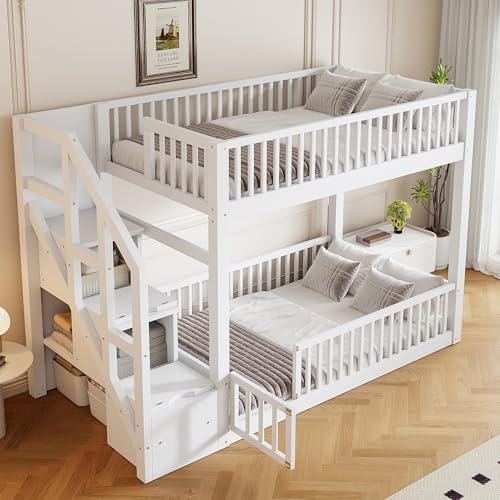
Twin Over Twin Bunk Bed with Rails On Top and Bottom, White | Wood Bunk Bed Frame with Storage Stairs & Door, Twin Size Floor Bunk Beds with High Fence & Slat for Kids Teens, Space Saving
Check price on Amazon
Bellemave Metal Bunk beds Twin Over Twin Size, Bunk beds with guardrail and Door for Kids, Floor House bunk Bed for Kids,White
Check price on Amazon
Eailaveo Twin Over Twin Floor Bunk Bed with Storage Ladder and Guardrails,for Kids Teens Adults (White#Ladder, Twin Over Twin)
Check price on Amazon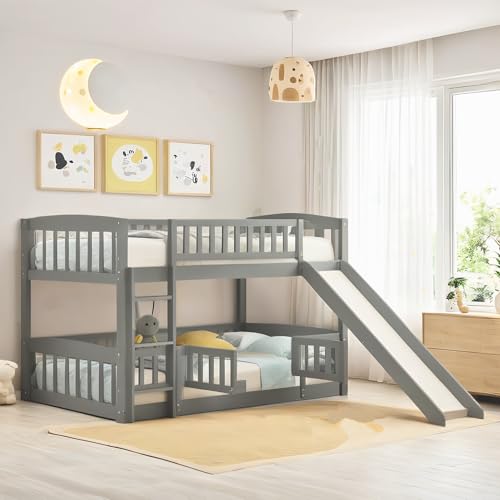
Bellemave Twin Over Twin Low Bunk Bed with Slide and Fence Railings Wood Floor Bunk Beds with Ladder for Kids Boys Girls Teens, Grey
Check price on Amazon
Merax Twin-Over-Twin Floor Bunk Bed with Storage Ladder, Natural | Wood Bunk Bed Frame with Guardrails and Space-Saving Floor Design for Teens and Adults
Check price on Amazon
Harper & Bright Designs Twin Over Twin House Bunk Bed Frame for Boys Girls Kids Adults Toddler with Fence and Door, White
Check price on Amazon