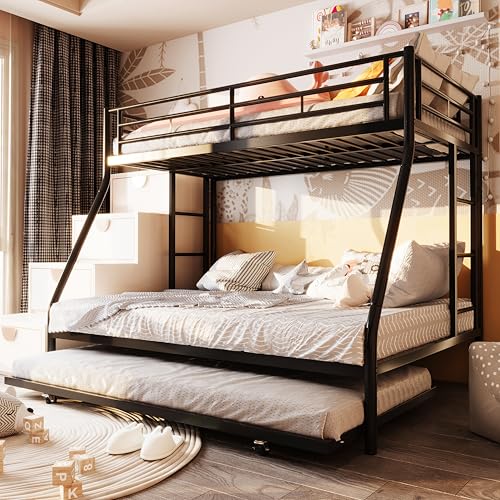
Bunk Beds with Trundle Underneath: The Complete Buying Guide
Everything you need to know before choosing a space-saving bunk bed with a hidden trundle — from frame materials and mattress fit to safety features and room layouts.
Explore Recommended OptionsWhy this guide matters: A bunk bed with a trundle underneath gives you three sleeping surfaces in the footprint of a standard bunk. For families with growing children, frequent overnight guests, or small bedrooms, that extra roll-out bed can be the difference between a cramped room and a genuinely flexible sleeping space. This guide walks you through the decisions that matter most so you can choose with confidence.
1. What Is a Bunk Bed with a Trundle Underneath?
A bunk bed with a trundle underneath is a stacked sleeping arrangement where the lower bunk conceals a roll-out bed. The trundle sits on casters or a sliding track and tucks neatly beneath the bottom bunk when not in use. Pull it out, and you have a third sleeping surface ready in seconds.
The trundle is typically smaller than the main bunks — often a twin — and sits lower to the floor. That lower profile is deliberate: it keeps the rolled-away bed compact enough to store under the bottom bunk while still providing a comfortable, functional sleeping platform for guests, sleepovers, or siblings sharing a room.
What separates a trundle bunk from a bunk bed with a pull-out bed underneath is mostly terminology and mechanism. Trundles usually roll out on their own frame, while pull-out beds may use a more integrated pop-up design. Both serve the same core purpose: adding a bed without adding floor space.
For buyers researching options, it helps to understand that trundle bunk beds come in a wide range of configurations. Some are simple twin-over-twin setups, while others pair a full lower bunk with a twin upper and a trundle below. There are also models with storage drawers beside the trundle, and bunk beds with storage underneath that combine drawers and a trundle in the same footprint.
2. Why Choose a Trundle Bunk Bed?
The appeal of a trundle bunk bed comes down to one word: flexibility. The trundle is invisible most of the time, but it transforms the bed into a three-person sleeping solution when needed. That matters in several common situations:
- Shared children's rooms: Two siblings get their own bunks, and the trundle handles sleepovers without an air mattress on the floor.
- Guest rooms and home offices: The room stays usable as a workspace or study, and the trundle converts it into a guest-ready bedroom when visitors arrive.
- Small apartments and condos: Floor space is precious. A trundle bunk uses vertical space and hides the extra bed when it is not needed.
- Vacation homes and cabins: A single trundle bunk can sleep three, which reduces the number of beds you need to furnish.
Beyond sleeping capacity, trundle bunks also simplify room transitions. A child who outgrows a toddler bed can move into the bottom bunk while the top bunk stays available for an older sibling or a guest. When the trundle is not in use, the room looks and functions like a standard bunk bed setup.
For households that need even more utility, there are bunk beds with a third bed underneath that go beyond the trundle format, and bunk beds with a trundle for adults designed with higher weight capacities and longer mattress decks.
3. Types of Trundle Bunk Beds
Not every trundle bunk is built the same way. The configuration you choose affects how the bed fits your room, how easy it is to use, and how many people it can sleep. Here are the main types you will encounter:
Twin-over-Twin with Trundle
The most common configuration. Two twin bunks stack vertically, and a twin trundle slides out from under the bottom bunk. This is the standard choice for children's rooms and guest spaces where three single sleepers are needed. It is widely available across all market tiers.
Full-over-Full with Trundle
Both main bunks are full size, and the trundle is usually a twin. This setup suits older children, teens, or adults who need more sleeping room per person. Bunk beds with full on top and bottom are heavier and require more ceiling height, so measure carefully before choosing.
Full Bottom with Twin Top and Trundle
A hybrid layout: the lower bunk is full size, the upper bunk is twin, and a twin trundle hides underneath. This is a popular choice for parents who want a more spacious lower bunk for a younger child while keeping the overall footprint manageable. You can explore similar layouts in bunk beds with full on bottom and twin on top.
Trundle with Storage Drawers
Some designs split the under-bunk space between a trundle and built-in drawers. This is useful when the room lacks a dresser or closet space. If storage is a priority alongside the extra bed, look at bunk beds with storage drawers and bunk beds with drawers for comparable options.
Stair-Access Trundle Bunks
Instead of a ladder, these models use a staircase to reach the top bunk, and the trundle sits below. Stairs are easier for younger children and can double as storage steps. See bunk beds with stairs and bunk beds with slides and stairs for related configurations.
Ladder-Access Trundle Bunks
The classic setup: a ladder leans against or attaches to the top bunk, and the trundle rolls out from the bottom. These are typically the most space-efficient and the most widely available. Compare options in bunk beds with ladder and bunk beds with ladder and slide.
| Configuration | Best For | Sleeping Capacity | Space Consideration |
|---|---|---|---|
| Twin-over-Twin + Trundle | Children's rooms, guest rooms | 3 sleepers | Compact; standard bunk footprint |
| Full-over-Full + Trundle | Teens, adults, larger rooms | 3 sleepers | Requires more floor and ceiling space |
| Full Bottom / Twin Top + Trundle | Mixed-age siblings | 3 sleepers | Moderate; good balance of comfort and size |
| Trundle + Storage Drawers | Rooms with limited closet space | 3 sleepers + storage | Same footprint, added utility |
| Stair-Access + Trundle | Young children, safety-focused homes | 3 sleepers | Stairs extend outward; plan clearance |
4. Frame Materials and Construction
The frame material determines how stable the bunk feels, how long it lasts, and how much weight it can safely support. Trundle bunk beds are typically built from one of three materials:
Metal Frames
Metal bunk beds are common in entry-level and mid-range tiers. High-grade steel frames with reinforced joints offer a solid build and a relatively slim profile, which helps in small rooms. Look for powder-coated or rust-proof finishes, especially if the bed will be used in humid climates. Metal frames tend to have a lighter visual weight than wood, which can make a small bedroom feel less crowded.
Wood Frames
Solid wood and engineered wood frames are available across all tiers. Pine and rubberwood are common in entry-level and mid-range models, while hardwood and premium finishes appear in higher-end tiers. Wood frames tend to feel warmer and blend more easily with bedroom decor. Check that the slats are reinforced and that the trundle track is mounted securely to the main frame rather than relying on the trundle's own casters alone.
Upholstered and Mixed-Material Frames
Some premium trundle bunks incorporate upholstered headboards or fabric panels. These are more decorative and often heavier. They work well in guest rooms and older children's rooms where style matters as much as function. If you choose upholstered, confirm that the fabric is easy to clean and that the trundle mechanism is not obstructed by the upholstery.
Construction tip: A trundle bunk bed carries weight on multiple levels. Prioritize models with a solid build, reinforced corner joints, and a trundle frame that slides on smooth, durable casters. A heavy-duty trundle mechanism is one of the clearest signs of a well-made bed in any tier.
5. Choosing the Right Trundle Mattress
The trundle mattress is where many buyers run into problems. Because the trundle stores under the bottom bunk, there is limited vertical clearance. A mattress that is too thick will prevent the trundle from rolling back in, or it will rub against the underside of the bunk above.
Most trundle frames accept mattresses between 6 and 8 inches thick. Some premium designs accommodate up to 10 inches, but always confirm the clearance before ordering. A standard twin mattress is the most common trundle size, though full-size trundles exist in larger configurations.
Firmness and Support
Trundle mattresses are often used for guests and children, so medium-firm to firm support is generally the safest choice. It provides adequate support without the deep sink that can make a low-profile bed harder to get out of. If the trundle will be used daily, invest in a higher-quality foam or hybrid mattress rather than an entry-level inflatable or thin foam pad.
Mattress Type by Tier
- Entry-level: Foam or basic innerspring mattresses, usually 6 inches thick. Suitable for occasional guest use.
- Mid-range: Memory foam or hybrid mattresses with better support layers. Appropriate for regular sleepovers and children's daily use.
- Premium: Higher-density foam, pocket-coil hybrids, and cooling covers. These are the best fit for daily adult use or year-round guest rooms.
If you are also furnishing the main bunks, it helps to review bunk beds with mattresses and bunk beds with mattress included to see which combinations are sold together and how the trundle mattress is specified.
6. Safety Features to Verify
Bunk beds carry inherent safety considerations because of the elevated sleeping surface. A trundle adds a moving component, so the safety checklist is slightly longer than for a standard bed.
Guardrails
The top bunk must have full-length guardrails on both sides, with no gap wider than a few inches. Some models also include guardrails on the bottom bunk, which is useful for younger children. Look for bunk beds with rails on top and bottom if you want that extra reassurance.
Ladder and Stair Security
Ladders should attach firmly to the frame, not rest loosely against it. If you choose a stair-access model, confirm that the steps are wide, textured, and have a handrail. Stairs are generally safer for children under six.
Trundle Locking Mechanism
A good trundle locks into place when fully extended so it does not slide during use. When retracted, it should stay closed rather than drifting out. Test this during assembly and periodically afterward.
Weight Capacity
Check the weight capacity for the top bunk, bottom bunk, and trundle separately. Adult use requires higher capacities, so if the bed will serve teens or adults, choose a model rated accordingly. This is especially relevant for bunk beds with a trundle for adults.
Assembly and Anchoring
Follow the manufacturer's assembly instructions precisely. Where possible, anchor the frame to the wall using the provided hardware. This is particularly important in homes with young children who may climb or lean on the bed.
Safety reminder: Never place a bunk bed directly under a ceiling fan or a light fixture that could be reached from the top bunk. Keep the area around the ladder clear, and avoid placing the bed next to a window with accessible blinds or cords.
7. Room Sizing and Layout Planning
Before choosing a trundle bunk bed, measure the room carefully. A trundle needs clear floor space in front of the bed to roll out fully. If a dresser, desk, or wall blocks that path, the trundle becomes inconvenient to use.
Floor Space for the Trundle
Plan for at least the length of the trundle mattress plus a comfortable walking margin in front of the bed. A twin trundle needs roughly the same rollout depth as a twin bed. If the room is tight, consider a trundle that rolls out sideways rather than endwise, or choose a bed with a shorter rollout.
Ceiling Height
The top bunk needs enough clearance for a person to sit up without hitting the ceiling. A common guideline is at least 30 to 36 inches between the top mattress and the ceiling. For full-over-full configurations, this becomes even more important.
Door and Closet Clearance
Check that the bed does not block closet doors, room doors, or heating vents. A trundle bed placed against a wall with a swinging closet door can make the room feel cramped even when the trundle is closed.
Shared Rooms
In shared children's rooms, a trundle bunk can free up floor space for play, study, or storage. If you need more built-in utility, compare bunk beds with lots of storage and bunk beds with space underneath to see how different layouts use the area beneath the bottom bunk.
8. Market Tiers and What They Offer
Trundle bunk beds are available across a wide range of market positions. Understanding what each tier typically delivers helps you match the bed to your intended use without over- or under-specifying.
| Tier | Typical Construction | Best For | What to Expect |
|---|---|---|---|
| Entry-level | Basic metal or engineered wood; simple casters | Occasional guest use, first bunk bed | Functional trundle, lighter frame, fewer extras |
| Mid-range | Reinforced steel or solid wood; smoother trundle track | Daily children's use, regular sleepovers | Better stability, improved guardrails, more consistent finish |
| Premium | High-grade steel, hardwood, or upholstered panels | Teens, adults, long-term guest rooms | Heavy-duty trundle mechanism, higher weight capacity, refined details |
| Luxury / commercial-grade | Solid hardwood, commercial hardware, custom finishes | Vacation rentals, high-use guest rooms, design-focused homes | Flagship-tier build, professional-grade trundle glide, premium materials |
Entry-level models are a reasonable fit for occasional use, but if the trundle will be pulled out several times a week, moving up to the mid-range tier usually pays off in smoother operation and a sturdier frame. Premium and luxury tiers make sense when the bed is a long-term investment or when the room needs to serve adults as well as children.
If you are comparing broader options, the buying guides and reviews section covers related categories and helps put these tiers in context.
9. Assembly, Care, and Longevity
A trundle bunk bed is a mechanical piece of furniture as well as a sleeping surface. A little maintenance keeps the trundle rolling smoothly and the frame stable.
Assembly Tips
- Assemble the bed in the room where it will be used. A fully assembled bunk bed is difficult to move through doorways.
- Use the provided hardware and follow the sequence in the instructions. Tighten bolts progressively rather than fully tightening one side first.
- Test the trundle rollout before the bed is fully loaded with mattresses. Adjust the track or casters if it binds.
- Anchor the frame to the wall if the hardware is included and the wall type allows it.
Routine Care
- Check bolts and connections monthly, especially during the first few months of use.
- Clean trundle casters or tracks according to the manufacturer's guidance. Dust and carpet fibers can accumulate and make the rollout stiff.
- Rotate the trundle mattress periodically to prevent uneven wear.
- Keep the area under the bed clear of clutter so the trundle can move freely.
When to Replace
Inspect the frame for wobbles, cracks, or loose joints. If the trundle no longer locks securely or the frame shows signs of fatigue, it is time to replace the bed rather than continue using it. Safety should always come before convenience.
10. Frequently Asked Questions
What is a bunk bed with a trundle underneath?
A bunk bed with a trundle underneath is a stacked sleeping arrangement where the lower level includes a hidden roll-out bed stored beneath the bottom bunk. The trundle slides out on casters or a track, providing an extra sleeping surface without permanently occupying floor space.
Is a trundle bed suitable for everyday sleeping?
Most trundle beds are designed for occasional or guest use because they typically sit lower to the ground and may use a thinner mattress. However, several mid-range and premium models now accommodate standard-height mattresses and can support daily sleeping for children or teens.
What mattress thickness works with a trundle?
Trundle mattresses usually range from 6 to 8 inches thick. Always check the clearance height of the trundle frame before buying a mattress. Some premium trundle designs accept up to 10 inches, but exceeding the recommended thickness can prevent the bed from rolling back under the bunk.
Are bunk beds with trundles safe for young children?
Yes, when properly assembled and used according to the manufacturer's guidelines. Look for full-length guardrails on the top bunk, a secure ladder, and a weight capacity that matches the intended users. The trundle should lock firmly in place when fully extended and retract smoothly.
Can adults use a bunk bed with a trundle?
Some models are built for adults, particularly those constructed from high-grade steel or solid wood with reinforced slats. Verify the weight capacity for each level before purchase. Adult-friendly trundle bunk beds typically fall into the mid-range to premium tiers.
How much floor space does a trundle save?
A trundle bunk bed effectively provides three sleeping surfaces within the footprint of roughly two. When the trundle is closed, the bed occupies the same floor area as a standard bunk bed, making it a strong option for small bedrooms, guest rooms, and shared children's rooms.
Continue exploring: If you are still comparing layouts, you may find these related guides useful: bunk beds overview, bunk beds with trundle bed underneath, bunk beds with full on bottom and trundle, and bunk beds with nothing underneath for a simpler open-underneath design.