
Bunk Beds with Storage Drawers: The Complete Buyer's Guide
Maximize every square foot of your bedroom with a bunk bed that sleeps two and stores twice as much. Learn how to choose the right drawer configuration, frame material, and safety features before you buy.
Explore Recommended ModelsWhy bunk beds with storage drawers make sense: If you are researching this category, you already know a standard bunk bed saves floor space. What you may still be weighing is whether built-in drawers are genuinely useful or just a marketing extra. The short answer: in shared bedrooms, guest rooms, and compact apartments, integrated storage drawers turn unused under-bed volume into functional wardrobe space — without adding a single piece of furniture. This guide walks you through drawer types, frame construction, sizing, and safety so you can make a confident decision.
What to Expect from Storage Drawers on a Bunk Bed
Storage drawers on bunk beds are typically positioned under the bottom bunk, built into the staircase, or integrated into the side of the frame. Their purpose is straightforward: capture the dead space beneath the lower mattress and convert it into enclosed storage for clothing, bedding, toys, or off-season items. The quality of that storage, however, varies significantly across the market.
Entry-level models often use fabric bins or shallow wooden drawers on simple glides. Mid-range models move to metal ball-bearing runners and deeper drawer boxes. Premium and luxury tiers feature solid wood dovetail drawers, soft-close mechanisms, and reinforced frames rated for heavier loads. Understanding these tiers helps you match a model to your household's actual usage rather than over- or under-specifying.
If your priority is maximum concealed volume, models with lots of storage combine drawers, shelves, and staircase compartments. If you prefer a cleaner footprint, a straightforward underneath storage layout may be the better fit.
Drawer Configurations: Which Layout Fits Your Room?
Drawer placement affects both usability and the amount of clearance you need around the bed. Before choosing, sketch your room and mark door swings, windows, and walking paths. Then compare the three common configurations below.
| Configuration | Best For | Space Requirement |
|---|---|---|
| Under-bed drawer bank (bottom bunk front) | Everyday clothing, bedding, shared kids' rooms | Clear floor space in front of the bed for drawer extension |
| Side-access drawers | Narrow rooms where the bed sits against a wall | Clearance on one side only |
| Staircase drawers | Families wanting combined climb access and hidden storage | Footprint of the staircase; no extra front clearance |
Staircase-integrated drawers are a popular choice because they serve double duty — but they reduce the number of large flat drawers available. Models with bunk beds with stairs often pair staircase storage with a compact drawer bank for a balanced setup. If you want a simpler frame with drawer capacity, a standard bunk bed with drawers is the most direct option.
Frame Materials and Drawer Durability
The frame carries the weight of two sleepers plus the drawer hardware. Material choice directly affects longevity, noise, and wobble.
- High-grade steel frames: Excellent strength-to-weight ratio, resistant to warping, and typically the most stable for heavy use. Look for reinforced corner brackets and powder-coated rust-proof finishes.
- Solid hardwood frames: Warm appearance and strong screw retention for drawer glides. Maple, oak, and beech are preferred for long-term durability.
- Engineered wood (MDF/particleboard): Common in entry-level and mid-range models. Acceptable when properly braced, but drawer runners may loosen over time under heavy loads.
Drawer hardware matters as much as the frame. Metal ball-bearing glides with a smooth full-extension travel are the practical standard for daily use. Soft-close mechanisms reduce slamming and extend hardware life. On wooden drawers, dovetail joints outperform stapled construction for heavy contents. For a broader comparison of frame styles beyond storage, see the main bunk beds category.
Sizing: Matching the Bunk to Your Sleepers and Room
Bunk beds with storage drawers come in twin-over-twin, full-over-full, and mixed configurations. Storage drawers add roughly 4–8 inches of depth to the footprint, so measure carefully.
For growing children, twin-over-twin is the most space-efficient. For teens or adults sharing a room, full-over-full bunk beds provide adult-length sleeping surfaces on both levels. If you need a larger lower berth for a couple or an older child, full-size on bottom models pair a generous lower mattress with a twin upper. Households that want maximum flexibility for guests should review full-on-bottom with trundle configurations, which add a third sleeping surface without sacrificing drawer storage.
Always confirm the mattress thickness range the frame supports — deep drawer boxes reduce the clearance available for the lower mattress, and overly thick mattresses can interfere with drawer operation on some designs.
Safety Features to Verify Before Purchase
Bunk bed safety is non-negotiable, and storage drawers introduce a few extra checks:
- Guardrails on the top bunk: At least 5 inches above the mattress top on all open sides, with no gaps wider than 3.5 inches.
- Secure ladder attachment: The ladder should hook or bolt to the frame, not merely lean against it.
- Drawer stops or locks: Drawers should not pull completely free unless intentionally removed, and should resist accidental opening.
- Weight ratings: Check both the per-bunk sleeper rating and the per-drawer load rating. Mid-range and premium models typically publish these clearly.
- Stability: A reinforced frame with cross-bracing reduces sway. Avoid models that flex noticeably when the top bunk is occupied.
For households with younger children, models with rails on top and bottom offer additional security during the transition period.
Room Layout and Drawer Clearance Tips
Drawers need room to open. A full-extension drawer bank on a full-size bunk typically requires 20–24 inches of clear floor space in front of the bed. In tight rooms, side-access drawers or staircase storage avoid this requirement entirely.
Consider the traffic path between the bed and the door, closet, and window. If the bunk sits in a corner, orient drawer access toward the open side of the room. For rooms that must also serve as a study or play area, combined solutions such as bunk beds with desk and wardrobe consolidate three functions into one footprint. Where wardrobe volume is the priority, bunk beds with dresser designs integrate a dedicated clothing station alongside the sleeping area.
Finally, plan for mattress ventilation. Drawer boxes should not block airflow under the bottom mattress; reputable designs leave ventilation gaps in the frame base.
Keeping Drawers Smooth for Years
Storage drawers on bunk beds endure daily use, often by children. A simple maintenance routine extends their life:
- Vacuum drawer tracks monthly to remove dust and debris.
- Tighten glide screws and frame bolts every few months.
- Avoid overloading drawers beyond the manufacturer's rating.
- Apply furniture wax to wooden runners to keep them gliding smoothly.
- Check that drawer fronts remain aligned; misalignment usually signals a loose glide that is easy to correct early.
How to Choose: A Quick Decision Framework
Use this sequence to narrow the market efficiently:
- Step 1 — Sleepers: Determine mattress sizes for each bunk based on the age and height of sleepers.
- Step 2 — Storage volume: Estimate what the drawers must hold. Clothing and bedding need deeper boxes; toys and linens tolerate shallower ones.
- Step 3 — Access: Match drawer configuration to the clear floor space available.
- Step 4 — Tier: Choose entry-level for light use, mid-range for daily family use, and premium or luxury for adult sleepers and long-term installation.
- Step 5 — Safety check: Confirm guardrails, ladder attachment, drawer stops, and published weight ratings.
If you are still comparing storage-led designs across the category, the bunk beds with storage hub groups the main variants side by side, and our buying guides and reviews section covers broader furniture selection criteria.
Recommended Bunk Beds with Storage Drawers
⚠️ AFFILIATE DISCLOSURE: This website contains affiliate links. As an Amazon Associate, we earn from qualifying purchases. If you make a purchase through these links, we may receive a small commission at no additional cost to you. Read our full affiliate policy.

BTHFST Bunk Bed Twin Over Twin with Stairs, Storage Drawers and LED Lights | 8 Drawers, Heavy Duty Bunk Bed, Hanging Area, Full-length Guardrail, Space-saving Bed for Dorm, Bedroom, Apartment
Check price on Amazon
BTHFST Bunk Bed Twin Over Twin with Stairs, Storage Drawers and LED Lights | 8 Drawers, Heavy Duty Bunk Bed, Hanging Area, Full-length Guardrail, Space-saving Bed for Dorm, Bedroom, Apartment
Check price on Amazon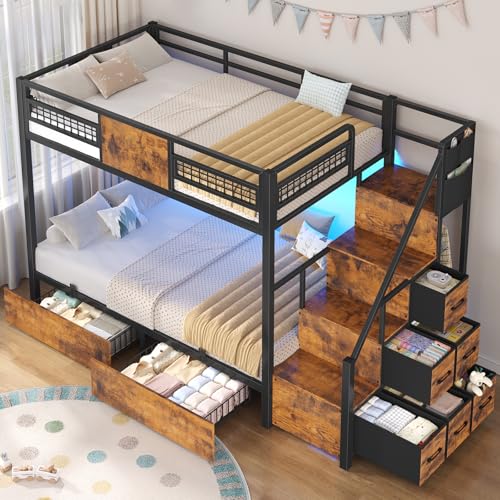
BTHFST Bunk Bed Twin Over Twin with Stairs, Storage Drawers and LED Lights | 8 Drawers, Heavy Duty Bunk Bed, Hanging Area, Full-length Guardrail, Space-saving Bed for Dorm, Bedroom, Apartment
Check price on Amazon
DICTAC Twin Over Twin Bunk Bed with 6 Storage Drawers,Led Lights and Charging Station Metal Bunk Beds with Side Bookcase,3 Storage Boxes &Shelf,L-Shaped bunk Bed with Safety Guardrail and Ladder,Black
Check price on Amazon
Jocoevol Metal Bunk Bed Twin Over Twin with Storage Staircase, Clothes Rack, LED Twin Bunk Beds for Kids with 2 Storage Drawers, Full-Length Guardrail, No Box Spring Needed, Easy Assembly, White
Check price on Amazon
BTHFST Bunk Bed Full Over Full with Stairs, Storage Drawers and LED Lights | 8 Drawers, Heavy Duty Bunk Bed, Hanging Area, Full-length Guardrail, Space-saving Bed for Dorm, Bedroom, Apartment
Check price on Amazon
Twin Over Twin Bunk Bed with Reversible Storage Dresser & Angled Ladder | Full-length guardrails, no box spring needed, 6 drawers. For kids, teens, dorms, small rooms. Floor-level low design. Black
Check price on AmazonFrequently Asked Questions
Are bunk beds with storage drawers safe for children?
Yes, when properly constructed and correctly assembled, bunk beds with storage drawers are safe. Look for models with reinforced guardrails, sturdy ladder attachment, and drawers that lock or stop securely to prevent accidental opening. Always follow the manufacturer's weight limits and assembly instructions.
What is the best drawer configuration for a bunk bed?
The best configuration depends on your room layout. Under-bed drawer banks on the bottom bunk are ideal for everyday clothing, while side-access drawers work well in tighter spaces. Staircase drawers combine climbing access with hidden storage and suit shared kids' rooms especially well.
How much weight can bunk bed storage drawers hold?
Drawer weight capacity varies by construction. Entry-level models typically handle light bedding and clothing, while mid-range and premium models with reinforced glides and solid wood construction support heavier loads. Always check the manufacturer's stated capacity per drawer.
Can bunk beds with drawers be used by adults?
Yes, many full-over-full and queen-over-queen bunk beds with drawers are rated for adult use. Check the weight rating of both the top and bottom bunks, and choose models with high-grade steel or solid hardwood frames for long-term durability.
How do I maintain the drawers on a bunk bed?
Keep drawer glides clean and free of debris, tighten hardware periodically, and avoid overloading drawers beyond the stated capacity. For wooden drawers, a light application of furniture wax on the runners keeps them sliding smoothly.