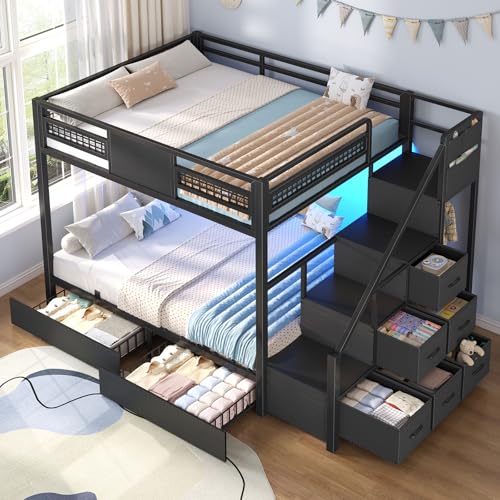
Full Over Full Over Full Bunk Beds: The Complete Triple Bunk Buying Guide
Planning to sleep three in a single footprint? A full over full over full bunk bed stacks three full-size sleeping surfaces into one vertical frame. This guide explains configurations, structural requirements, safety features, mattress specifications, and room planning so you can choose a triple bunk that fits your household and lasts for years.
SleepWisePicks Quick Take: A full over full over full bunk bed is the highest-capacity configuration in the bunk bed category — three full-size mattresses, three sleepers, one footprint. It is ideal for large families, vacation homes, and multi-child rooms, but it demands careful attention to ceiling height, frame strength, ladder access, and per-tier weight ratings. Read this guide before you compare models, and you will know exactly which specifications matter.
What Is a Full Over Full Over Full Bunk Bed?
A full over full over full bunk bed — often called a triple full bunk or three-tier full bunk — is a bunk bed frame with three stacked sleeping platforms, each sized for a standard full mattress (approximately 54 by 75 inches). The bottom tier typically sits close to the floor or on a low platform, the middle tier is raised above it, and the top tier reaches the highest point of the frame.
Unlike the more common full over full bunk beds that sleep two, the triple configuration adds a third full-size sleeping surface while keeping the same floor footprint. That makes it a vertical space solution rather than a horizontal one. The trade-off is height: a finished triple full bunk commonly stands between 75 and 90 inches tall depending on the model, which has a direct impact on ceiling clearance and ladder design.
Most triple full bunks are built from metal, solid wood, or a combination of both. Entry-level models favor tubular steel, while mid-range and premium models often use solid pine, hardwood, or reinforced steel with thicker gauge construction. The best models include full-length guardrails on the upper two tiers, wide integrated ladders or staircases, and corner braces that distribute load across the frame.
Who Buys a Full Over Full Over Full Bunk Bed?
Triple full bunks serve a specific set of households. If any of the following describes your situation, this configuration is worth serious consideration:
- Large families with three children sharing a room. Three full mattresses give each child a genuinely comfortable sleeping surface rather than a narrow twin.
- Vacation rentals and guest houses. A triple full bunk maximizes sleeping capacity per square foot, which is valuable in cabins, beach houses, and short-term rental properties.
- Multi-generational homes. Adult-rated triple bunks can accommodate teenagers, college students, and visiting adults in a shared guest space.
- Bunk rooms and sleepover rooms. Families who regularly host cousins, friends, or guests benefit from three full beds in one place.
- Small homes with high ceilings. If your ceiling height supports it, a triple bunk converts vertical space into sleeping capacity that a standard bed cannot match.
If your household needs only two sleeping surfaces, a standard full over full bunk bed is simpler, shorter, and easier to climb. The triple configuration is best reserved for situations where three full-size sleepers genuinely need to share a footprint.
Common Full Over Full Over Full Bunk Bed Configurations
Not every triple full bunk is built the same way. The configuration determines how the frame assembles, how you access each tier, and how the unit behaves if you later need to separate or reconfigure it. Below are the most common layouts available today.
1. Standard Three-Tier Stack
The classic layout: three full platforms stacked vertically with fixed ladders or a staircase at one end. This is the most space-efficient design and the most common configuration in the triple full category. Access to the middle and top tiers is usually via an angled ladder or a vertical ladder attached to the frame.
2. Staircase and Storage Access
Instead of a ladder, some models use a built-in staircase with storage compartments behind each step. This improves safety for younger sleepers and adds usable storage for bedding, books, or toys. Staircase models add depth to the footprint, so measure your room carefully before ordering. For households that value storage integration, full over full bunk beds with stairs and storage offer a comparable approach in a two-tier format.
3. Separable and Convertible Models
Some triple bunks are modular: the frame disassembles into individual full beds or into a standard two-tier bunk plus a standalone bed. This flexibility is valuable if your household composition changes. Convertible designs are closely related to full over full convertible bunk beds, which offer similar reconfiguration options in a two-tier format.
4. L-Shaped Triple Bunks
An L-shaped triple bunk places one full bed perpendicular to the stacked pair, creating an L footprint. This layout works well in corner placements and rooms where a straight vertical stack would block a window or doorway. The trade-off is a larger floor footprint than a straight stack.
5. Floor-Level Bottom Bunk
Some triple designs place the bottom full mattress at or near floor level, with the middle and top tiers stacked above. This lowers the overall center of gravity and makes the bottom tier easier to access for younger children or adults with mobility considerations. It is similar in spirit to full over full floor bunk beds, adapted for three sleepers.
Configuration tip: Before choosing a layout, map the room on paper. Mark the frame footprint, the ladder or staircase swing, and the clearance needed to open windows, doors, and closets. A triple full bunk that fits the room but blocks a doorway is a daily frustration.
Full Over Full Over Full Bunk Bed Quality Tiers
Triple full bunks range from practical starter frames to heavy-duty commercial-grade units. Rather than comparing raw numbers, it helps to understand how the category is typically segmented. The table below uses a neutral tier system that applies across brands and market positions.
| Tier | Typical Materials | Best For | What to Expect |
|---|---|---|---|
| Entry-level | Tubular steel, thinner gauge metal, basic hardware | Light use, younger children, short-term setups | Functional construction with basic guardrails and a standard ladder. Weight limits are typically lower per tier, and assembly hardware is simpler. |
| Mid-range | Reinforced steel, solid pine, mixed wood-and-metal construction | Daily use by children and teens, family homes | Stronger frame geometry, wider ladder treads, improved guardrail coverage, and better load distribution. A solid choice for most households. |
| Premium | Solid hardwood, heavy-gauge steel, premium joinery | Adult sleepers, heavy daily use, long-term ownership | Higher per-tier weight ratings, reinforced corner joints, smoother finishes, and more refined ladder or staircase designs. |
| Commercial-grade | Industrial steel, commercial hardwood, bolted connections | Rental properties, hostels, dormitories, high-turnover use | Built for repeated use and heavier occupants. Often includes stricter safety certifications and more robust assembly hardware. |
As a general rule, the mid-range tier offers the best balance of durability and structural refinement for a family home. Entry-level models are reasonable for light use, while premium and commercial-grade frames are worthwhile investments for adult sleepers, rental properties, or households that expect daily use for a decade or more.
For households comparing triple full bunks with other high-capacity options, it also helps to review full over full bunk beds with high weight capacity — many of the same construction principles apply, and understanding them makes it easier to evaluate a triple bunk's load ratings.
Safety Features That Matter on a Triple Full Bunk
Height makes safety the single most important consideration in the triple full category. A fall from the top tier is more consequential than a fall from a standard bunk, so the frame's safety features deserve close attention.
Guardrails on the Upper Tiers
Both the middle and top tiers should have full-length guardrails on all open sides, with no gap larger than a few inches at the corners. Guardrails should be attached to the frame with reinforced brackets, not decorative hardware. On a triple bunk, the middle tier is just as important as the top tier — do not assume guardrails are included on both.
Ladder and Staircase Design
Wide, flat ladder treads are easier and safer to climb than round rungs. Ladders should be firmly attached to the frame and extend above the top rail. Staircase models should have handrails and non-slip step surfaces. For younger children, a staircase with storage often proves safer than a vertical ladder.
Weight Ratings Per Tier
Each tier of a triple bunk should carry its own weight rating. Check the manufacturer's specification for per-tier capacity, not just an overall frame rating. A common pattern is a higher rating on the bottom tier and somewhat lower ratings on the middle and top tiers, though premium models often maintain consistent ratings across all three.
Frame Rigidity and Joint Construction
A triple bunk carries substantially more load than a two-tier frame. Look for reinforced corner joints, cross-bracing, and center support rails. Metal frames should use thicker gauge steel at load-bearing points; wooden frames should use solid hardwood rather than particle board at critical joints.
Placement and Clearance
Position the bunk away from ceiling fans, light fixtures, and windows that open inward. Leave clearance for the ladder or staircase, and keep the top tier away from walls that could trap a sleeper. If the room has a sloped ceiling, verify that the top tier has adequate headroom across the full mattress length.
Safety reminder: Triple bunks are not recommended for very young children. Follow the manufacturer's age guidance, and consider a lower-profile two-tier bunk until children are old enough to use a ladder safely and consistently.
Choosing Mattresses for a Triple Full Bunk
Mattress choice affects both comfort and safety on a triple bunk. A mattress that is too thick can compromise guardrail height on the upper tiers and make ladder access awkward. A mattress that is too thin may not provide adequate support for adult sleepers.
Recommended Thickness
- Upper tiers: 6 to 8 inches is the safest range. This keeps the mattress surface well below the top of the guardrail and preserves ladder clearance.
- Middle tier: The same 6 to 8 inch range applies, since the middle tier is also elevated.
- Bottom tier: 8 to 10 inches is generally fine, as the bottom tier is close to the floor and does not have the same guardrail constraints.
Firmness and Support
Medium-firm mattresses work well for most sleepers on a bunk. They provide enough support for back and stomach sleepers while remaining comfortable for side sleepers. If the bunk will be used by adults, choose a mattress rated for adult weight rather than a child-focused foam model.
Foam vs. Innerspring
Memory foam and hybrid mattresses are popular for bunks because they minimize motion transfer between tiers — important when three people are sleeping in close vertical proximity. Innerspring mattresses are also suitable if the frame provides a solid support base. For households exploring foam options, foam beds in a box are a practical way to source bunk-friendly mattresses with predictable thickness.
Mattress Care on a Triple Bunk
Rotate mattresses periodically to distribute wear, especially on the top tier where weight is concentrated. Use a mattress protector on all three tiers, and check that the mattress fits the frame platform without overhang or excessive gaps.
Room Planning and Ceiling Height for Triple Full Bunks
The practical feasibility of a full over full over full bunk depends as much on the room as on the frame. Before you commit, measure and verify the following:
Ceiling Height
A finished triple full bunk typically stands 75 to 90 inches tall. Add at least 30 inches of clearance above the top bunk for comfortable sitting and safe movement. In practice, that means a ceiling height of at least 8.5 to 9 feet for most models. Low-ceiling rooms are usually better served by a two-tier bunk or a full over full low bunk bed.
Floor Footprint
A full mattress is 54 by 75 inches, so the frame footprint is roughly 60 by 80 inches plus ladder or staircase depth. Staircase models can add 15 to 20 inches of depth. Measure the room's usable floor area after accounting for doors, closets, and windows, and leave walking clearance around the frame.
Ladder and Staircase Swing
Ladders need room to be climbed safely. Staircases need room to be entered and exited. Mark the access zone on the floor and confirm it does not conflict with furniture, doors, or the path to the bathroom at night.
Wall and Window Clearance
Keep the top tier away from inward-opening windows and wall-mounted shelves. If the room has a ceiling fan, verify that the top tier does not place a sleeper within the fan's sweep. A wall anchor kit should be used on all bunk beds, including triple bunks, to prevent tipping.
Room Use and Traffic Flow
In a shared bedroom, the triple bunk should not block access to closets, dressers, or the door. Consider the room from the perspective of all three occupants: can each person reach their belongings without climbing over someone else? If not, a different layout or a lower bunk configuration may work better.
Related Considerations Before You Buy
Triple full bunks sit within a broader family of high-capacity bunk and full-size bed options. Depending on your household, one of these related categories may be a better fit:
- Full over full triple bunk beds — a broader overview of triple configurations, including twin-over-full and mixed-size layouts.
- Full size bunk beds for adults — weight ratings and frame construction for adult sleepers.
- Full over full bunk beds with storage — storage-integrated designs for smaller rooms.
- Full over full metal bunk beds — steel-frame options with their own durability and assembly characteristics.
- Full over full bunk beds wood — solid wood construction and finish considerations.
- Full bunk beds — the wider two-tier category if three sleeping surfaces are not required.
If you are furnishing a larger bunk room or a rental property, it is also worth comparing the triple full configuration with full over full over full bunk beds from multiple brands and reading the specification sheets side by side. The differences that matter most are per-tier weight ratings, guardrail coverage, ladder design, and overall assembled height.
Frequently Asked Questions
How much weight can a full over full over full bunk bed hold?
Weight capacity varies by model and material. Entry-level metal frames often support around 250 pounds per tier, while mid-range and premium solid wood or reinforced steel models commonly support 400 to 500 pounds per bunk. Always confirm the manufacturer's stated capacity per tier before purchase, and remember that the top tier may have a different rating than the bottom tier.
What ceiling height do I need for a full over full over full bunk bed?
A three-tier bunk typically requires a ceiling height of at least 8.5 to 9 feet to allow comfortable clearance for the top sleeper and safe movement. Measure the assembled height of the specific model plus a minimum of 30 inches of headroom above the top bunk before ordering. Rooms with lower ceilings are usually better suited to a two-tier bunk.
Is a full over full over full bunk bed safe for adults?
Yes, provided the frame is rated for adult weight and the top tiers are used responsibly. Adult-rated triple bunks feature reinforced guardrails, heavier-gauge steel or solid hardwood, and wider ladder treads. Many adults use them in vacation rentals, guest rooms, and shared family cabins. Always follow the manufacturer's weight and age guidance.
Can a full over full over full bunk bed be separated?
Some models are designed as modular units that separate into individual full beds, a standard full-over-full bunk plus a standalone bed, or a low bunk configuration. Check the product specification carefully — not all triple bunks offer this flexibility. Separable designs are useful if your household needs change over time.
What mattress thickness works best for triple bunk beds?
A mattress between 6 and 8 inches thick is generally recommended for the upper tiers to maintain guardrail effectiveness and safe ladder access. The bottom tier can accommodate a standard 8 to 10 inch full mattress. Always stay within the manufacturer's maximum mattress height guidance for each tier.
Ready to Compare Full Over Full Over Full Bunk Beds?
Review the recommended models below, compare their tier ratings and safety features, and choose the triple bunk that fits your room and household.
View Recommended Models