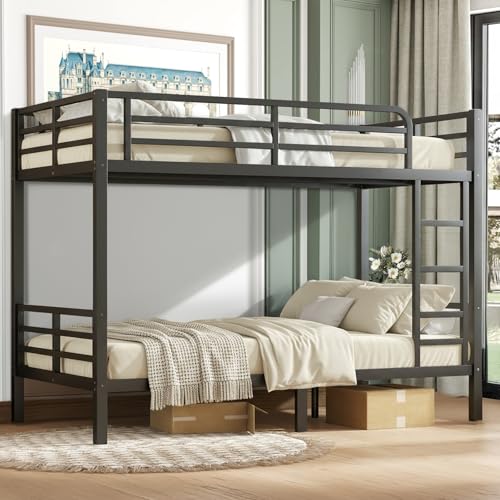
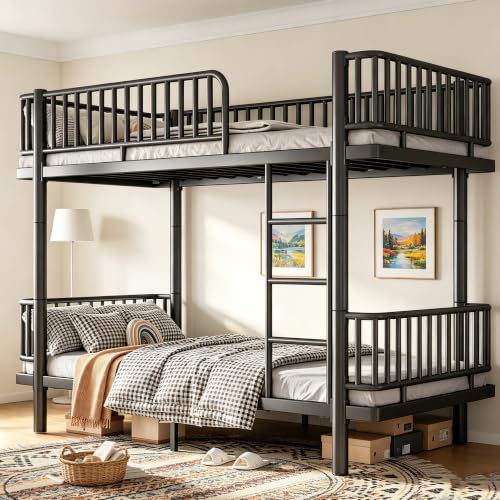
Heavy Duty Twin XL Bunk Beds: The Complete Buying Guide
Engineered for strength, built for comfort. Everything you need to know before choosing a heavy duty twin XL bunk bed for adults, teens, or guest rooms.
START READINGWhy Heavy Duty Twin XL Bunk Beds Deserve Your Attention
A bunk bed is more than a space-saving solution — it is a piece of furniture that carries real weight, real movement, and real people every single night. Standard bunk beds often work well for young children, but when adults, teenagers, or heavier sleepers are involved, the frame becomes the most important part of the equation. That is where heavy duty twin XL bunk beds come in.
Twin XL mattresses measure 38 inches wide by 80 inches long, giving five extra inches of length compared to a standard twin. For tall teens and adults, this extra length is not a luxury — it is a necessity. Combine that with a reinforced frame, and you get a bunk bed that genuinely serves adult sleepers rather than merely tolerating them.
This guide walks you through frame materials, weight capacity considerations, safety features, mattress pairing, and room planning. By the end, you should have a clear picture of what a well-built heavy duty twin XL bunk bed looks like and how to identify one that fits your household.
What Makes a Twin XL Bunk Bed Truly Heavy Duty?
The term "heavy duty" gets used loosely. In practice, a genuinely heavy duty bunk bed is defined by a handful of measurable construction characteristics. When you evaluate models, look for these signals:
- Frame material: High-grade steel or solid hardwood (such as pine, oak, or rubberwood) provides the structural backbone. Tubular steel with a rust-proof finish is common in commercial-grade models. For wooden options, look for reinforced corner joints and thick posts rather than thin slats. If wood is your preference, you may also want to explore heavy duty wooden bunk beds for adults as a complementary reference.
- Weight capacity: Manufacturers publish a per-bunk weight limit. A heavy duty model is one whose stated capacity comfortably exceeds the intended user's weight, leaving a margin for mattress weight and dynamic movement. Commercial-grade frames often advertise higher capacities than residential entry-level frames.
- Reinforcement details: Look for cross-bracing, center support rails, and welded rather than riveted joints. Corner brackets and steel slats distributed at close intervals contribute to load distribution.
- Guardrail height and construction: A full-length guardrail on the top bunk is non-negotiable. Heavy duty frames typically attach guardrails with reinforced hardware rather than simple brackets.
- Ladder integration: A sturdy ladder with flat steps and a secure attachment — ideally hooked over the frame or bolted in place — is a hallmark of a well-engineered bunk bed.
- Finish quality: A powder-coated or rust-proof finish protects the frame from wear and moisture, which matters in humid climates or shared living spaces.
These details separate a bunk bed that will last a decade from one that starts wobbling within a year. If you are comparing broader categories, the heavy duty bunk beds overview covers the full spectrum of reinforced options and can help you benchmark what "sturdy" really means.
Twin XL Dimensions: Why the Extra Length Matters
Before choosing a frame, it helps to understand exactly what a twin XL mattress brings to a bunk bed. Here is how the size compares to common alternatives:
| Mattress Size | Width | Length | Best For |
|---|---|---|---|
| Standard Twin | 38 in | 75 in | Children, smaller rooms |
| Twin XL | 38 in | 80 in | Teens, adults, taller sleepers |
| Full | 54 in | 75 in | Single adults, couples (tight fit) |
| Queen | 60 in | 80 in | Couples |
The key insight: twin XL keeps the narrow 38-inch footprint of a standard twin while extending the length to 80 inches, matching a queen mattress in length. For a bunk bed, this is the ideal combination — you save floor space horizontally while ensuring adult-sized sleepers are not cramped.
If you are designing a room for multiple adults, twin XL bunk beds pair naturally with related configurations such as full XL over full XL bunk beds if more width is needed, or heavy duty twin XL bunk beds for adults if durability for grown sleepers is the priority.
Metal vs. Wood: Choosing the Right Frame Material
The two dominant frame materials for heavy duty twin XL bunk beds each bring distinct advantages. Neither is universally better — the right choice depends on your household, climate, and design preferences.
Metal Frames
Steel bunk beds are the default choice for heavy duty applications. Tubular steel with reinforced joints delivers exceptional strength-to-weight ratios, and powder-coated finishes resist rust and scratches. Metal frames tend to have a cleaner, more industrial aesthetic and are generally easier to disassemble for moving. If strength is your top priority, heavy duty metal bunk beds for adults is a strong starting point for comparison.
When evaluating metal frames, check the gauge of the steel (lower gauge numbers mean thicker steel), the welding quality, and whether the slats are steel or wood. Steel slats add rigidity but may require a mattress with a firm base.
Wood Frames
Solid wood bunk beds offer warmth and blend naturally with traditional or rustic decor. The best heavy duty wooden frames use thick posts (at least 2 inches square), reinforced corner blocks, and solid wood slats rather than plywood or particle board. Wood frames are generally quieter than metal when properly constructed, but they demand more attention to humidity and joint maintenance.
For a deep dive into wooden construction standards, refer to the heavy duty wooden bunk beds for adults guide, which breaks down joinery and finish considerations in detail.
Whichever material you choose, the universal rule applies: reinforcement details matter more than the material label. A well-braced metal frame outperforms a poorly built wooden one, and vice versa.
Safety Features to Prioritize
Bunk bed safety is not optional, especially when adults are involved. The following features should be treated as baseline requirements rather than bonuses:
- Full-length guardrails on the top bunk: Guardrails should run the entire length of the mattress and be attached with reinforced hardware. The gap between the guardrail and mattress should not exceed a few inches to prevent entrapment.
- Secure ladder attachment: The ladder should hook over or bolt into the frame. Flat, wide steps are safer than narrow rungs, particularly for bare feet in the dark.
- Weight capacity rating: Never assume a bunk bed can handle adult weight without verifying the manufacturer's stated capacity. Heavy duty models publish these figures clearly.
- Stable base and center support: A center support rail reduces flex and distributes load. Some frames include additional legs or braces for the bottom bunk.
- No sharp edges: Rounded corners and deburred metal edges reduce the risk of injury in tight spaces.
- Proper assembly: Even the strongest frame becomes unsafe if assembled incorrectly. Follow the manufacturer's instructions precisely, and recheck bolts after the first week of use.
If you are evaluating a broader range of reinforced models, the heavy duty bunk beds with storage category often highlights frames that combine safety engineering with built-in drawers or shelving — a useful reference for understanding how safety and utility intersect.
Choosing the Right Mattress for a Twin XL Bunk Bed
The mattress you pair with a heavy duty twin XL bunk bed directly affects both comfort and safety. Two rules dominate:
Thickness matters on the top bunk. A mattress that is too thick can rise above the guardrail, defeating its purpose. A 6- to 8-inch twin XL mattress is generally the safest choice for the upper bunk. For the lower bunk, an 8- to 10-inch mattress works well since guardrail height is not a concern.
Firmness affects frame stress. Very soft mattresses allow the sleeper to sink and concentrate weight in specific areas, which can accelerate wear on slats and joints. A medium-firm mattress distributes weight more evenly and pairs well with reinforced frames.
Memory foam and hybrid mattresses are popular for bunk beds because they minimize motion transfer — an important consideration when two people share a bunk structure. If you are exploring mattress types, the hybrid mattresses guide explains how foam-and-coil constructions balance support and pressure relief.
Room Planning: Space, Height, and Layout
A heavy duty twin XL bunk bed is a substantial piece of furniture. Before purchasing, measure your room carefully and account for the following:
- Ceiling height: Allow at least 30 to 36 inches between the top of the upper mattress and the ceiling. For adults, more clearance is preferable — aim for 36 inches or more if possible.
- Bunk-to-bunk clearance: The space between the bottom mattress and the underside of the top bunk should be sufficient for the lower sleeper to sit up comfortably. For adults, this typically means 32 to 38 inches.
- Footprint: A twin XL bunk bed occupies roughly the same floor area as a standard twin bunk bed (about 38 by 80 inches for the mattress, plus frame overhang). Confirm door swing, closet access, and walkway width remain usable.
- Wall anchoring: Many manufacturers recommend anchoring the frame to the wall for added stability. This is especially important in households with active sleepers or children who may climb on the frame.
For rooms that serve multiple purposes — a guest room that doubles as a home office, for example — convertible bunk beds that separate into two twin XL beds offer valuable flexibility. Related configurations such as heavy duty loft beds for adults are worth considering if you prefer open floor space beneath the sleeping area rather than a second bunk.
Who Should Consider a Heavy Duty Twin XL Bunk Bed?
These beds serve a surprisingly wide range of households. The most common scenarios include:
- Families with teenagers: Teens outgrow standard twin beds quickly. Twin XL length accommodates growth spurts, and heavy duty frames handle the wear and tear of active adolescents.
- Adult siblings or roommates sharing a room: When floor space is limited, a twin XL bunk bed provides two full-length sleeping surfaces without sacrificing legroom.
- Guest rooms and vacation homes: A durable bunk bed maximizes sleeping capacity while remaining comfortable for adult guests.
- College dorms and rental properties: Commercial-grade frames withstand frequent use and reduce long-term replacement needs.
- Multigenerational homes: Grandparents or extended family members who need a comfortable, safe place to sleep benefit from the extra length and reinforced construction.
If your household includes younger children as well, you may want to compare options in the high weight capacity bunk beds category, which highlights models that bridge the gap between child-friendly and adult-capable designs.
Heavy Duty Twin XL Bunk Beds at a Glance
The table below summarizes how different tiers of heavy duty twin XL bunk beds compare across key criteria. Use it as a quick reference when narrowing down your options.
| Tier | Frame Construction | Weight Capacity | Best For |
|---|---|---|---|
| Entry-level | Steel frame, basic slats | Moderate | Light adult use, guest rooms |
| Mid-range | Reinforced steel or solid wood, center support | High | Daily adult use, teens |
| Premium | High-grade steel, welded joints, cross-bracing | Very high | Heavy adults, long-term residential use |
| Commercial-grade | Thick tubular steel, industrial hardware, rust-proof finish | Highest available | Dorms, rentals, high-traffic settings |
Notice that the differences are structural rather than cosmetic. A premium or commercial-grade frame invests in thicker steel, better welding, and more comprehensive bracing — features that translate directly into stability and longevity.
Your Pre-Purchase Checklist
Before you commit to a heavy duty twin XL bunk bed, run through this checklist:
- Measure your ceiling height and confirm adequate clearance above the top bunk.
- Verify the weight capacity against the heaviest intended user plus mattress weight.
- Inspect the guardrail design — full-length rails with secure hardware are essential.
- Check the ladder attachment and step design for safety and comfort.
- Confirm mattress thickness compatibility, especially for the top bunk.
- Review the assembly requirements and whether professional installation is recommended.
- Plan wall anchoring if the manufacturer recommends it.
- Compare convertible options if flexibility (two separate beds) matters to you.
For additional context on heavy-duty frames in general, the heavy duty beds resource covers structural standards across bed types, while heavy duty bed frames focuses specifically on the frame engineering that underpins bunk bed durability.
Frequently Asked Questions
What does twin XL mean for a bunk bed?
Twin XL refers to a mattress size that is 38 inches wide and 80 inches long — five inches longer than a standard twin. This extra length makes twin XL bunk beds ideal for taller teenagers and adults who need more legroom.
How much weight can a heavy duty twin XL bunk bed hold?
Weight capacities vary by model. Heavy duty twin XL bunk beds are engineered with reinforced steel frames or solid wood construction and typically support substantially more weight than standard bunk beds, making them suitable for adults and commercial environments. Always check the manufacturer's stated per-bunk capacity.
Are twin XL bunk beds safe for adults?
Yes, when properly constructed and installed. Look for models with high-grade steel or solid wood frames, full-length guardrails, secure ladder attachments, and a weight capacity that exceeds the intended user's needs.
What mattress thickness works best with twin XL bunk beds?
A mattress between 6 and 8 inches thick is generally recommended for the top bunk to ensure guardrails remain effective. For the bottom bunk, a standard twin XL mattress of 8 to 10 inches works well.
Can twin XL bunk beds be separated into two beds?
Many twin XL bunk bed designs are convertible, allowing the top and bottom sections to be used as two separate twin XL beds. This flexibility is useful for guest rooms or growing families.
Final Thoughts
A heavy duty twin XL bunk bed is an investment in both space efficiency and long-term durability. The extra length accommodates adult sleepers, while reinforced construction ensures the frame remains stable night after night. Focus your evaluation on frame material, weight capacity, safety features, and mattress compatibility — and do not overlook room measurements.
Whether you are furnishing a shared bedroom, a guest room, or a rental property, the right heavy duty twin XL bunk bed should serve your household comfortably for years. Use the checklist and comparison table above as your guide, and explore related configurations to find the model that fits your space and sleepers best.