Full Over Full Bunk Beds with Mattress: The Complete Buying Guide
Two full-size sleeping surfaces in one footprint. Learn how to choose a full over full bunk bed with mattresses included — sizing, safety, frame materials, and setup — so you buy once and sleep well for years.
Jump to Buying EssentialsWhat Makes a Full Over Full Bunk Bed with Mattress Worth Choosing
Full over full bunk beds solve a very specific problem: how do you give two sleepers proper full-size room without dedicating two separate floor areas? The answer is vertical stacking. Unlike twin-over-twin configurations, both levels here are full size, so teenagers, adults, and couples sharing a guest space all get generous width. Unlike a full over queen arrangement, both mattresses are the same standard full size, which simplifies shopping for sheets and bedding.
When mattresses are included in the bundle, you skip the most error-prone part of bunk bed ownership: matching the right mattress thickness and firmness to the frame. A well-designed bundle ensures the top mattress sits at or below the guardrail line and the bottom mattress fits snugly between the rails. That said, not every bundle is equal — the guide below explains what separates a solid setup from a frustrating one.
Full Over Full Bunk Bed Sizes and Room Requirements
A standard full mattress measures about 54" wide × 75" long. A full over full bunk frame is therefore roughly 58–62 inches wide and 80–84 inches long once you account for posts and rails. Add clearance for the ladder and room to open drawers or storage stairs, and you should plan for a footprint of roughly 7 feet by 8 feet in the room.
Ceiling height matters just as much as floor space. Most bunk beds need at least 30–36 inches of clearance between the top mattress surface and the ceiling so the upper sleeper can sit up without hitting their head. Measure your ceiling before you commit to any stacked design — this is the single most common sizing mistake buyers make.
- Floor footprint: plan around 7' × 8' including ladder access
- Ceiling clearance: 30–36 inches above the top mattress recommended
- Door and hallway clearance: confirm the assembled frame fits through your entry path, or check whether it ships in manageable sections
- Mattress thickness: typically 6–10 inches per level for bunk use; confirm the frame's stated maximum
Frame Types: Metal, Wood, and Convertible Designs
The frame is the structural heart of the bed, and it dictates both safety and longevity. Here is how the main categories compare for a full over full configuration:
| Frame Type | Market Tier | Best For | Key Considerations |
|---|---|---|---|
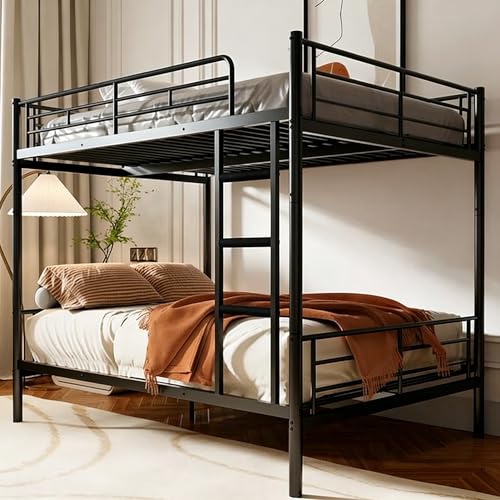
| Steel / metal bunk frame | entry-level to mid-range | Teens, guest rooms, high-traffic shared bedrooms | Look for reinforced corner joints, powder-coated rust-resistant finish, and a stated weight capacity per level. Metal frames are typically the most durable per tier. |
| Solid wood bunk frame | mid-range to premium | Primary bedrooms, design-forward rooms, long-term family use | Hardwood (pine, rubberwood, oak) resists wobble better than composite boards. Check for slat spacing under 3 inches and corner-block reinforcement. |
| Convertible / detachable bunk | mid-range to high-end tier | Growing families, flexible guest rooms, future reconfiguration | Splits into two standalone full beds. Verify the separation hardware is included and the frame remains stable in both configurations. See full over full bunk beds that separate for models built around this feature. |
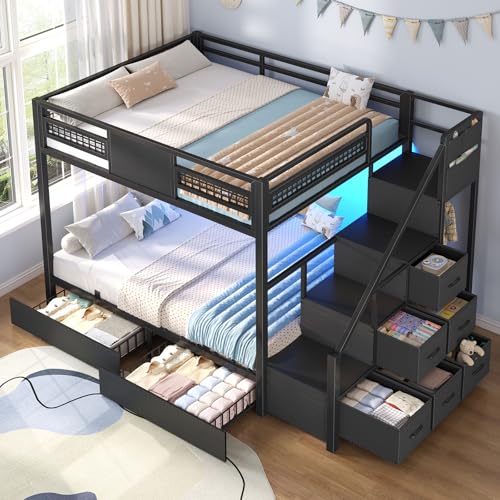
| Storage-integrated bunk | mid-range to premium | Small rooms, kids' rooms, maximizing every square foot | Stairs with built-in drawers or under-bed storage add function but increase footprint. Confirm drawer clearance against walls and doors. |
If you specifically want the separation option, compare full over full convertible bunk beds and detachable models side by side. For a design-led room, wood full over full bunk beds offer a warmer look than metal. And if floor-level access matters — say, for younger children or a low-ceiling room — floor bunk beds keep the lower mattress close to the ground.
Mattresses Included: What to Check Before You Buy
A "with mattress" bundle is only as good as the mattresses inside it. Many entry-level bundles ship with thin foam mattresses that are fine for occasional guest use but compress quickly under nightly adult weight. Mid-range and premium bundles typically upgrade to denser foam or pocketed coils, which hold their shape longer and sleep cooler.
Use this checklist to evaluate any mattress-included bundle:
Mattress Bundle Evaluation Checklist
- Thickness: each mattress should be at least 6 inches thick; 8 inches is a comfortable mid-range standard. Anything above 10 inches on the top bunk risks defeating the guardrail.
- Certification: look for third-party foam or textile certifications such as CertiPUR-US or OEKO-TEX on the listing.
- Support type: dense polyurethane foam is common at entry-level; pocketed coils or hybrid construction appear in premium bundles and generally sleep cooler.
- Firmness: medium-firm is the safest universal choice for shared bunk beds used by different sleepers.
- Cover quality: removable, washable covers are a practical upgrade for kids' rooms.
- Bunk suitability statement: the manufacturer should explicitly rate the mattress for bunk use.
If the bundle's mattresses do not meet your needs, some frames are sold separately so you can pair them with a dedicated bunk mattress. Our guides to full mattress bunk beds and full size bunk beds with mattress included go deeper on mattress pairing. For an even larger sleeping surface on the lower level, a full over queen configuration for adults is worth a look.
Safety Features That Actually Matter
Bunk bed safety is not a checkbox — it is a combination of design features that work together. When reviewing any full over full bunk bed with mattress, prioritize these elements:
- Full-length guardrails on the top bunk on both long sides, with no gap wider than a few inches at the corners.
- A weight capacity stated per level — not a single combined figure. Adult-rated models typically rate each level well above an average single sleeper.
- Wide, flat ladder steps rather than narrow rungs, ideally with a handrail. Angled ladders are easier to climb than vertical ones.
- Reinforced slat support with slat spacing under 3 inches, and a center support rail on full-size lower levels.
- No sharp exposed hardware at head height on the upper level.
- Stability testing — check the listing for a stated test standard or load rating.
For households with heavier sleepers or adult use, review high weight capacity full over full bunk beds and the dedicated guide to full over full bunk beds for adults.
Stairs, Storage, and Access Options
How you get to the top bunk shapes daily usability. A basic ladder is the most compact option but the least comfortable for nightly use. Built-in stairs are safer and easier for children and older teens, and many stair designs include drawers or cubbies underneath. If storage is a priority in a small room, compare bunk beds with stairs and storage against storage stair models. For maximum drawer space, full over full bunk beds with drawers put the space under the lower bunk to work.
Other popular configurations include models with a full trundle for a third sleeper, and L-shaped designs that trade a straight stack for a corner-friendly layout.
How to Set Up and Maintain Your Bunk Bed
Assembly is usually a two-person job and takes an afternoon for most full over full frames. Follow the manufacturer's sequence exactly — tightening the frame before the slats are seated is the most common cause of wobble. Once assembled, re-tighten all bolts after the first week of use, then check them seasonally.
- Place the bed against a wall or corner where possible, but never rely on the wall for structural support.
- Keep the ladder clear and never place furniture in front of it.
- Rotate and flip the mattresses every few months to even out compression.
- Use a mattress protector on both levels — spills on the top bunk travel downward.
- Avoid jumping on the upper level; even adult-rated frames are not trampolines.
Matching Bedding and Room Style
Full-size bedding is widely available, which is one of the practical advantages of this configuration. If you want a coordinated look, explore full bedspreads and comforters and full size bedsets. For a styled guest room, French country style bedspreads add a layered, hotel-like feel.
Smaller rooms benefit from vertical styling — a slim floating bedside shelf beside the lower bunk keeps essentials within reach without stealing floor space. If you are furnishing the whole room, farmhouse bedside tables pair naturally with wood bunk frames.
Choosing Between Similar Bunk Configurations
Full over full is not the only option, and the right choice depends on who is sleeping where. Here is how the closest alternatives compare:
- Standard full over full bunk beds — the baseline for two full-size sleepers in one footprint.
- Full and twin bunk beds — a smaller upper level, useful when one sleeper is a child.
- Full size bunk beds — the broader category if you are still deciding on exact dimensions.
- Full over full over full triple bunks — three full-size levels for larger households or vacation rentals.
- Full over full triple configurations — a comparison view of triple-stack options.
- Metal full over full bunk beds — the most durable choice per tier for heavy daily use.
If you are outfitting a cabin, rental, or camping-adjacent property, the family camping guide covers related sleeping arrangements.
Who Should Buy a Full Over Full Bunk Bed with Mattress?
This configuration fits best when you need two genuinely full-size sleeping surfaces in a shared room. That includes:
- Teen siblings who have outgrown twin beds but still share a room.
- Guest rooms and vacation rentals that need to sleep four adults comfortably.
- Multi-generational households where adult weight ratings and stair access matter.
- Families planning ahead — a convertible model can split into two full beds later.
It is less suitable for very young children, who do better on a lower bunk or a floor-level design, and for rooms with low ceilings where the upper level would feel cramped.
Frequently Asked Questions
What size mattress fits a full over full bunk bed?
Two standard full-size mattresses, each about 54 inches wide by 75 inches long. Most manufacturers recommend keeping the top bunk mattress at 8–10 inches thick or less so the guardrail remains effective.
Are full over full bunk beds safe for adults?
Yes, when the frame is rated for adult weight. Look for reinforced steel or solid hardwood, a stated weight capacity for each level, wide ladder steps, and full-length guardrails. Adult-rated models are designed for nightly adult use.
Do full over full bunk beds come with mattresses included?
Many bundles include two full-size mattresses, but quality varies. Check thickness, foam density or coil count, certifications, and whether the mattresses are explicitly rated for bunk use. Some frames ship as frame-only.
Can a full over full bunk bed be separated into two beds?
Some models are convertible or detachable and split into two standalone full beds. This is useful for growing families or flexible guest rooms. Check the product description for a convertible or detachable design, and confirm the separation hardware is included.
Ready to Compare Full Over Full Bunk Beds with Mattress?
Browse our curated selection of full over full bunk beds with mattresses included — filtered for solid frames, bunk-rated mattresses, and safety features that matter.
View Recommended Products