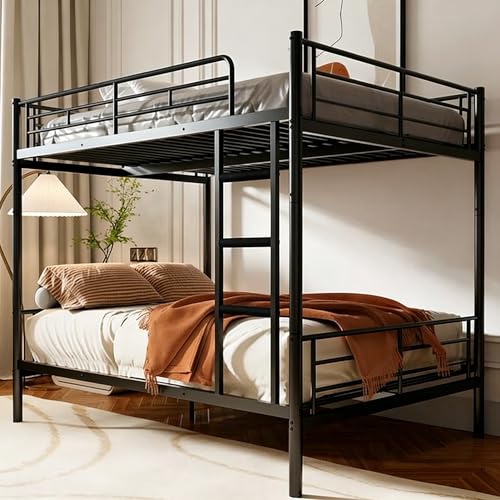
What Makes a Full Over Full Detachable Bunk Bed Different?
A full over full detachable bunk bed consists of two full-size beds stacked vertically, connected by a frame system that can be unbolted, unclamped, or unlocked to create two standalone beds. This design solves one of the biggest drawbacks of traditional bunk beds: permanence. Instead of committing to a fixed bunk layout, you gain a sleeping arrangement that adapts to your changing needs.
For households with growing children, this flexibility is especially useful. A bunk bed works well when siblings share a room, but once they need their own space, the detachable design lets you split the beds into separate rooms without another purchase. Similarly, guest rooms can use the bunk configuration during busy periods and convert to a single-bed layout during quieter months.
If you are exploring broader bunk bed configurations, our guide to full over full bunk beds covers the full range of options and design considerations.
Key Design Components
A detachable full over full bunk bed relies on a few core structural elements that determine both safety and ease of separation:
- Reinforced corner posts and side rails: These provide the load-bearing strength needed to support two full-size mattresses stacked vertically. High-grade steel and solid hardwood are common choices in durable models.
- Detachable connecting hardware: Bolts, brackets, or locking plates join the upper and lower frames. Premium models use tool-free or quick-release mechanisms, while standard models typically require a hex key or screwdriver.
- Full-length guardrails: Safety rails on the upper bunk prevent accidental falls. On detachable models, guardrails are usually integrated into the upper frame, so they remain in place when the bed is separated and used as a standalone full bed.
- Sturdy ladder or integrated stairs: Access to the top bunk should feel secure. Many detachable models offer a ladder that attaches to the upper rail, while others include built-in stairs with storage.
For households that prioritize easy separation and long-term durability, models with full over full bunk beds that separate offer additional insight into hardware and frame styles.
Detachable vs. Standard Bunk Beds: A Practical Comparison
Before committing to a detachable model, it helps to see how it compares with a fixed bunk bed. The table below breaks down the main differences using neutral, market-based descriptors rather than specific figures.
| Feature | Detachable Bunk Bed | Standard Fixed Bunk Bed |
|---|---|---|
| Flexibility | Converts into two full-size beds | Remains in bunk configuration |
| Assembly Complexity | Moderate to high (more hardware) | Low to moderate |
| Long-Term Adaptability | High — adapts to changing space needs | Low — layout is fixed |
| Structural Rigidity | Solid when properly assembled; requires careful tightening | Very rigid once assembled |
| Best For | Growing families, guest rooms, multi-use spaces | Permanent shared bedrooms |
| Typical Tier | Mid-range to premium | Entry-level to mid-range |
If you are planning a shared bedroom for teenagers or young adults, the flexibility of a detachable model pairs well with the durability found in full over full bunk beds for adults. Many of these models include reinforced frames and higher weight capacities.
Materials and Build Quality: What to Look For
The material of a detachable bunk bed affects both its stability and how easily it can be separated and reassembled over time. Here is a breakdown of the most common options:
Metal Frames
Metal bunk beds, especially those built from high-grade steel, are known for their strength-to-weight ratio. They typically use bolt-together construction, which makes separation straightforward. Look for powder-coated or rust-proof finishes to extend the lifespan of the frame. Metal models are often a solid choice for households that expect frequent conversion between bunk and separate-bed setups. Our guide to full over full metal bunk beds explores frame thickness, joint design, and stability features in more detail.
Wooden Frames
Wooden detachable bunk beds offer warmth and a more traditional look. Solid hardwood — such as pine, oak, or rubberwood — tends to hold screws and bolts more securely over repeated assembly cycles than engineered wood. If you plan to separate and reassemble the bed several times, check that the frame uses metal-to-metal connections rather than wood screws alone. For a closer look at wood construction, see our guide to full over full wood bunk beds.
Upholstered or Mixed-Material Frames
Some detachable models combine a metal or wood frame with upholstered side panels for a softer look. These are typically positioned in the mid-range to premium tier and require more careful handling during separation to avoid damaging the fabric panels.
Size and Space Planning
A full-size mattress measures 54 inches wide by 75 inches long. A full over full bunk bed therefore occupies roughly the same footprint as a single full bed but provides two sleeping surfaces. Before choosing a model, measure your room carefully and account for:
- Ceiling height: The top bunk needs enough clearance for a person to sit up comfortably. Standard ceilings of 8 feet usually work, but low ceilings may require a low-profile bunk design.
- Door and hallway clearance: Since the bed arrives disassembled or in large sections, confirm that the boxes or panels can fit through doorways and stairwells.
- Separation space: If you plan to separate the bunks into two full beds, ensure the room — or a second room — has enough floor area for two standalone beds.
For rooms where floor space is especially tight, consider a full over full floor bunk bed, which places the lower mattress closer to the ground and reduces the overall height of the unit.
Safety Features to Prioritize
Safety is the most important consideration for any bunk bed, and detachable models introduce additional factors because the frame is designed to come apart. Keep these points in mind:
- Guardrails on all open sides: The upper bunk should have guardrails on both the long sides and the ends, with a gap no larger than a few inches between the rail and the mattress.
- Secure ladder attachment: The ladder should hook or bolt firmly to the upper rail and remain stable when climbed.
- Weight capacity disclosure: Reputable manufacturers state the recommended weight limit for each bunk. Choose a model rated for the intended users, especially if adults will use the bed.
- Hardware quality: Detachable beds rely on bolts, brackets, and locking plates. Check that the hardware is described as heavy-duty or reinforced, and follow the assembly instructions exactly.
- Mattress thickness limits: The upper bunk should not be fitted with a mattress that exceeds the height specified by the manufacturer, as this can reduce the effectiveness of the guardrails.
Models designed with higher weight limits and reinforced joints are covered in our overview of full over full bunk beds with high weight capacity.
Storage and Accessory Options
Many full over full detachable bunk beds can be paired with storage features that make the most of the space beneath the lower bunk. Common options include:
- Under-bed drawers: Sliding drawers provide concealed storage for clothing, linens, or toys. See full over full bunk beds with drawers for examples of drawer configurations.
- Trundle beds: A trundle adds a third sleeping surface that rolls out from beneath the lower bunk, useful for sleepovers. Compare options in our guide to full over full bunk beds with full trundle.
- Stairs with built-in storage: Staircase-style access can include compartments in each step, combining safety and storage. See full over full bunk beds with stairs and storage.
How to Choose the Right Detachable Bunk Bed for Your Home
Use this step-by-step approach to narrow down your options:
- Step 1 — Define the primary use: Decide whether the bed will stay in bunk form most of the time or be separated regularly. Frequent conversion favors models with quick-release hardware and metal-to-metal joints.
- Step 2 — Confirm room dimensions: Measure ceiling height, floor space, and doorway widths. If you plan to separate the beds, map out where each one will go.
- Step 3 — Choose the frame material: Metal for maximum durability and straightforward separation, or wood for a warmer aesthetic. Check that the wood model uses reinforced connections.
- Step 4 — Prioritize safety features: Full-length guardrails, a secure ladder, and a clearly stated weight capacity are non-negotiable.
- Step 5 — Consider storage: If space is tight, look for drawers, a trundle, or storage stairs.
- Step 6 — Review the assembly process: Read the manufacturer's assembly guide to confirm that separation and reassembly are manageable with standard tools.
For a broader look at convertible options, our article on full over full convertible bunk beds explains how different conversion mechanisms work.
Care and Maintenance Tips
To keep a detachable bunk bed safe and stable over time:
- Re-tighten bolts and connecting hardware every few months, especially after separation or reassembly.
- Inspect guardrails and ladder attachments for looseness or wear.
- Use a mattress that fits the frame snugly and stays within the manufacturer's thickness guideline.
- Keep the frame clean and dry; for metal models, touch up any scratches in the powder coating to prevent corrosion.
- Store the hardware in a labeled bag when the bed is separated, so reassembly is straightforward.