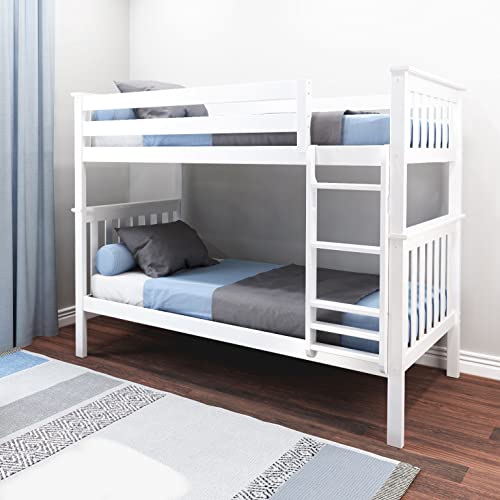
Bunk Beds That Separate Into Twin Beds
Discover how separable bunk beds work, what to inspect before you buy, and which configurations make the most sense for guest rooms, shared bedrooms, and flexible small spaces.
EXPLORE RECOMMENDED OPTIONSWhy this guide matters: A bunk bed that separates into twin beds gives you two sleeping arrangements in one footprint. During the bunk years it saves floor space; later, or when guests arrive, it can become two standalone twin beds without a second purchase.
This guide explains the mechanics, the structural checks that matter, and the practical trade-offs so you can decide with confidence.
What Are Bunk Beds That Separate Into Twin Beds?
A separable bunk bed is a stacked twin-over-twin configuration built from two independent bed frames that lock or stack together. Instead of one welded, single-purpose structure, the top bunk and the bottom bunk are separate units designed to be used vertically as a bunk, then unstacked and placed side by side as two individual twin beds.
This category sits between a standard fixed bunk bed and a convertible design. If you are comparing formats, the broader bunk bed buying guide covers safety, sizing, and layout fundamentals, while this page focuses specifically on the separation feature.
Terminology you will encounter across listings and buying pages includes:
- Bunk beds that can be separated — the general category of stackable twin frames.
- Bunk beds that separate into single beds — another common phrasing for the same idea.
- Bunk beds that convert to two singles — used when the frames are designed to stand alone.
- Bunk beds that can be two single beds — a plain-language description of the end state.
- Bunk beds convert to single beds — a shorter variant seen in buying content.
- Bunk bed that turns into two beds — a descriptive phrase for the same function.
- Bunk beds that turn into 2 singles — a near-identical expression.
- Bunk bed that turns into two beds — the stacking-and-splitting format.
- Bunk beds that can be separated — interchangeable with the main category name.
- Bunk beds that convert to two singles — the same stackable format.
Most separable bunk beds on the market are twin-over-twin. If you need larger sleeping surfaces, you may be better served by a double-on-bottom-twin-on-top layout, but the separation feature is far more common on twin-over-twin frames.
How the Separation Mechanism Works
Separable bunk beds rely on one of a few structural approaches. Understanding the differences helps you choose a frame that stays solid in both modes.
- Stackable posts with alignment pins. The upper frame sits on brackets or alignment hardware on the lower frame. Pins or interlocking metal plates keep the top bunk from shifting. When you separate the beds, the upper frame becomes a low-profile twin bed on its own legs.
- Nested frames. The top unit nests over the bottom unit's corner posts. This design is common in metal bunk beds and often uses bolted connection plates at the corners.
- Ladder-integrated locking systems. On some models, the ladder and a locking bar work together to secure the stack. Removing the ladder is part of the separation process.
- Hardware kits with safety stops. Mid-range and premium separable bunk beds typically include safety stop mechanisms and reinforced corner plates to prevent accidental unstacking.
Regardless of the mechanism, every separable bunk bed should have a clear instruction set for both the stacked and separated modes. A frame that is stable as a bunk but wobbly as a standalone twin bed is a sign of poor engineering.
What to Check Before Buying
Because the frame has to perform two roles, the inspection list is longer than for a fixed bunk bed. Focus on these points:
- Weight capacity in both modes. Confirm the rated capacity for the stacked configuration and for each frame used separately. Adult-sized capacities matter in guest rooms.
- Reinforced corner hardware. Look for bolted steel plates, not just pins. Heavy-duty hardware is the difference between a stable frame and a creaky one.
- Guard rail height and coverage. The top bunk needs guard rails on both long sides and, depending on the design, the foot end. Check that the guard rails remain attached when the frame is separated.
- Ladder attachment. A ladder that hooks into the frame without damaging the finish is easier to remove and reinstall when you switch modes.
- Footprint when separated. Two twin beds side by side need more floor area than one bunk. Measure your room in both configurations before committing.
- Mattress thickness compatibility. If you plan to use thicker mattresses, review bunk beds for thick mattresses to avoid guard rail and ladder issues.
- Assembly and disassembly. Ask whether the separation process requires tools, and whether the hardware is designed for repeated assembly.
For a broader checklist, the bunk bed buying guide walks through room clearance, ceiling height, and mattress sizing in detail.
Which Rooms Benefit Most
Separable bunk beds shine in rooms that change over time. The most common use cases:
- Guest rooms. Use the bunk when two guests share the room, then split into two twin beds for longer stays or different layouts.
- Kids' and teens' rooms. Start as a bunk while children are young, then separate as they grow and want their own space. See bunk beds for kids for safety guidance specific to younger sleepers.
- Small apartments. A bunk saves floor space in the shared configuration, and the separated twins allow for flexible reconfiguration. If floor space is tight, review bunk beds for small rooms.
- Vacation rentals and cabins. The ability to convert between one stacked unit and two singles reduces the need for multiple bed types. See bunk beds for camping and cabin-oriented layouts for context.
- Low-ceiling rooms. A separable frame lets you drop to two low twin beds when overhead clearance is limited. The low-ceiling guide covers the height math.
If the room has sloped walls, the sloped ceiling guide explains placement options that keep the top bunk usable.
Materials and Build Quality
Separable bunk beds are available across multiple tiers of construction. Use the tier descriptors below as a relative guide rather than an absolute ranking:
| Tier | Typical Construction | Best For |
|---|---|---|
| Entry-level | Lightweight metal or thin engineered wood, pinned connections | Light use, occasional guest sleeping, short-term setups |
| Mid-range | Reinforced steel or solid wood posts, bolted corner plates | Everyday family use, frequent stacking and separation |
| Premium | Heavy-duty steel or hardwood, integrated locking hardware | Adult use, long-term configurations, high-traffic rooms |
| Top-tier / commercial-grade | Commercial-rated frames, reinforced guard rails, documented weight ratings | Rentals, shared housing, institutional settings |
Solid wood frames in the mid-range and premium tiers tend to hold their alignment better after repeated separation. Metal frames are lighter and often easier to move, but the hardware quality matters more because the lock points carry the structural load. In both cases, a rust-proof finish and reinforced bolt plates extend service life.
Safety Considerations for Separable Bunk Beds
Safety for separable bunk beds is about both the stacked and separated states. Key points:
- Lock the stack every time. If the bed is used as a bunk, confirm every locking mechanism is engaged. A partially seated upper frame is the most common failure point.
- Check guard rail attachment after separation. Some designs keep the rails on the top frame; others detach. Follow the manufacturer's instructions for the separated configuration.
- Anchor standalone frames. When the beds are separated, each twin frame should be anchored or positioned against a wall per the instructions to prevent tipping.
- Respect the weight rating. Do not exceed the rated capacity in either mode. Adult use requires an adult-rated frame; see twin-over-twin bunk beds for adults.
- Inspect hardware periodically. Bolts loosen over time, especially on frames that are assembled and disassembled. Re-tighten at every mode change.
- Keep the ladder clear. The ladder should hook securely and be free of obstructions. Remove it when the frame is in separated mode unless the design specifies otherwise.
Common Twin-Over-Twin Configurations
Most separable bunk beds follow a twin-over-twin format, but the details vary enough to affect your choice:
- Standard twin-over-twin — the base configuration for separable frames.
- Black metal bunk beds — a popular finish that hides wear and suits many bedroom styles.
- Twin XL over twin XL — longer sleeping surfaces for taller sleepers; check whether the frame separates.
- Bunk beds with a trundle underneath — adds a third sleeping spot, but the trundle space may affect separation clearance.
- Bunk beds and trundle beds — a combined format for guest-heavy rooms.
If the room needs a desk or storage, some frames are built with those additions. Review bunk beds with a desk underneath and bunk beds with built-in shelves to see whether the separation feature is preserved.
Styling and Room Setup After Separation
Once the bunk separates, the room layout changes. Two twin beds placed side by side or in an L-shape open up wall space for other furniture. A few ideas that work well with separable frames:
- Pair separated twins with a black modern bedside table or a black wood bedside table for a unified look.
- Add blackout curtains to control light in a shared room.
- Use body pillows on the separated beds for guest comfort.
- Choose bedding in coordinated tones, such as blue bedspreads and comforters, to tie the two beds together.
- If the room is small, a platform bed with storage can replace one of the separated twins as needs change.
For layout context in compact rooms, the small room guide and the small rooms with storage guide cover spacing and clearance.
Pros and Cons of Separable Bunk Beds
Advantages
- Two configurations from one purchase: bunk mode for space savings, separated mode for flexibility.
- Useful for growing families and rooms that change function over time.
- Often a solid long-term choice for guest rooms and vacation properties.
- Separation can simplify cleaning and mattress rotation.
Trade-offs
- Hardware and locking mechanisms require more maintenance than fixed frames.
- Separated mode needs more floor area than bunk mode.
- Entry-level separable frames may lose alignment with frequent mode changes.
- Guard rail and ladder design must be verified for both configurations.
If you only ever need a bunk, a fixed frame is simpler. If you expect the room to change, the separable format is the more efficient long-term choice.
Quick Buying Checklist
- Confirm the frame is explicitly described as separable or stackable.
- Check weight ratings for stacked and separated modes.
- Verify guard rail height and coverage on the top bunk.
- Inspect the locking hardware for reinforced plates and safety stops.
- Measure floor area for both the bunk and the separated layout.
- Match mattress thickness to the frame's guard rail and ladder design.
- Review assembly instructions for the separation process.
- Plan for periodic hardware tightening.
Frequently Asked Questions
Do all bunk beds separate into twin beds?
No. Only frames explicitly designed as separable or stackable can be used as two standalone twin beds. A fixed bunk bed with welded or permanently joined posts should never be separated.
Can a separable bunk bed be separated and rejoined repeatedly?
Yes, but the frequency matters. Mid-range and premium frames with bolted reinforced hardware handle repeated changes better than entry-level pinned designs. Re-tighten hardware at every change.
How much floor space does a separated bunk bed need?
Two twin beds placed side by side need roughly the combined footprint of two twin frames plus clearance between them. Measure the room in both configurations before buying.
Are separable bunk beds safe for adults?
Only if the frame is rated for adult weight in both stacked and separated modes. Check the manufacturer's stated weight capacity and look for adult-rated models such as twin-over-twin bunk beds for adults.
What mattress thickness works best?
A mattress that sits below the guard rail on the top bunk and fits the ladder clearance is safest. Review bunk beds for thick mattresses if you plan to use deeper mattresses.
Can separated twin beds be placed apart in different rooms?
Yes, if each frame is designed to stand alone and the instructions permit it. Confirm that the top frame has its own support legs and that the guard rails are either removable or designed for standalone use.